The address of the clients’ home in Ross was enough to intrigue Brad Krefman. When he read it, he says, “I knew the project was going to be something special.” The designer’s intuition was correct: Situated on an acre-size property, the house presented magnificent grounds with mature oaks and exceptional views of a distant Bald Hill. “You don’t see that often,” Krefman notes.
Early conversations with the owners further confirmed this would be an exciting endeavor. The empty nesters had raised their children in the 1970s residence, which had last been remodeled around 2000, and were ready for the next phase: a graceful setting that equally accommodates grandchildren and adult gatherings. “They wanted to add a level of refinement and sophistication that didn’t exist when their kids were growing up,” Krefman explains.
The designer met the couple via architect Jared Polsky, who had updated the structure 26 years earlier with fellow architect Rich Perlstein and now returned for round two. For this iteration, he referenced the portfolio of Connecticut firm Shope Reno Wharton, whose traditionally crafted estates the husband admires. With general contractor Norman Charles, Polsky and architect Laura Van Amburgh took most of the abode down to the foundation, then reconstructed it with elements such as a cupola, swooping rooflines, smooth gables and a veranda-like front porch. “We’ve done a lot of shingle-style residences,” Polsky says. “This is probably the crown jewel of them all.” Stone wainscoting lines the façade, punctuated with wood windows, some oval, emphasizing the home’s curves.
Home Details
Architecture:
Jared Polsky and Laura Van Amburgh, Polsky Perlstein Architects
Interior Design:
Brad Krefman, Brad Krefman Interior Design
Norman Charles, Norman Charles Construction
Landscape Architecture:
Brad Eigsti, Imprints Landscape Architecture
Styling:
Habitat Creative Studio
The interiors’ viewpoint stems from “vacations, places and experiences that embody a lifestyle the clients were trying to create,” Krefman says. In particular, he tapped into their sentimentality for The Carlyle hotel in New York, establishing an emulative palette of black, white and gold in the foyer. There, artwork in the style of a Ludwig Bemelmans illustration hints at the next space: a gentlemen’s-club-like dining room the designer intended as a reinterpretation of the hotel’s iconic Bemelmans Bar.
“Think of it like in The Wizard of Oz —the world goes from black and white to Technicolor. The transition is dramatic,” he muses. Outfitted with a dining table, bistro seating and plush stools, the space is wrapped in wood panels that frame gold wallpaper murals with Madeline- like scenes. Krefman helped the owners determine the placement of each cheeky vignette—the fishing frog here; the tea-drinking elephant there—and carried the motif onto hand-painted sconce shades.
Primed for gatherings, the reworked layout flows from the dining room to the living areas and onto the terrace, balancing intimate, moody spaces and light, bright zones. “The front, formal rooms have refinement, then the back ones have a more rustic relaxedness to them,” the designer observes. For instance, the great room—containing the kitchen, breakfast nook and family area—soars to 17 feet with reclaimed-wood arched trusses. Fronting an oversize window, a grand blackened-steel range hood extending from the ceiling anchors the volume with an industrial note.
Unifying the dwelling’s duality, Krefman threaded golden nature tones throughout, like the entry’s metallic-fabric bench, the dining room’s ochre chairs, a yellow-striped banquette in the breakfast nook and marigold kitchen stools. “Despite the sophistication, there needed to be a layer of whimsy and fun,” he says. “We needed bright colors and unexpected moments.” Sunshine hues continue outside, as on the chaises surrounding the restored pool. Responding to the architecture, landscape architect Brad Eigsti softened the front of the house with white hydrangeas, azaleas and catmint as well as layered greens like boxwood globes, while the back unfolds into functional “outdoor rooms”: a cutting garden, citrus grove and turfed play space for grandchildren. “We were trying to keep things classic but comfortable, merging the homeowners’ fun personalities with the house’s formality,” Eigsti describes.
Mirroring the couple’s evolution, the transformation proved a dynamic exercise in lasting design, Krefman says. “We had to look past trends and get back to core principles, analyzing what is classic and timeless—and why,” he reflects. “The clients’ sense of taste has morphed over time, and now they are using the house to its fullest.”
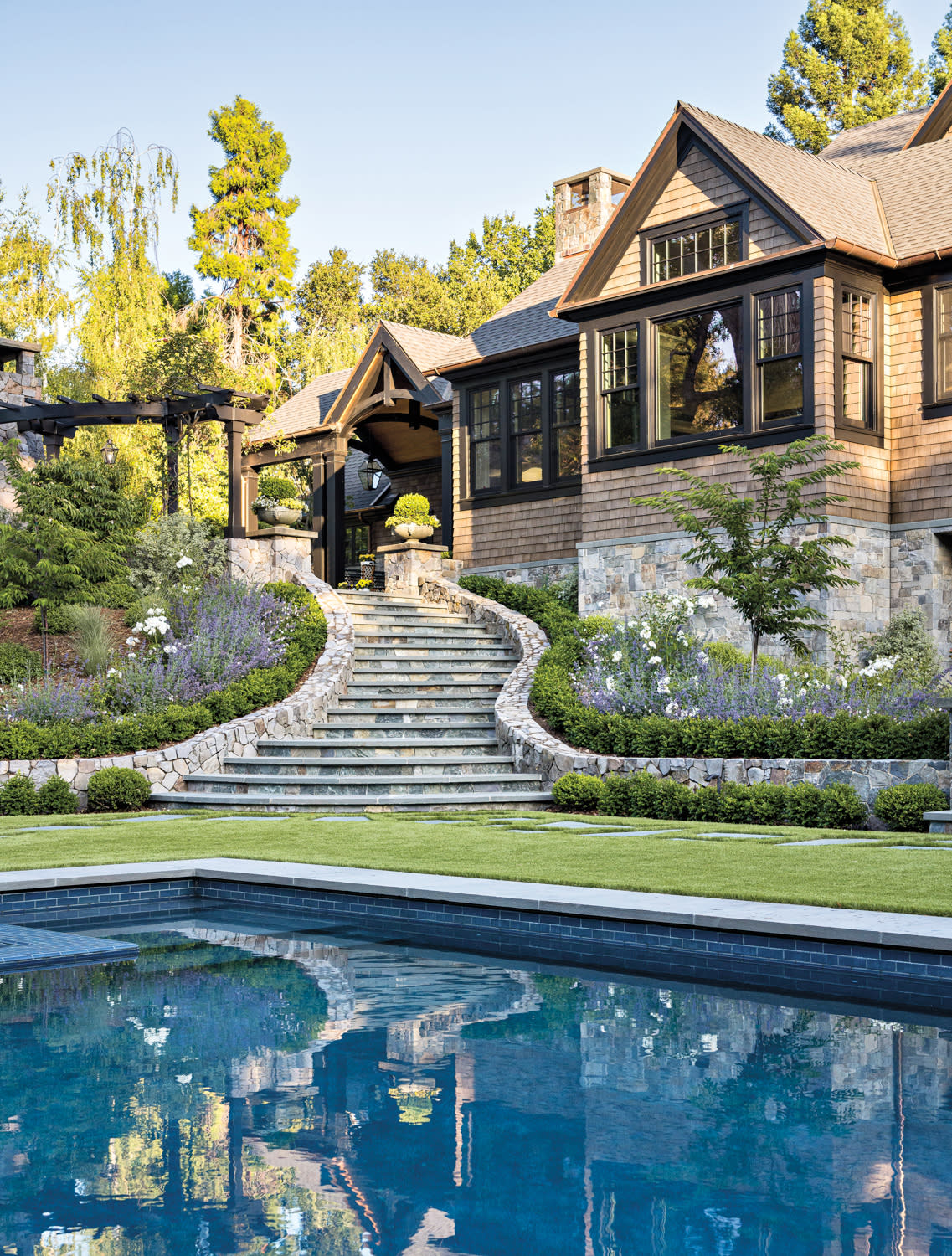
A bluestone staircase leads from the back of the house to the rear yard and pool, which received new coping. Retaining walls hold plantings selected for their low heights. “I didn’t want to hide the house,” Eigsti says.
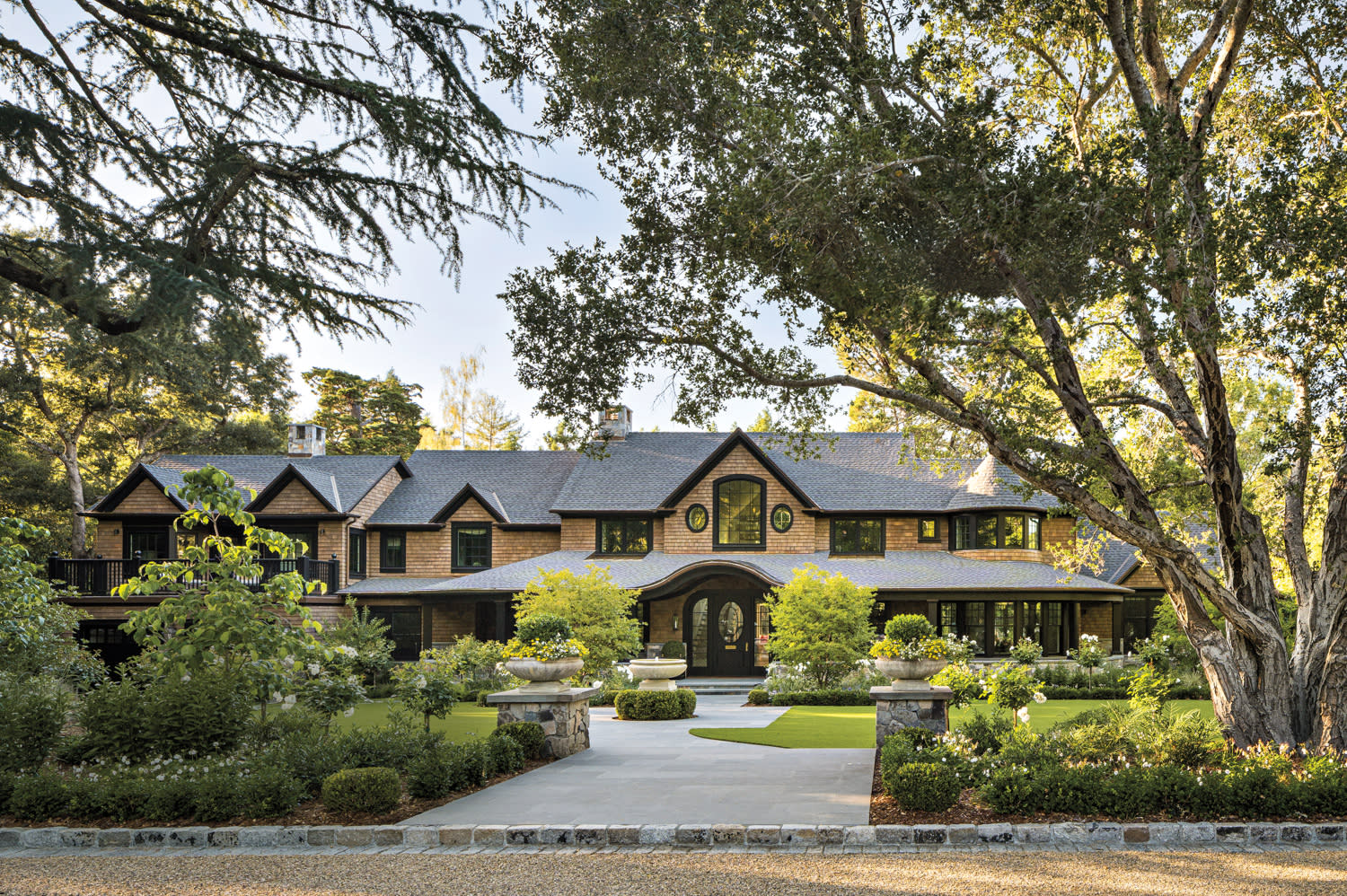
Benjamin Moore’s Black Beauty colors the Loewen windows and doors punctuating the façade. Complementing the structure, landscape architect Brad Eigsti introduced flowering crepe myrtles, hydrangeas and azaleas as well as green plantings including boxwood globes.
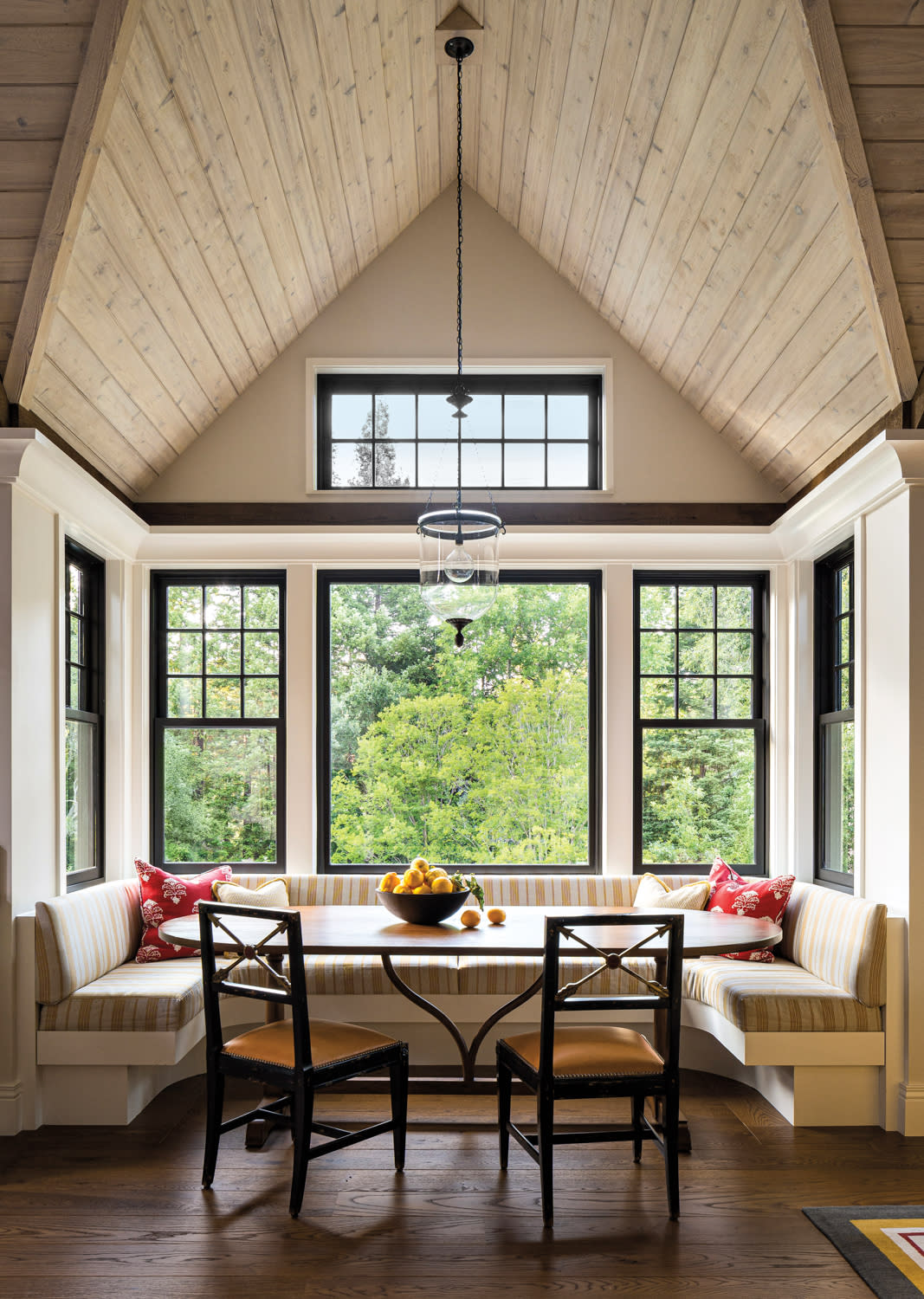
Michael’s Custom Built Upholstery fabricated the breakfast nook banquette, using a C&C Milano textile. A pair of Mulligan’s chairs faces a Dos Gallos table. A Cox London light hangs from the whitewashed and scraped cedar ceiling.
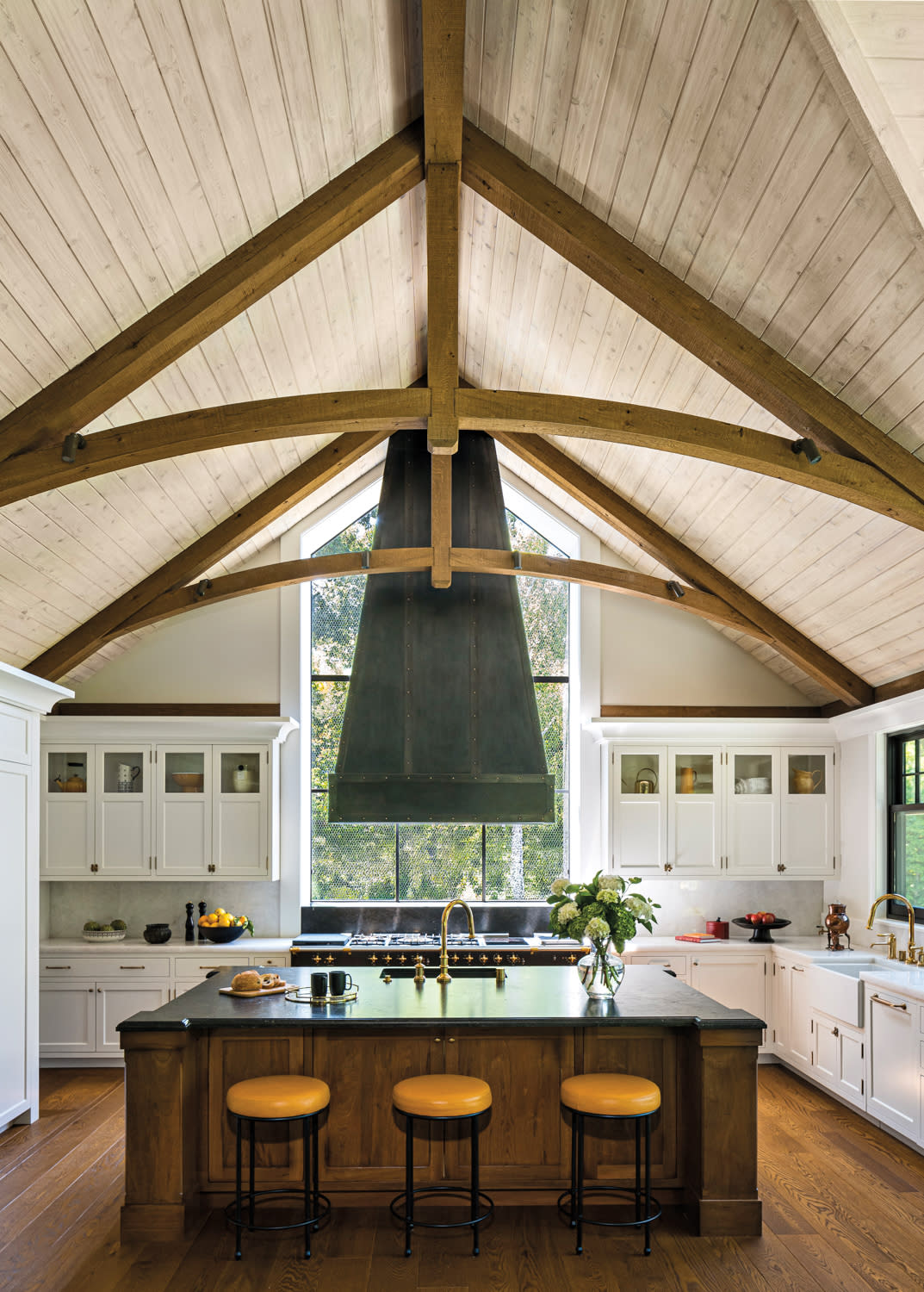
Reclaimed oak timbers and B-K Lighting fixtures arc over the kitchen. Da Vinci Marble supplied the island’s Petit Granit limestone and the Bianco quartzite backsplash. Cabinetry by Leonardo’s Casework & Design exhibits hardware from The Golden Lion. The stools are by Lawson-Fenning. Waterworks faucets and a Lacanche range complete the scene.
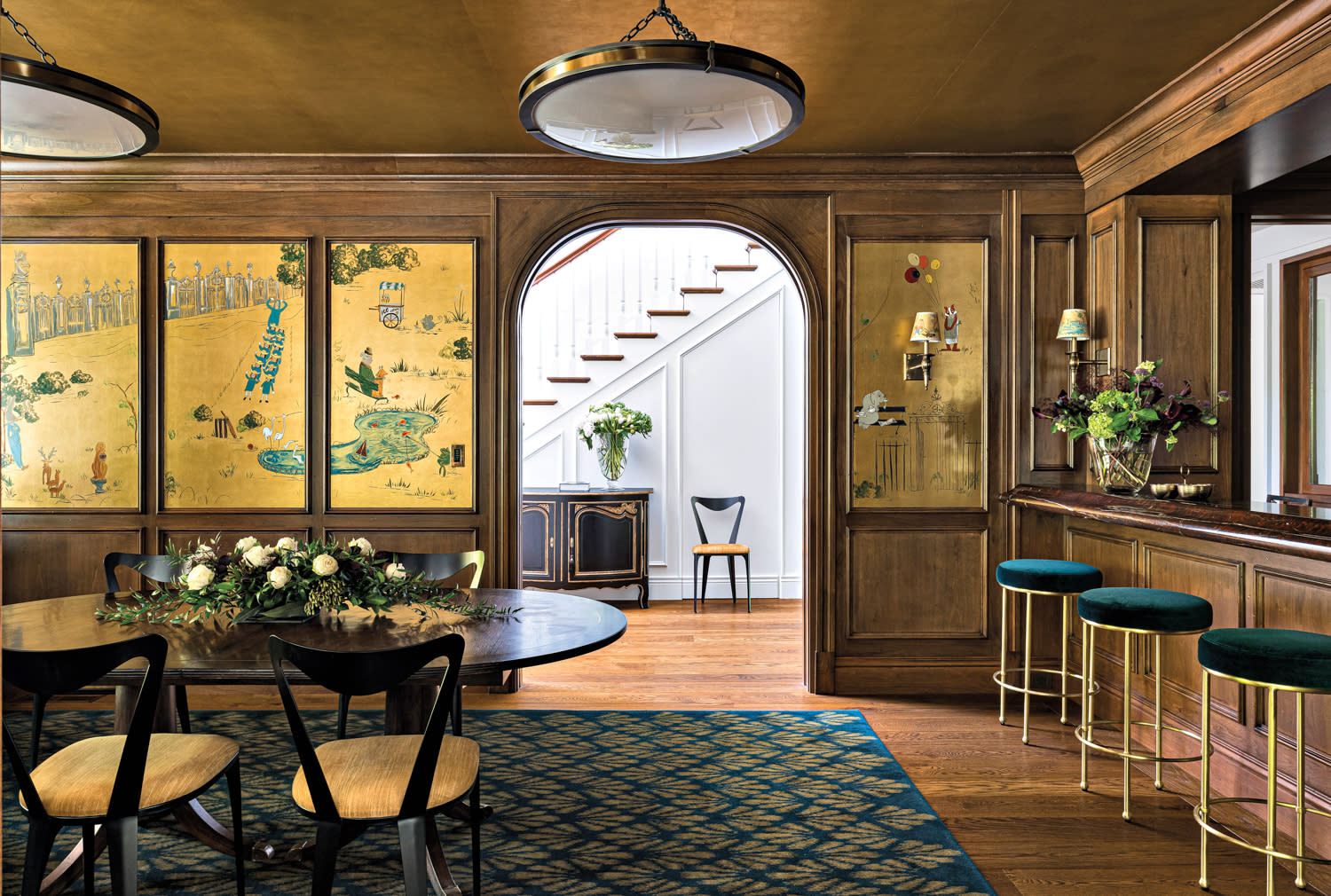
A de Gournay wallcovering and Rocky Mountain Hardware sconces enliven the dining room’s walnut paneling by Leonardo’s Casework & Design. Lawson-Fenning stools line the bar of Rouge de Rois stone from Da Vinci Marble. Tom Faulkner chairs join a New Classics table.
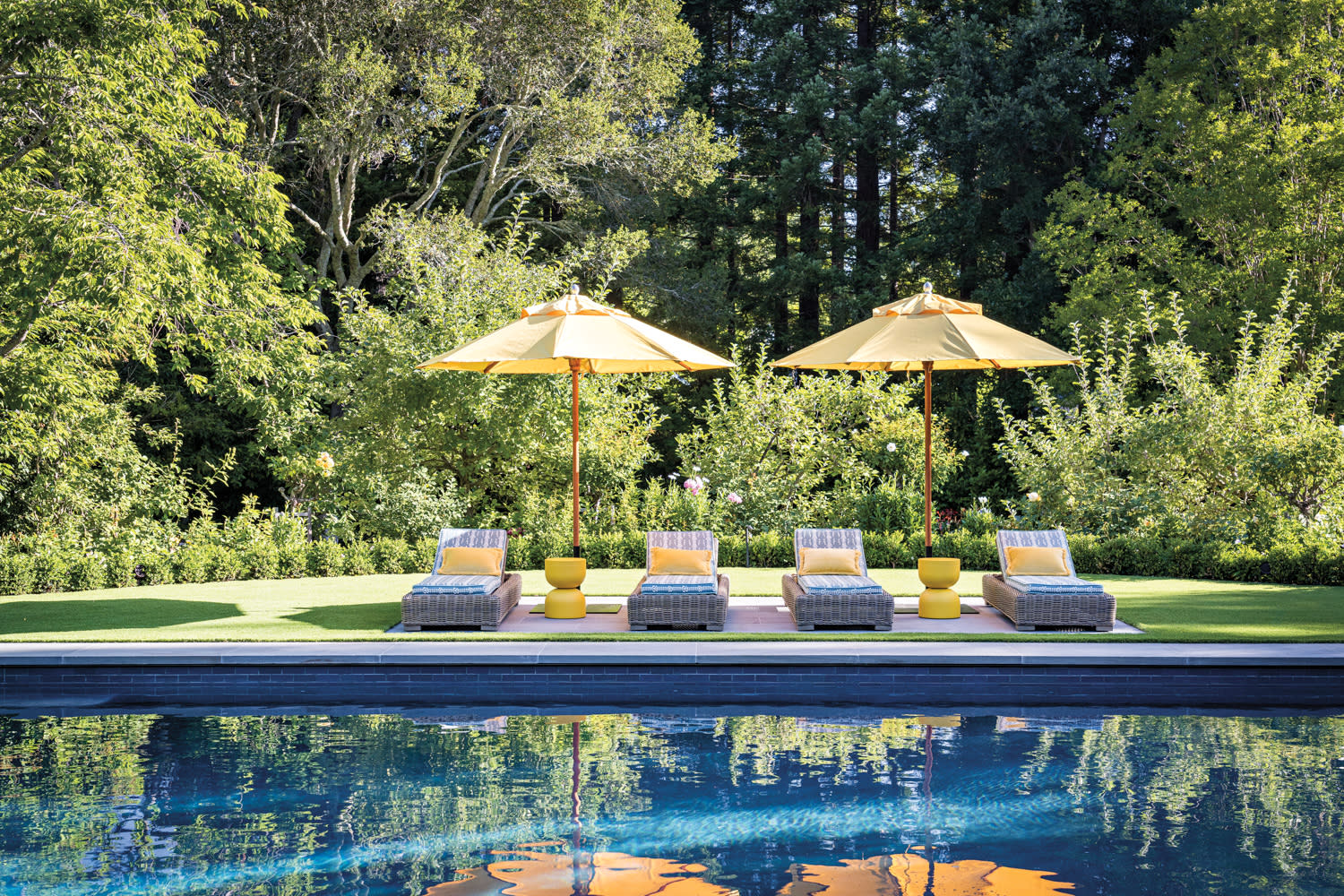
Tuuci umbrellas shade RH chaise lounges alongside the renovated backyard pool. To round out the mature oak trees on the lush site, Eigsti added dogwoods and cherry trees.
A bluestone staircase leads from the back of the house to the rear yard and pool, which received new coping. Retaining walls hold plantings selected for their low heights. “I didn’t want to hide the house,” Eigsti says.