Clean lines, classic proportions and a sense of both quiet grandeur and timeless beauty were key factors that inspired the design of this stately Colonial Revival-style Beverly Hills home, recall Tim Barber and Katie Peterson-Hesketh. “Our clients really wanted the symmetry and the graciousness that this house brings from the façade, and they liked 1930s details, which we implemented in small ways throughout the house,” explains Peterson-Hesketh, the project’s principal architect. And though the residence is a brand-new build, the owners also desired a home that appeared anything but—achieved through plenty of historic architectural detailing. Happily, the firm Barber established more than 30 years ago is particularly adept at this. Renowned for designing with an eye well-versed in traditional forms, craftsmanship and sustainability, layered within the context of a contemporary Californian lifestyle, the architect’s work is steeped in generational appeal and longevity. Such was the idea for this dwelling, with a layout where traditional formal spaces transition into more casual living areas, structured to evolve as the owners’ three young children grow.
The elegant living and dining rooms are positioned opposite one another at the front of the house—both with gently arched bay windows that nod to the architectural style of the early 20th century—while a classically detailed foyer forms the home’s centerpiece. A recessed entry porch steps into this voluminous double-height space, which is layered with a coffered ceiling and paneling that enhance a traditional stairway. “The foyer introduces a refined architectural language that carries throughout the home,” notes Barber, who worked with general contractor Robert Kleiman on the meticulous build. An arched opening beneath the stairway then connects to the rear of the home, where the more casual, open-plan living spaces unfold. Walk through to enter a family room, where glazed pocket doors link a sunlit kitchen with a playroom cleverly placed at the opposite end. An array of windows and doors overlook the outdoor kitchen, porch, backyard and pool.
Home Details
Architecture:
Tim Barber and Katie Peterson-Hesketh, Tim Barber Architects
Interior Design:
Cate Levis, Cate Levis Design and Elana Zeligman, Elana Zeligman Interiors
Home Builder:
Robert Kleiman, Structure Home
Landscape Architecture:
Daniel Busbin, Daniel Busbin Landscape Architecture
Styling:
Kate Flynn
Interior designers Cate Levis and Elana Zeligman collaborated closely on the home’s interiors, a process executed effortlessly in tandem thanks to their history as colleagues at a former firm. They’d each launched their individual practices before taking on this home, working so well as a duo that they’ve since completed another design project together. “This was very much a team effort where we analyzed every decision together, rather than ‘I’ll do this and you do that,’ ” Levis says. The pair concentrated on balancing their clients’ need for both a family-friendly and entertaining-ready house with furniture and lighting selections that felt at home within the structure’s detailed architectural envelope. “We sourced a lot of vintage pieces, especially in the formal living and dining rooms, and much of the lighting leans Art Deco,” shares Zeligman. She and Levis found an avid design partner in the wife (“She has a beautiful eye for vintage furniture and accessories,” remarks Levis). The designers peppered in pieces—see the multi-arm chandelier and domed pendant of the entry as well as the classic Danish-dining room chairs—but nothing is too on the nose. “There are little hints, things that make the spaces interesting without going with the most obvious traditional lighting or furniture,” Levis comments. “We paired new and old, so that this feels like a warm, lived-in home that marries the two.”
The interior palette is a study of neutrals, so the designers played with texture, wood and metal accents, and the owners’ art collection to create subtle moments of visual diversion. (A basement media room serves as a departure, where stronger colors and pattern reign.) But it’s the serene primary bedroom, topped by a vaulted ceiling with stepped coffered detailing, where the home’s 1930s-inspired architectural aesthetic meets layers of tonal softness in perfect harmony. “Our hope is that we’ve incorporated enough historical references that when someone enters, they think, ‘Oh, this house has always been there,’ ” concludes Peterson-Hesketh. “But also, we hope we’ve created a sense that this is a home that is loved.”
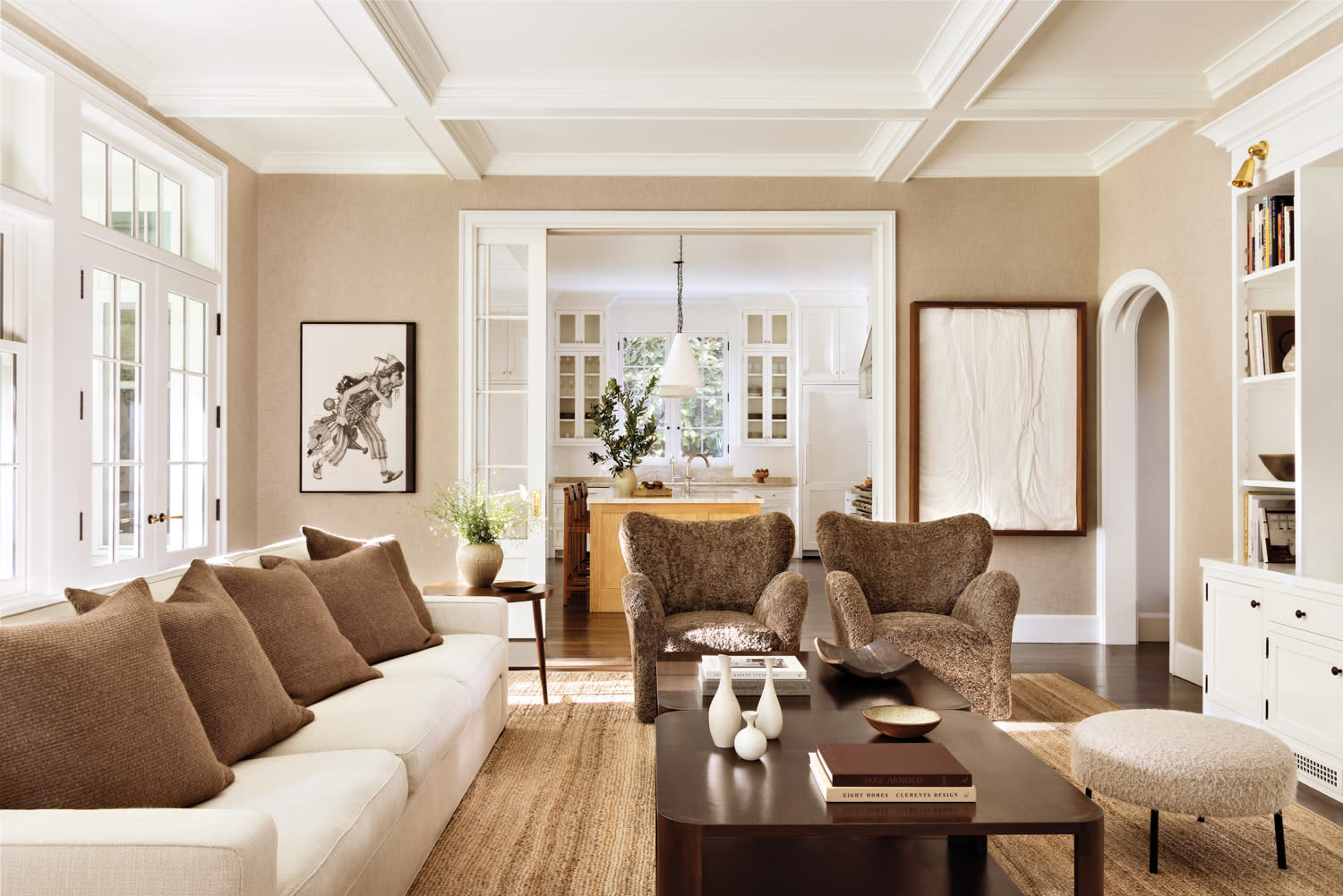
In the family room, custom furnishings—a sofa in a Perennials fabric, an ottoman in a Holly Hunt fabric and two dark walnut-stained coffee tables—gather atop a braided jute Stark rug. Artworks, from left, are by Karl Haendel and Anthony Pearson.
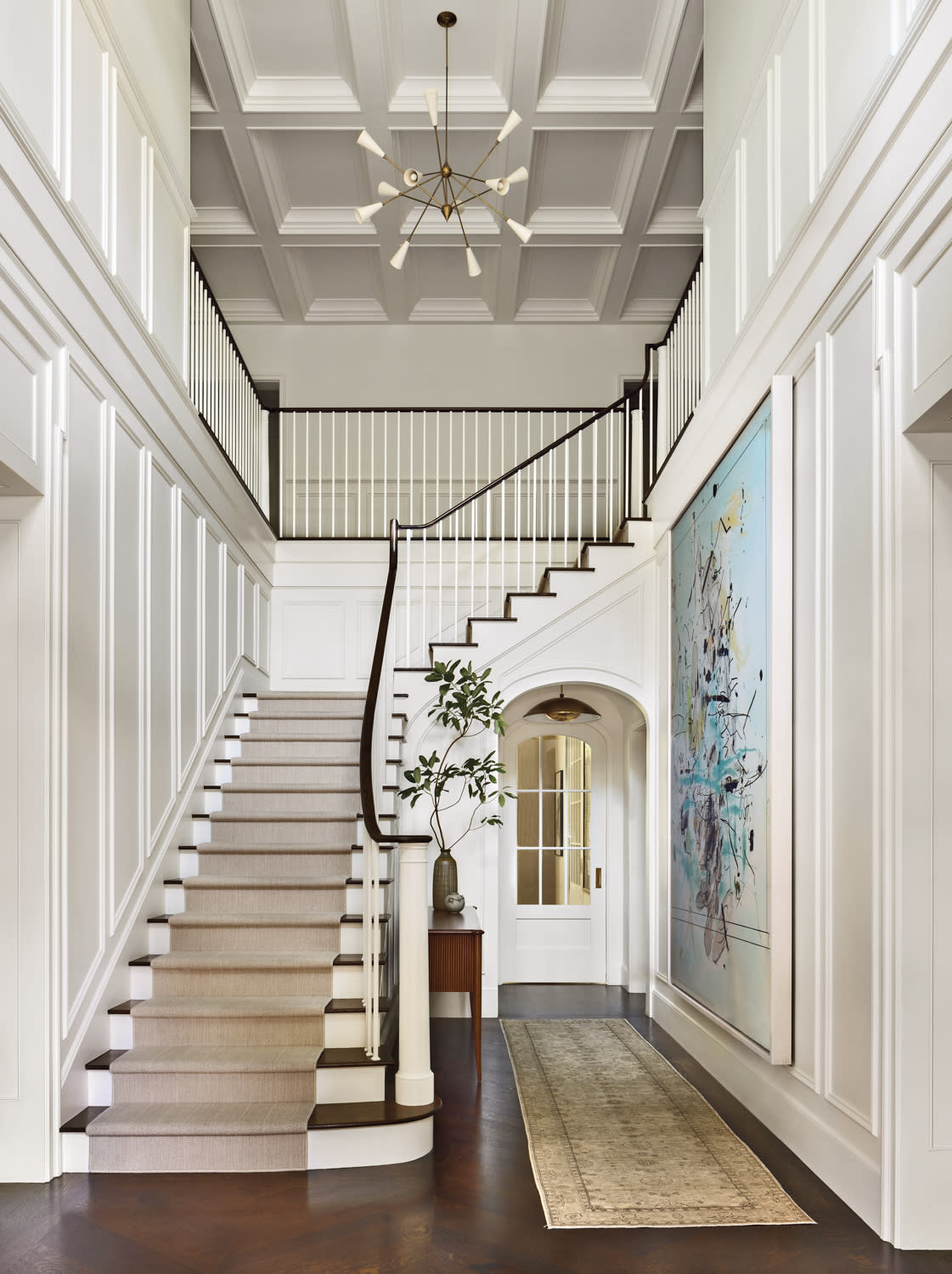
A paneled, double-height foyer with a coffered ceiling strikes a refined note. The chandelier is vintage Stilnovo, echoed by a vintage runner sourced through Jamal’s Rug Collection, and the artwork is by Secundino Hernández.
In the family room, custom furnishings—a sofa in a Perennials fabric, an ottoman in a Holly Hunt fabric and two dark walnut-stained coffee tables—gather atop a braided jute Stark rug. Artworks, from left, are by Karl Haendel and Anthony Pearson.
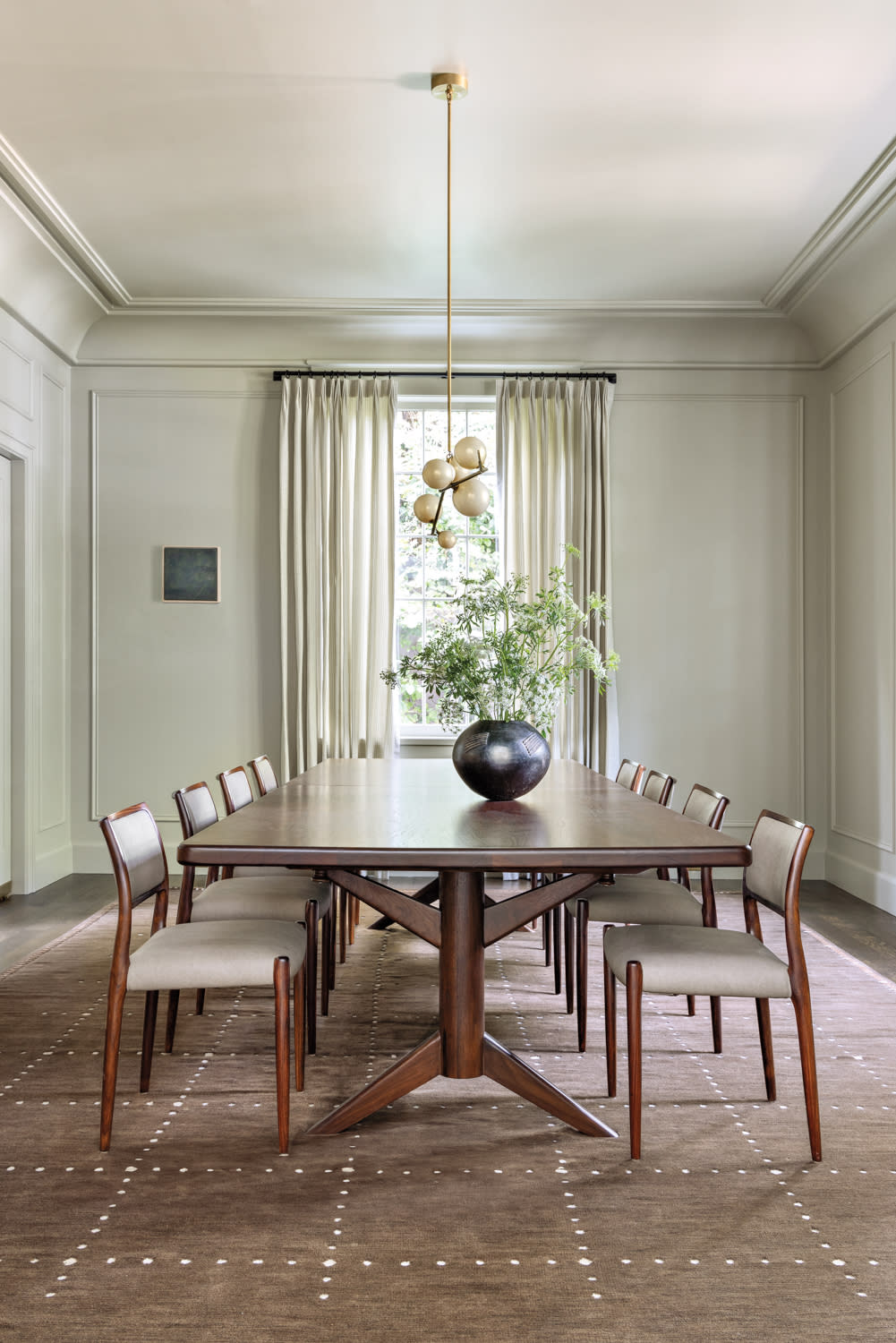
Farrow & Ball’s French Gray envelops the dining room walls and ceiling, where a custom walnut table and vintage Niels Otto Møller chairs rest atop a wool Beauvais Carpets rug. Artwork is by Chelsea Sommerfeld. A Lindsey Adelman chandelier illuminates the space.
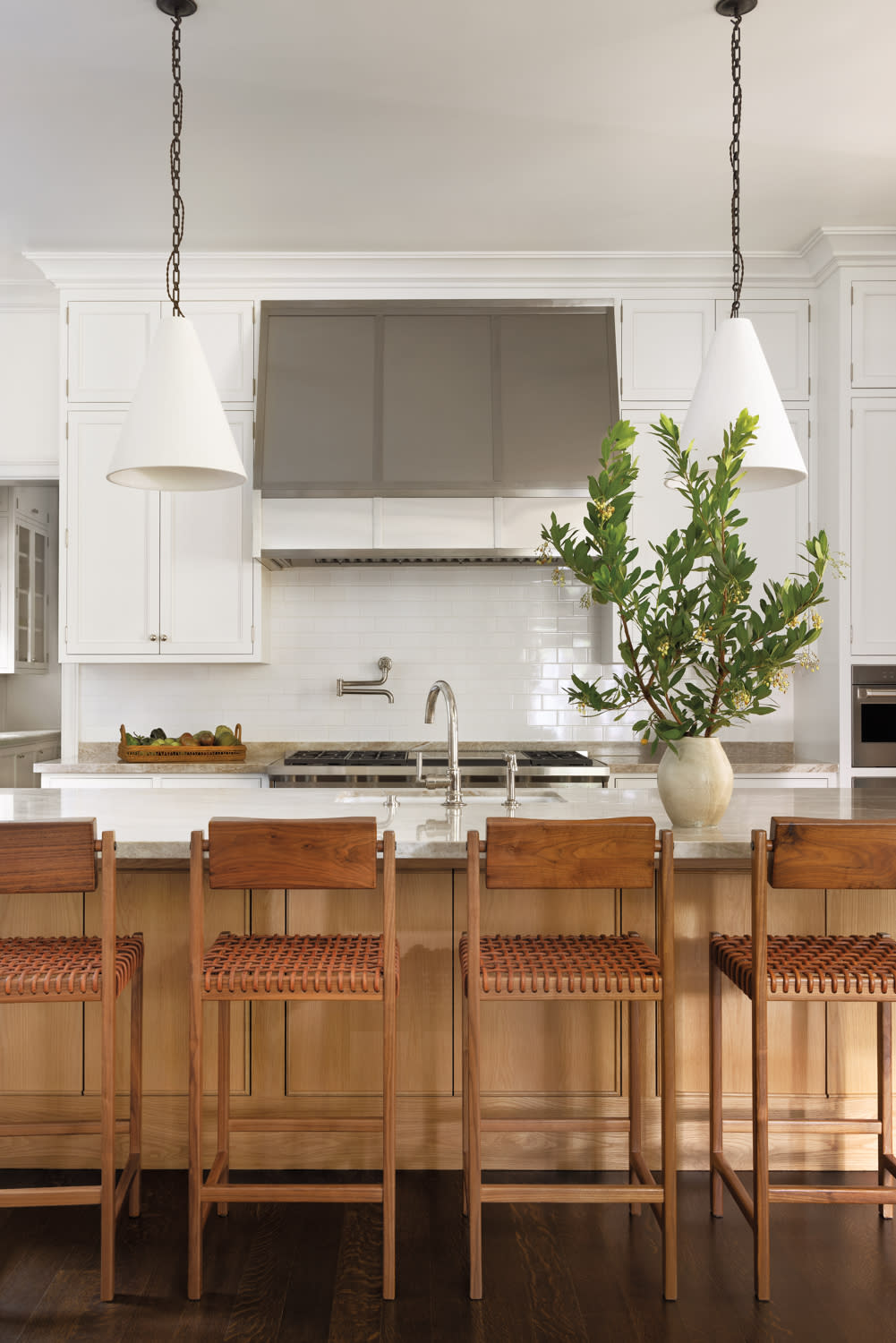
Thomas Hayes Studio stools and Rose Uniacke pendants enliven the kitchen, which features cabinetry by CJS Custom Woodworking & Design with counters of Perla Venata quartzite via Boulevard Tile and Stone. The faucet and pot filler are Waterworks.
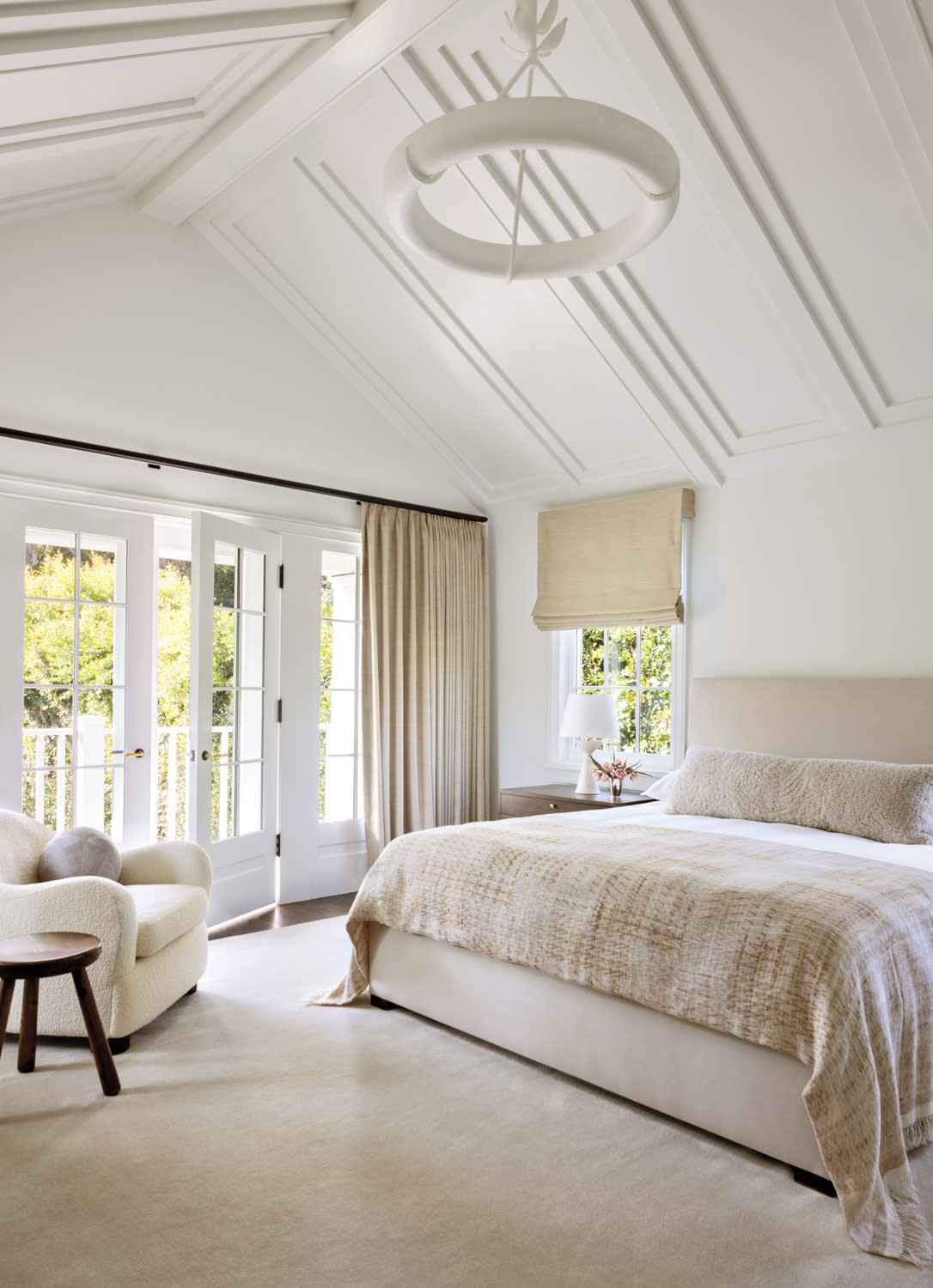
Defined by a vaulted ceiling with a stepped coffered detailing and painted Benjamin Moore’s Snowfall White, the primary bedroom is an airy retreat. The bed wears a coverlet from Pat McGann Gallery. The chandelier is Paul Ferrante, the chair is CB2 and the rug is by Stark.
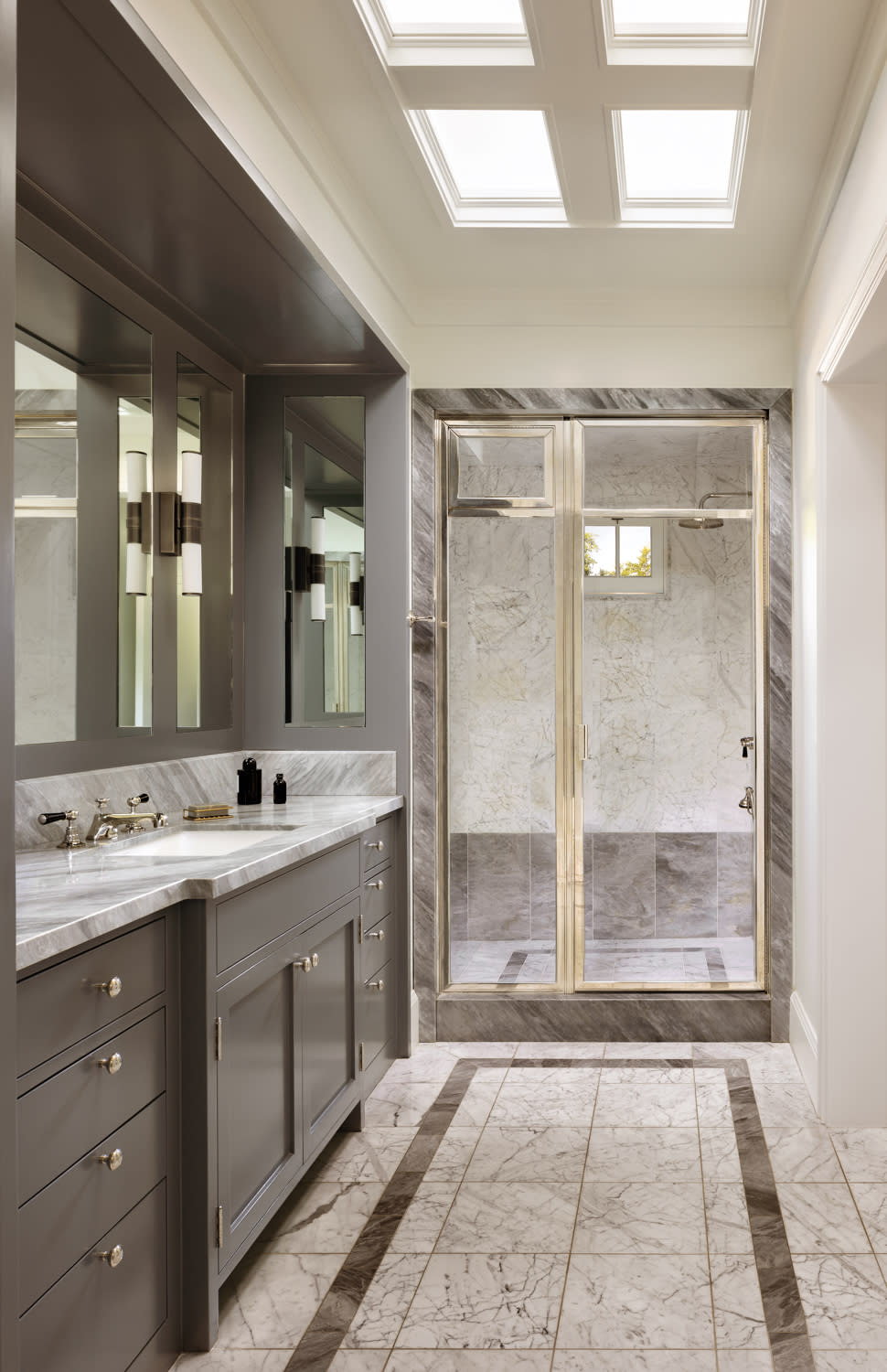
Geometric shapes like a brass-framed Met-Tec shower enclosure, the bordered Emser marble tiling and a gridded skylight all bring a bold aesthetic to the husband’s bathroom. The vanity counter is Grigio Nuvolato marble, with a Lefroy Brooks faucet.
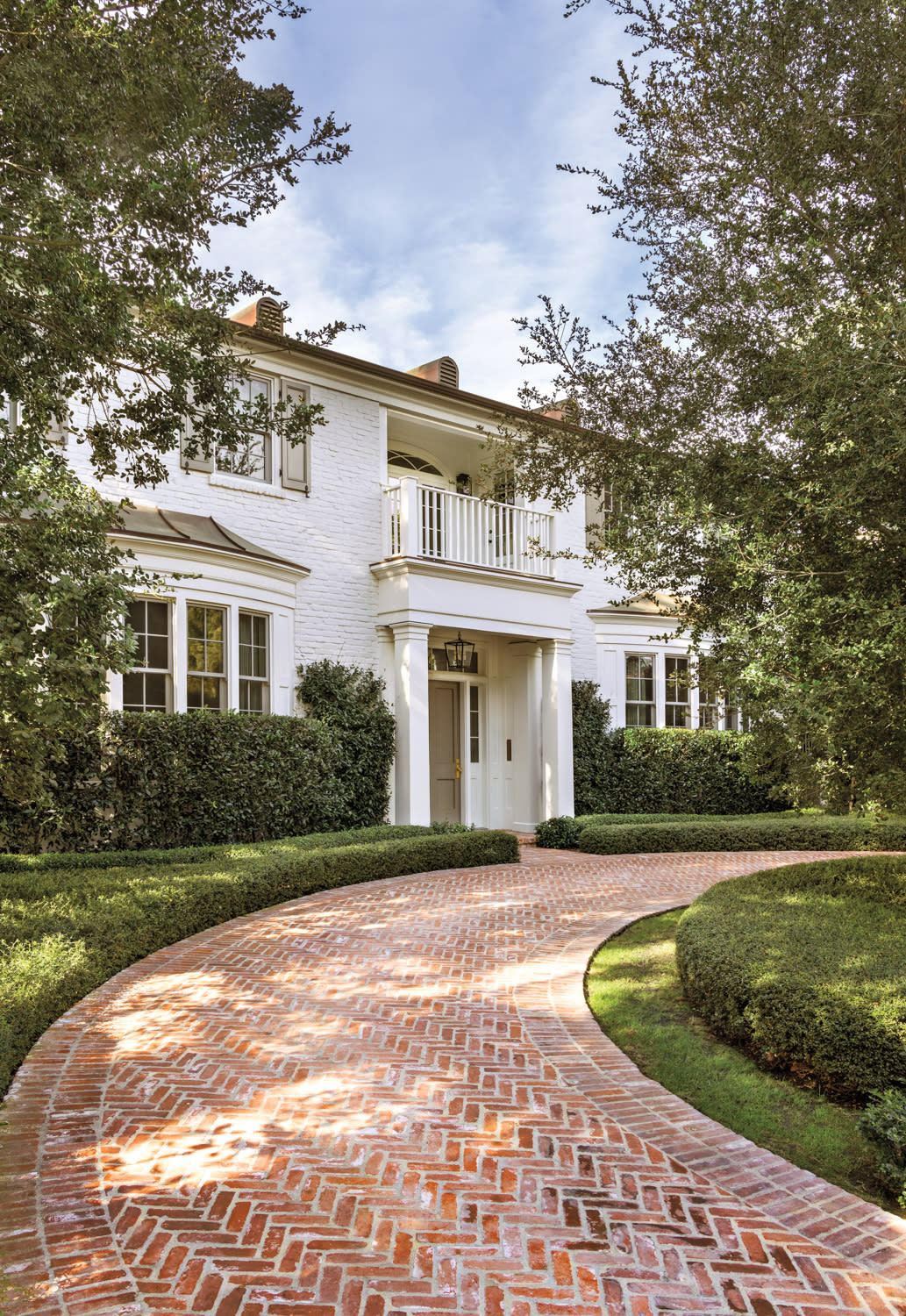
The dwelling’s architecture draws inspiration from 1930s Colonial Revival houses. Locally sourced reclaimed bricks were utilized for the façade and driveway. Orderly hedges by landscape architect Daniel Busbin enhance the home’s formality.