It was a pretty fall day when designer Lori Paranjape first toured the property her clients had purchased on Blackberry Mountain, leaves crunching beneath her feet. The site was steep, and she carefully made her way to a platform positioned to demonstrate the views from the yet-to-be-constructed abode. As Paranjape climbed onto the deck with the owners, Elizabeth and Brad Allen, and architect Keith Summerour, they were met with a breathtaking panorama of mountain and valley.
At that moment, the structure’s concept was born. “We stood there looking at the view,” the designer recalls, “and we asked ourselves: ‘If this is what you’ll see from the front door, could we put the staircase there—and line it entirely with glass?’ You could see Keith process that, and the house began to take shape for him right then.” Elizabeth chimed in, mentioning Brad’s need for a small office and their desire for an attached guesthouse—spaces Summerour sketched on a notepad at a restaurant immediately following the site visit. “By the time we finished lunch, he had all the floors and elevations drawn and the topography correct,” Paranjape remembers. “There were very few adjustments after that.”
Home Details
Architecture:
Keith Summerour, Joseph Lentini and Drew Kinney, Summerour Architects
Interior Design:
Lori Paranjape, Mrs. Paranjape Design + Interiors
Home Builder:
David Rhodes, Schmid & Rhodes
Landscape Architecture:
Andrew Spatz, Hedstrom Landscape Architecture
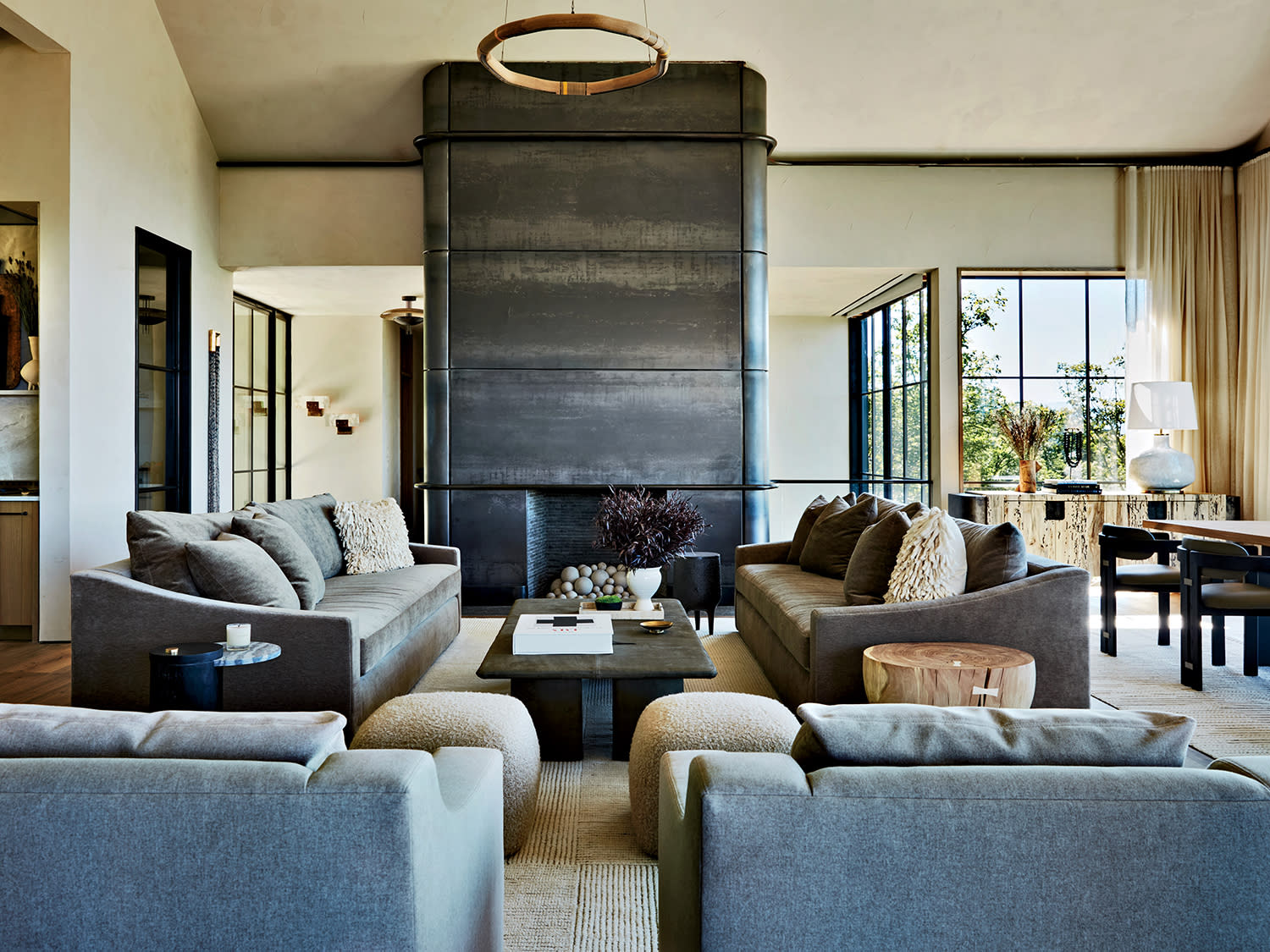
Amid the living area’s hand-applied plaster walls, the sofas, swivel chairs, coffee table and ottomans—all by Verellen—gather on a Moattar rug. Aespyre Metals fabricated the steel fireplace, and Ochre’s Drifter pendant brightens the space.
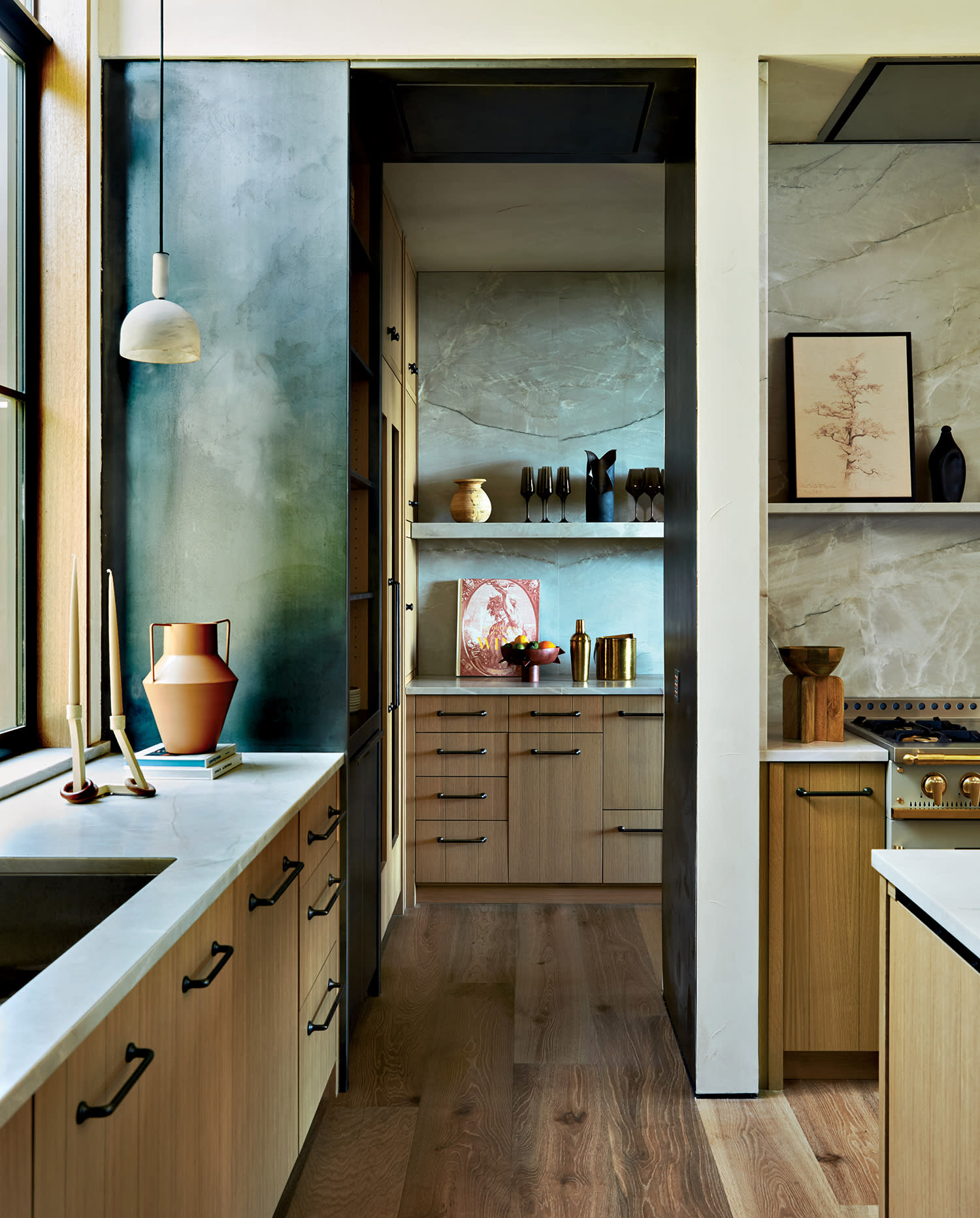
The kitchen’s white oak cabinetry by Law & Hicks Millwork pairs with Mont Blanc quartzite countertops in a honed finish. The Oki light is by Alain Ellouz for Holly Hunt. Duchateau’s Chaparral hardwood flooring flows into the scullery.
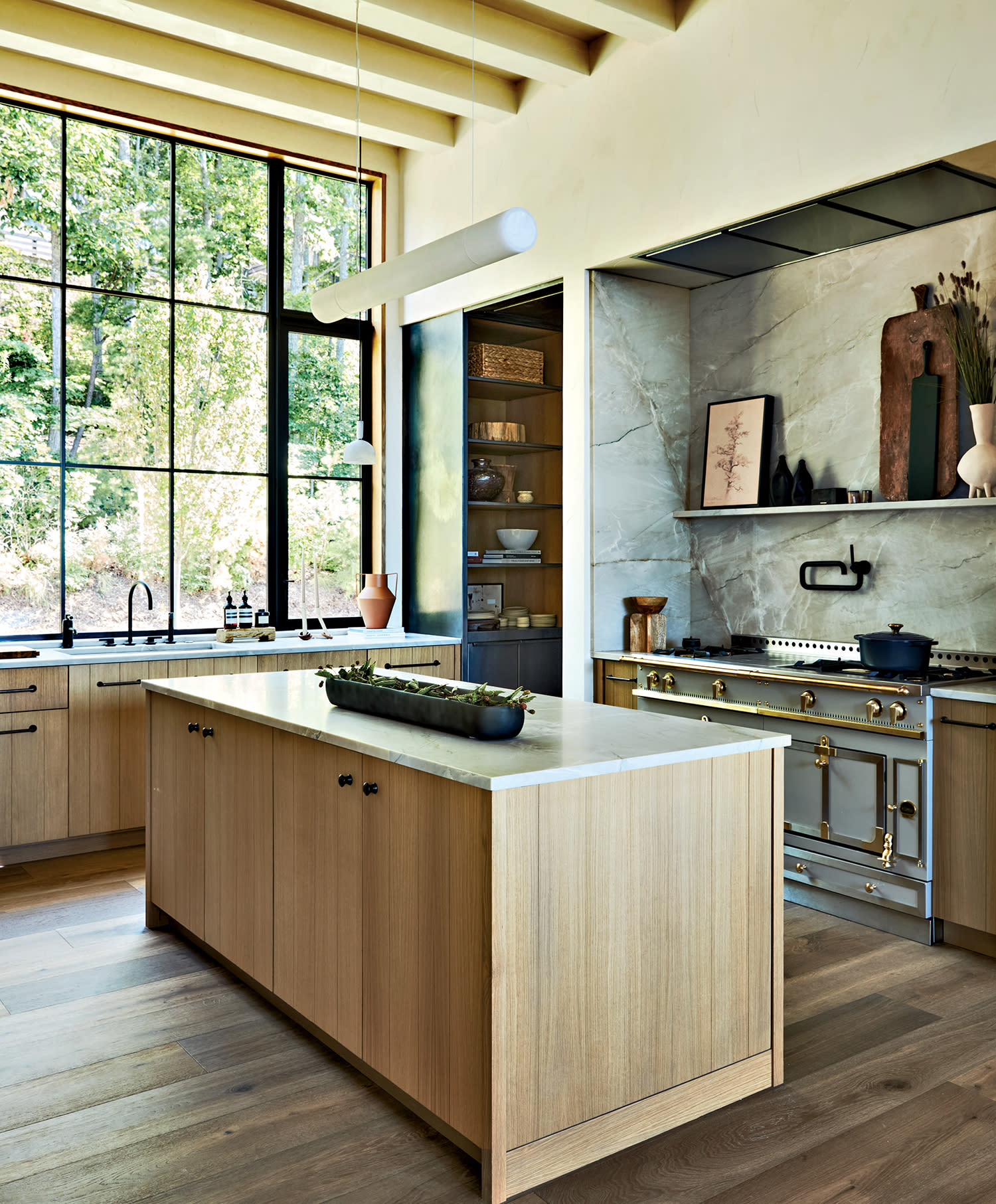
La Cornue’s Château 150 range anchors the kitchen, accompanied by Sub-Zero and Wolf appliances. The Waterworks faucet contrasts the Sumatra H pendant by Alain Ellouz for Holly Hunt.
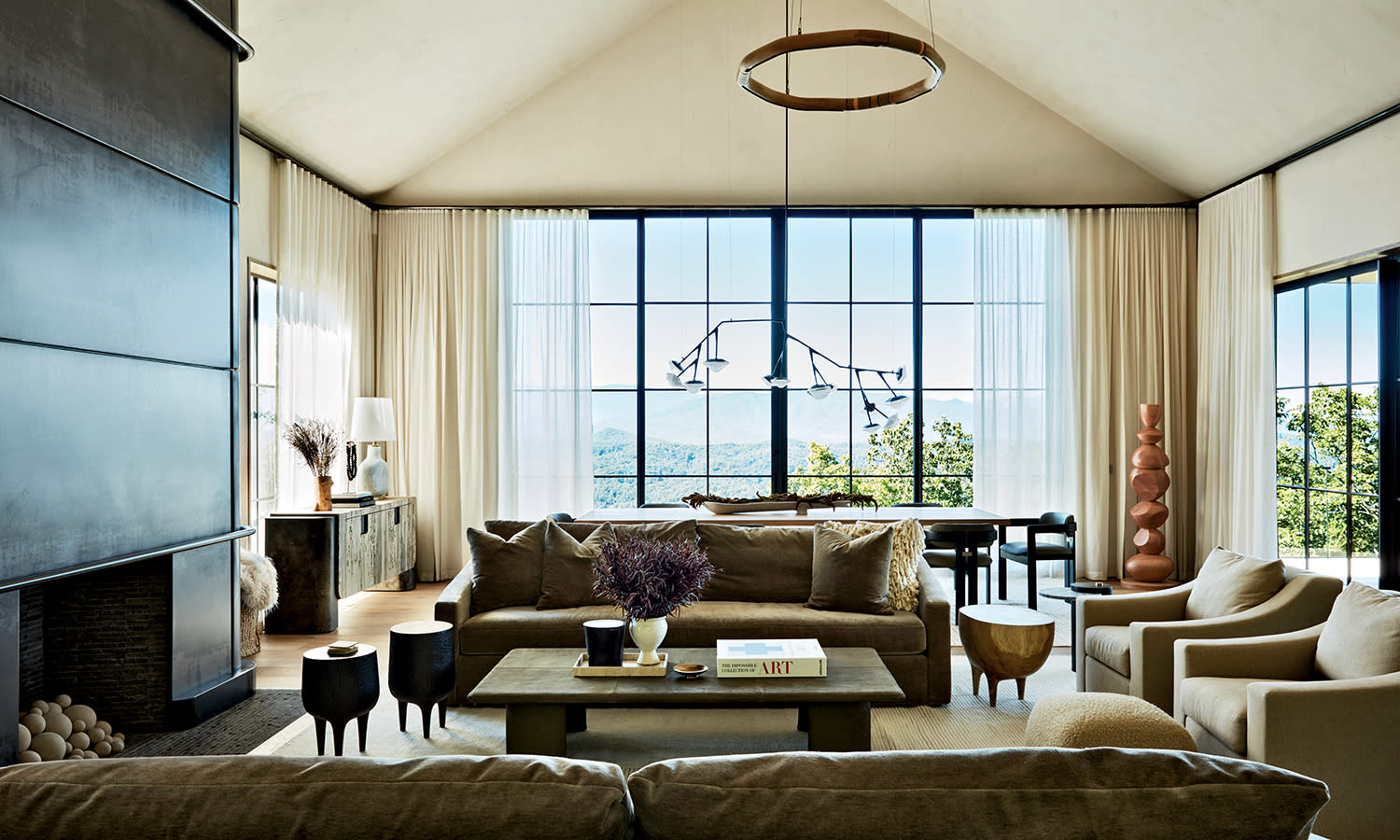
Moore & Moore Design LLC dressed the dining area windows in a Stroheim linen. A Gabriel Scott Myriad chandelier shines above the Olivya Stone table and chairs, with a Taracea sideboard nearby.
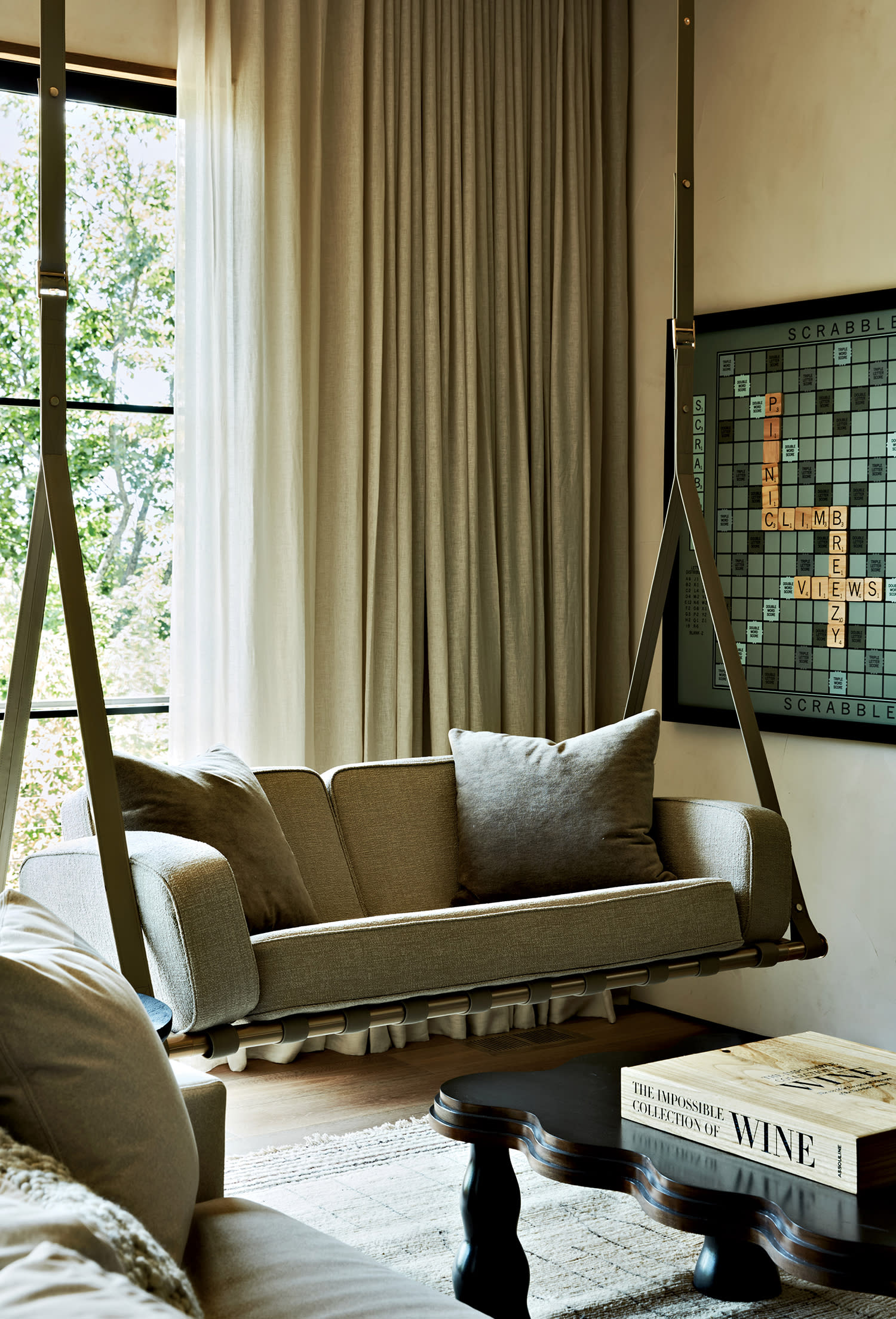
In the family room, Myface’s hanging Fable seat invites relaxation next to a coffee table from Ro + Co. Jaipur Living’s wool Kazben rug grounds the scene.
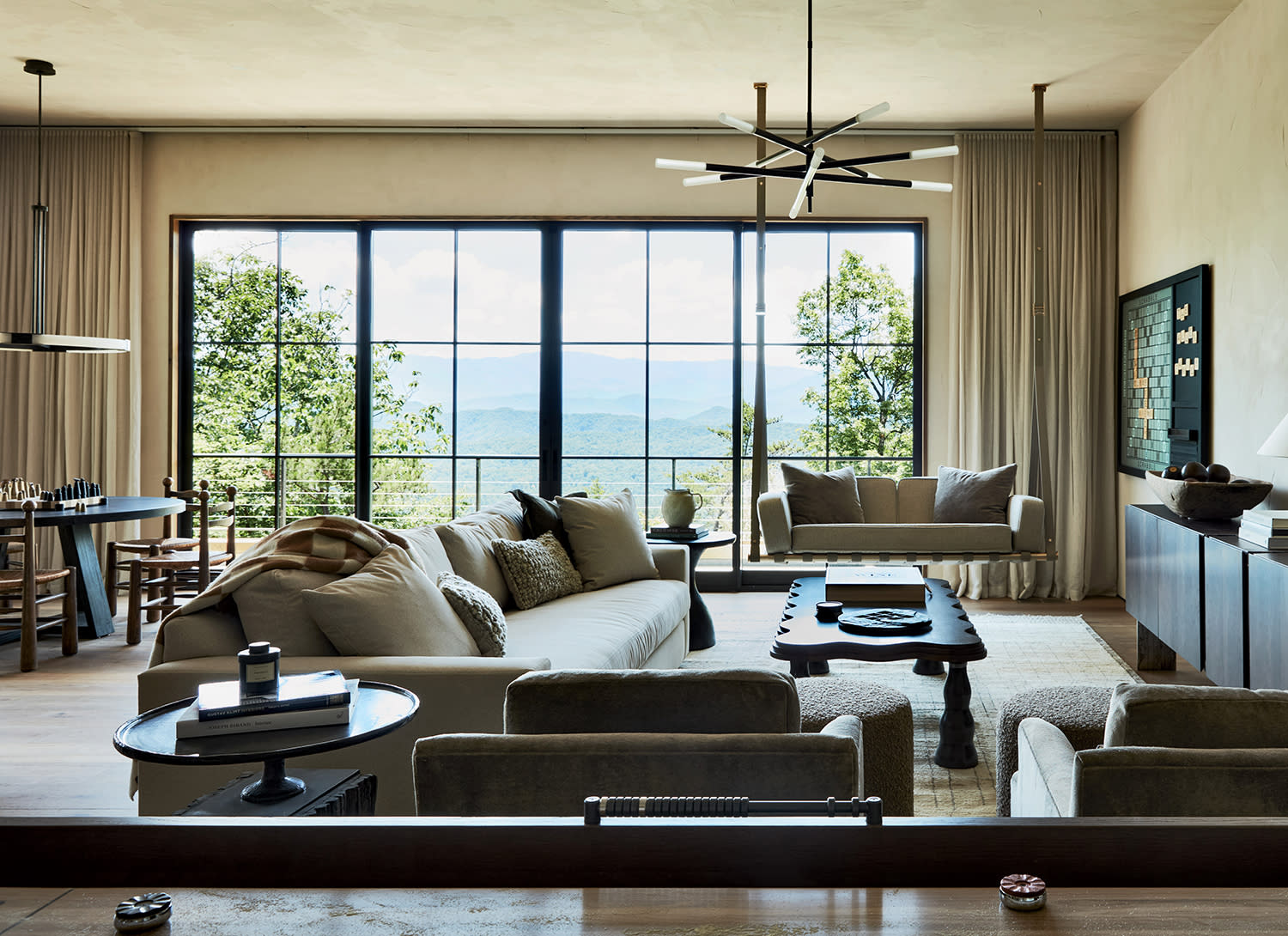
“We imagined everyone piled up on the sofa, high-stakes card games at the Clubcu table and quiet evenings,” Paranjape says. Visual Comfort & Co.’s Rousseau Grande chandelier creates a focal point above the Verellen sofa and Olivya Stone sideboard, bringing the vision to life.
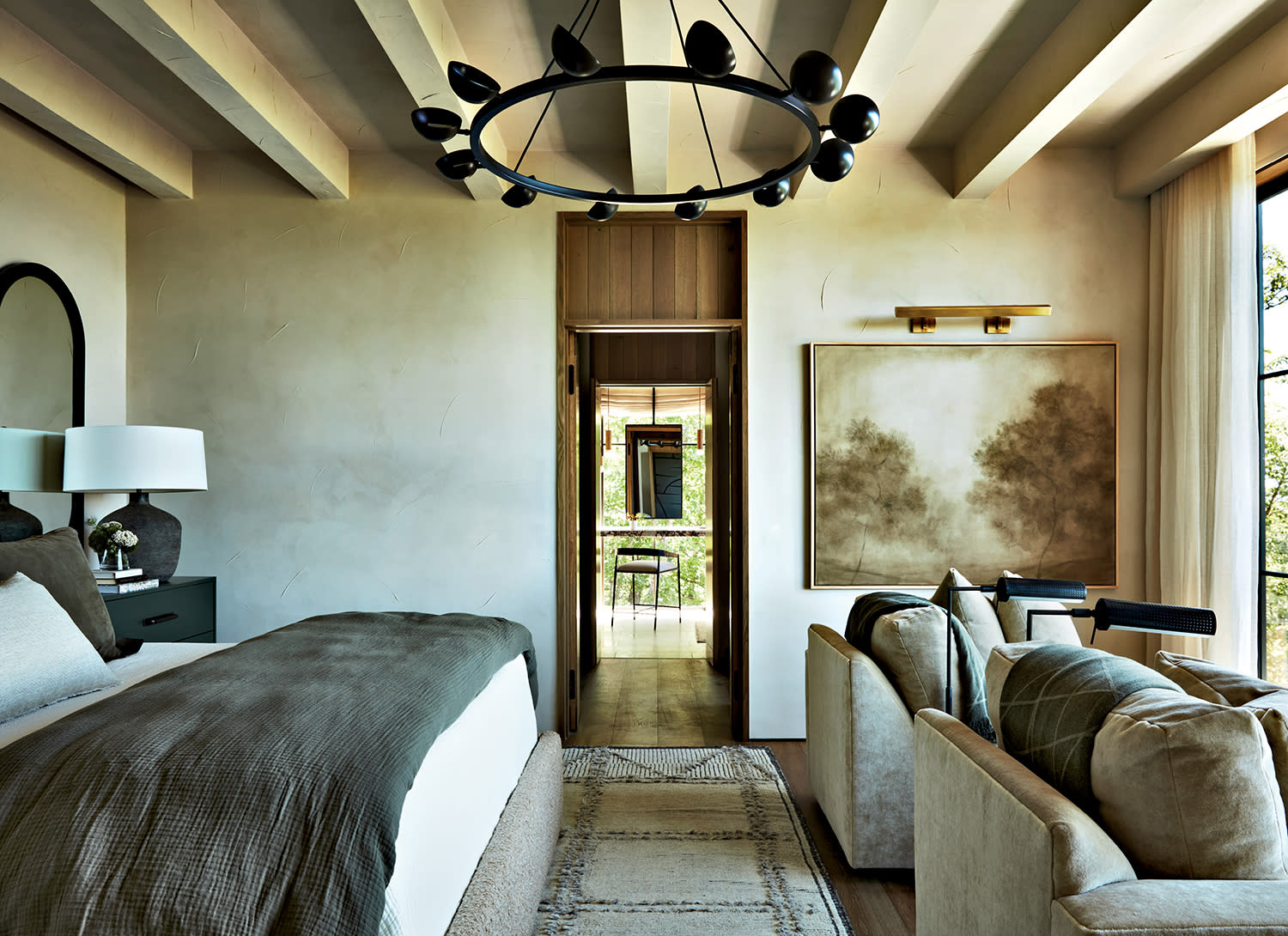
Verellen’s window-facing Gregoire chaises offer a cozy perch in the primary bedroom. Baker’s Giselle bed and the Moattar rug echo the muted, restful palette of the McKenzie Dove artwork. Jonathan Browning Studios’ Avion chandelier was sourced from R Hughes.
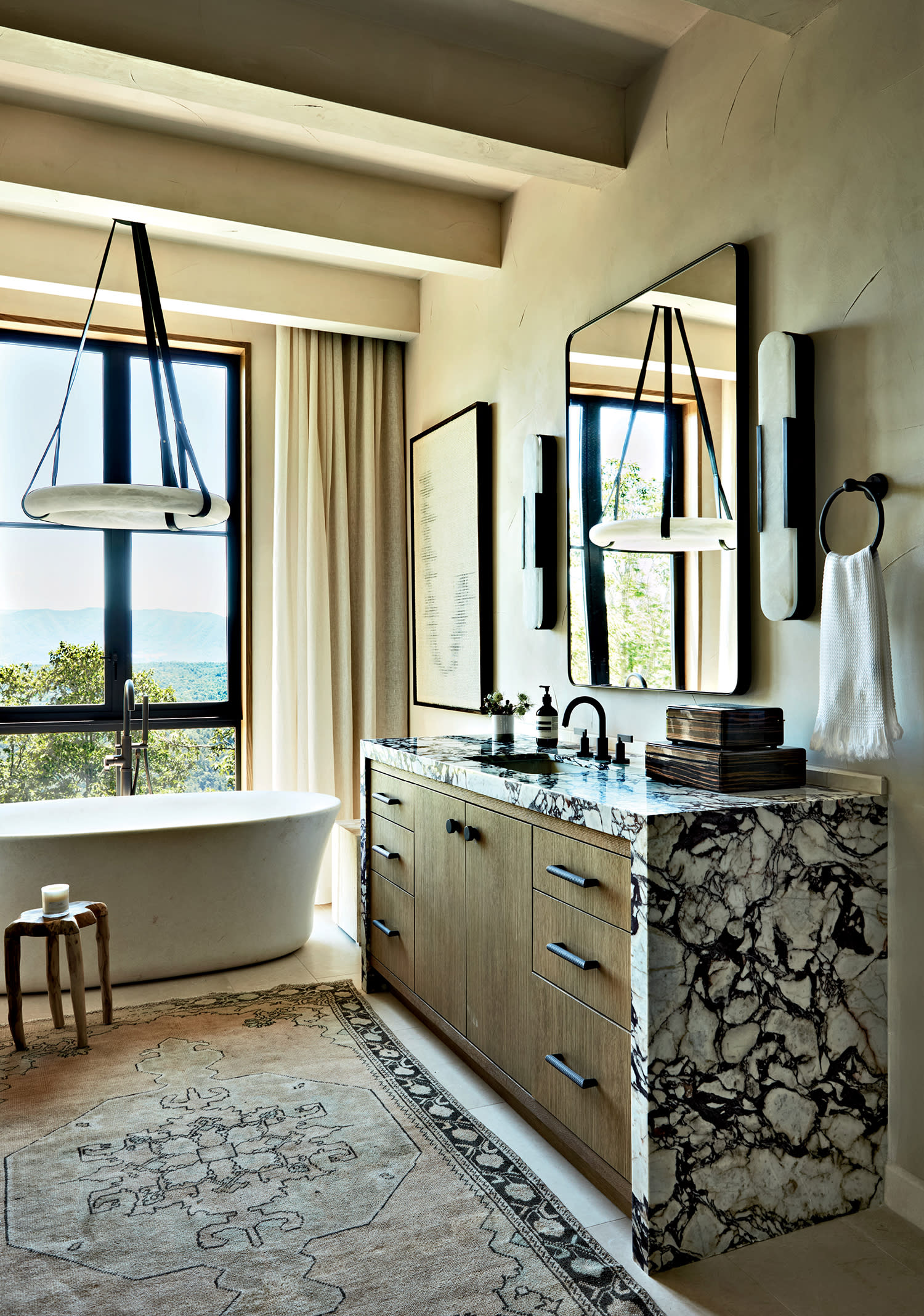
A waterfall of Calacatta Viola marble—featuring a Studio Ore faucet and Kohler sink—complements the primary bathroom’s white oak cabinetry by Law & Hicks Millwork. Holly Hunt’s Oslo chandelier crowns the Stone Forest tub beside a vintage carpet from Nashville Rug Gallery.
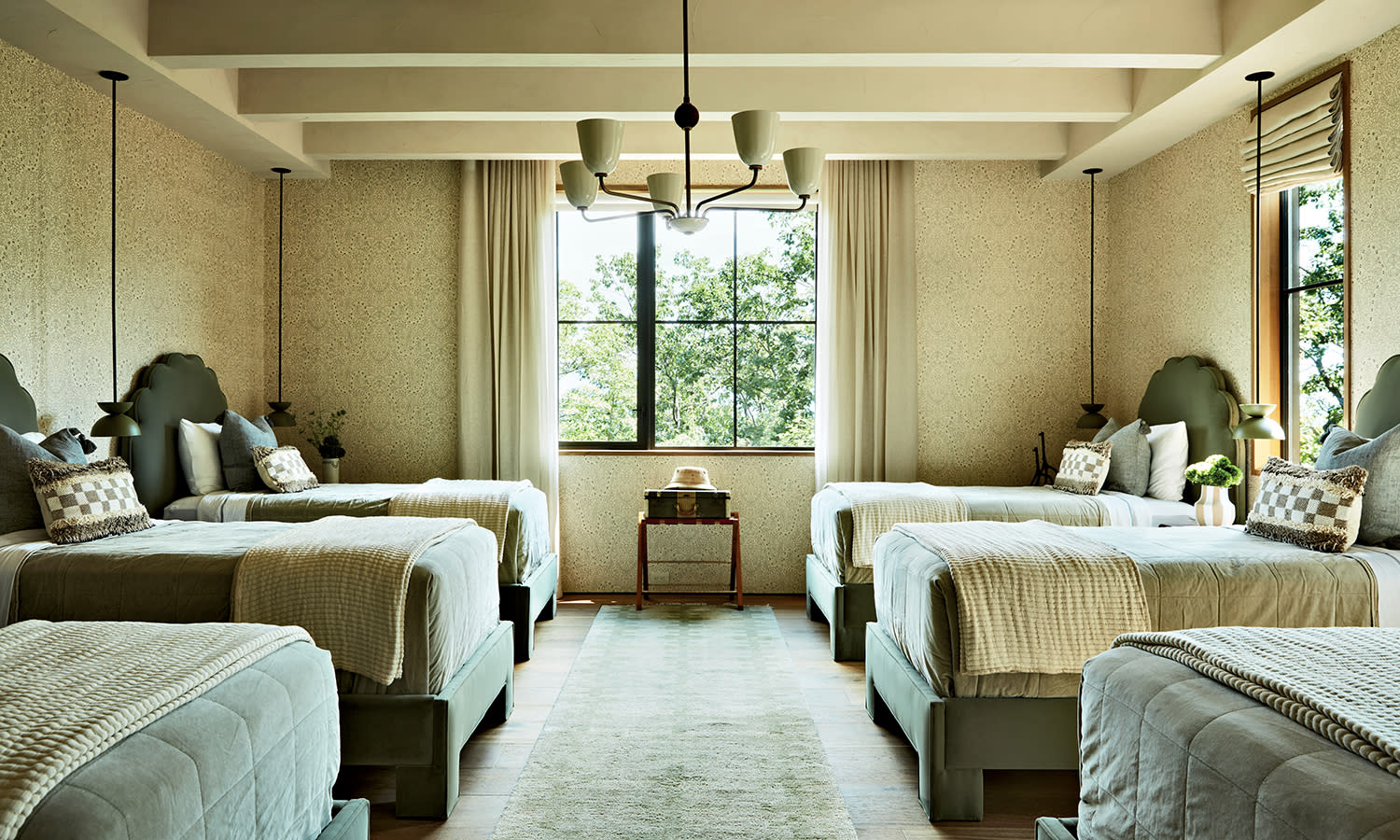
“I call this the ‘camp room’—it’s our take on a classic bunk room,” Paranjape says. Scout Design Studio beds outfit the space, wrapped in The Lawns’ Uroboros grass-cloth wallpaper. Pom Pom at Home coverlets adorn each bed.
From Summerour’s preliminary drawing came the resulting mountain retreat, a series of connected linear forms offering a contemporary presence while masquerading amid the area’s natural beauty. Part of this achievement is credited to scale: The residence deceptively appears as one story in the front, then terraces two-and-a-half floors down the hill in the back. “We could see early on that the architecture was different than anything else on the mountain,” says general contractor David Rhodes. Landscape architect Andrew Spatz inserted native hedges and perennial flowers to frame views and preserve privacy, concealing spaces such as a bocce ball court. “We wanted it to seem like the home was nestled in the slope,” he explains. Materials like wood, dark metal and expanses of glass further integrate the structure into its setting. “You feel like you’re amongst the trees in this house,” observes residential designer Joseph Lentini, who worked alongside Summerour and architect Drew Kinney, who is no longer with the firm. “It is really quite stunning.”
The exterior’s textures reappear in the dwelling, creating a smooth flow from hillside to inside, aided by an abundance of windows—in particular, a roughly 25-foot-tall glazed wall. “The windows go over your head but also well below you,” Paranjape notes. “It cascades through the center of the home.” Steel, too, stars in a monumental role: as a fireplace extending from the foundation to the roof, servicing both the living area and family room.
Within this sturdy shell, Paranjape injected refined coziness through elegant silhouettes and soft textiles like bouclé, velvet, wool and suede in earthy tones. “If you walk on any of the mountain trails, you will find our palette,” she says, pointing to charcoals and mossy greens. “We wanted the whole house to feel like a hug.” In the living area, for instance, the designer paired taupe mohair sofas with an organic-shaped coffee table and armchairs that have gently sloping arms.
Because the residence is intended as a respite, rooms such as the quartzite-clad kitchen and wood-paneled office are modest. Instead, more square footage is devoted to spaces like the family room—a playful, lounge-like hub with a shuffleboard table, swing and hidden kitchen. When someone wants to turn in early, however, the home’s layout allows enough separation for a retreat to one of the suites. There’s the primary, with a limestone tub; a guest cabin accessed through a breezeway; the whimsical “camp room” (as Paranjape calls it) boasting six twin beds and a triple sink in an adjoining bathroom. Each carries the same hues and textures as the public spaces but with its own flair, like the guest room with a patterned grass-cloth wallcovering, beaded chandelier and rope art.
It all amounts to a generational abode that feels as though it always existed between soaring eagles and cloudy foothills. “We wanted the house to be worthy of sitting on that pretty mountain,” Paranjape says. “This is a legacy home for the family—and a legacy project for me.”
La Cornue’s Château 150 range anchors the kitchen, accompanied by Sub-Zero and Wolf appliances. The Waterworks faucet contrasts the Sumatra H pendant by Alain Ellouz for Holly Hunt.