Among leafy streets that shade sprawling villas and breezy estates, designer Jennifer Bunsa’s clients discovered something of an anomaly: a 1970s town house, rising five stories. It was an ideal dwelling for Joana Benjamin and Frank Wooten, a globe-trotting couple with young children who settled in South Florida after stints in New York and California.
“It feels more like something you’d find in the Northeast,” observes their residential designer, Robert Kerr. Indeed, New York’s classic townhomes inspired the team’s direction for this Coconut Grove residence: a sophisticated interior with soft colors and natural materials, especially wood. But unlike its northern influences, with spaces clearly laid out, this structure “had no definition,” Bunsa adds. “Every room bled into the next.”
For Bunsa and Kerr, the first order of business was to rework the layout to suit the family’s lifestyle. The ground level now hosts a playroom and a gym, while the bedrooms are on the third story. Just above, the fourth floor displays a summer kitchen and dining terrace. “It feels like you’re going on a little vacation when you’re there,” muses the designer, who grounded the space with terra-cotta tiles inspired by ones the clients found in Italy. Crowning the structure is a rooftop terrace, offering stunning views of Biscayne Bay.
The public areas are housed on the second story, where the team most obviously took cues from New York townhomes, fashioning spaces comfortable for a young family yet stylish enough for sophisticated entertaining. In the dining area, for instance, the paneled walls are plastered, bestowing a luminous quality and a layer of formality. To mark transitions between rooms, they used painted wood thresholds at the openings and relied on flooring, particularly honey-toned white oak in a herringbone pattern—another nod to New York.
Bunsa repeated white oak details elsewhere on the main floor, lending consistency and warmth. She carried the material into the living room, using it to cover the fireplace wall, where a sliding panel craftily conceals the television. “We didn’t want a blank panel,” the designer explains, “so we came up with this grid pattern and floating shelves on brass supports to make it feel lighter.” White oak also appears on the island and lower cabinets in the kitchen, which Bunsa and Kerr—working with architect of record Michael C. Noll of M3 Design + Development—doubled in size to maximize storage and functionality. “It was segmented,” Kerr says, “but we made it feel grand, open and modern, with classic details.”
Home Details


Although Bunsa is known for a bold approach to color, for this project she went quieter, taking inspiration from the muted tones of a tapestry she had spotted by Madeleine Colaço, an artist from Brazil—a nod to Joana’s heritage. The piece’s earthy palette of pinks, greens and blues pop up around the home—notably in the living room, where one of the sofas and the chandelier, composed of individual pieces of Murano glass, are in soft rose shades, and the rug boasts greens and blues in a checkerboard pattern.
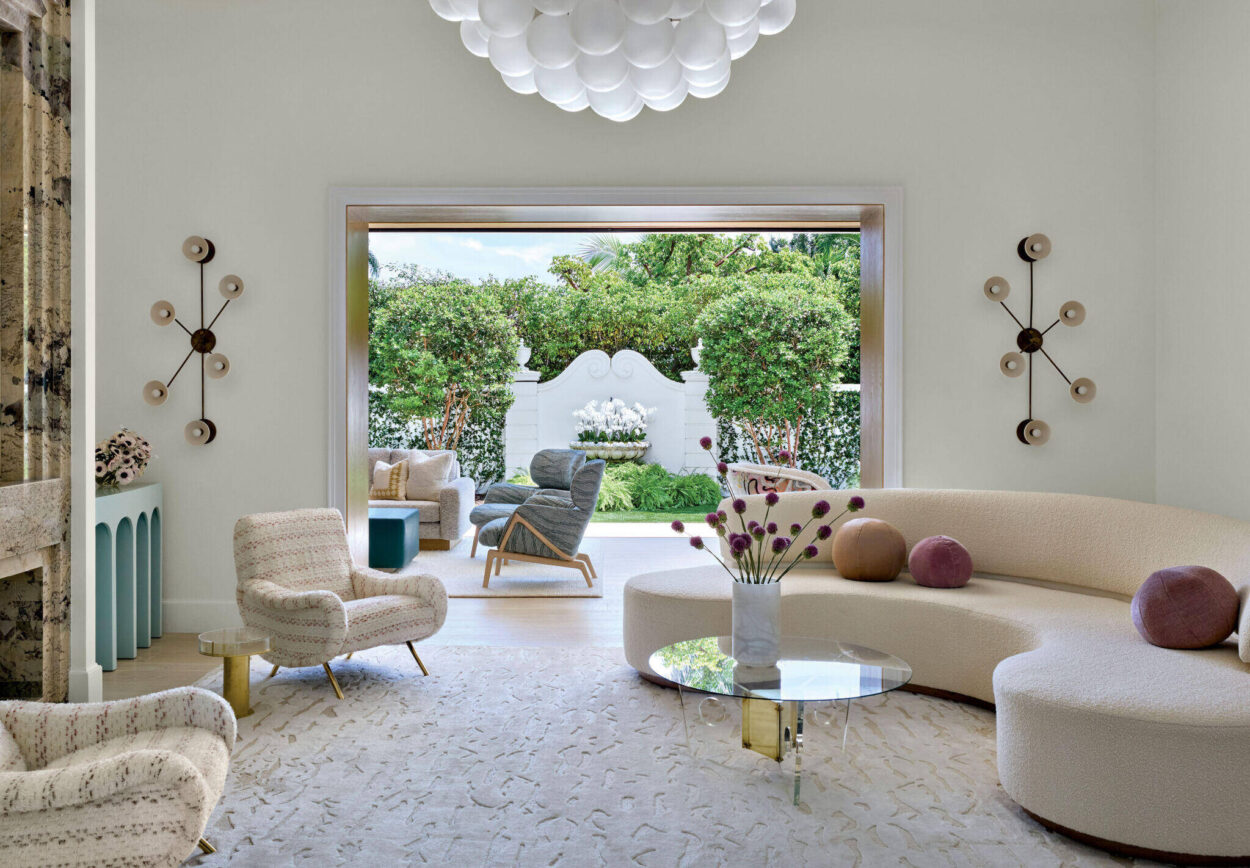
A certain softness extends to other furnishings, in part driven by the presence of small children. The living room features a coffee table bearing a curving top set on rounded legs, a vintage Danish armchair with a sinuous silhouette and a sconce in the shape of a yarumo leaf. Elsewhere, the dining room’s chandelier, sourced with Joana on a shopping trip to New York, consists of glass bubbles and fringe.
Ultimately, the design strikes a balance between a northern cosmopolitan aesthetic and a family-friendly Miami home, imbuing life through materials. “When you can’t bring in color, you think about texture in a different way,” Bunsa says. “This was a fun exercise in restraint.”