Working in the music business, especially as a talent scout, is an out-of-the-house gig involving marathons of shows, travel and networking. So, when Wendy Goldstein, the chairwoman and chief creative officer of Republic Records—who oversees the careers of many well-known artists—retreats to her Beverly Hills residence, she wants her homecoming to feel like entering a sanctuary. And while “sanctuary” might conjure up images of clean, white, Zen-like spaces, this haven embraces a range of colors, strong patterns, antiques, art and vibes. “It’s like her: a bit rocker chic, with an Hermès bag,” quips designer Stephen Pappas.
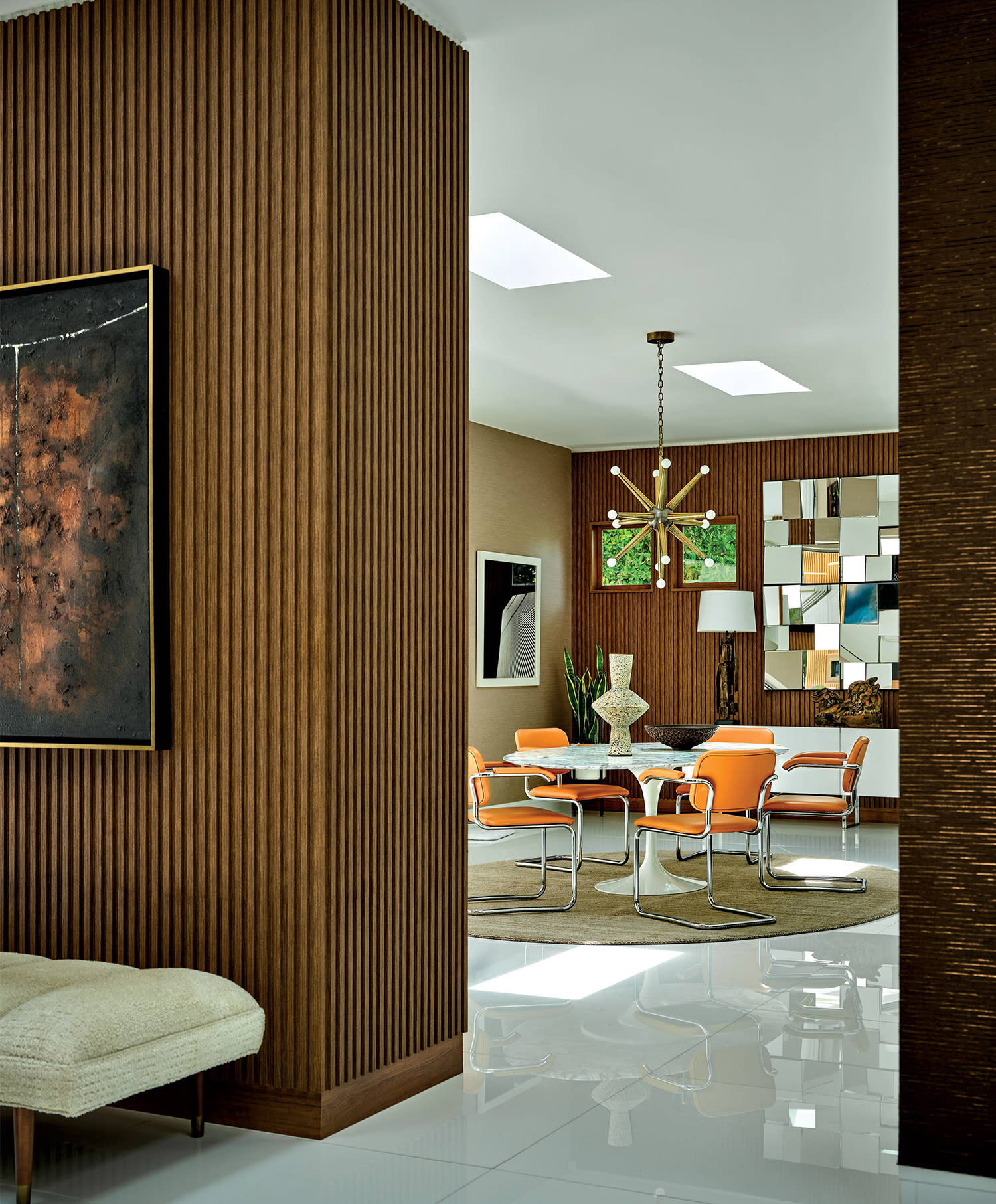
The great room is accented by slat wall installations by Eric Schum Studio. Artwork is by David Rankin.
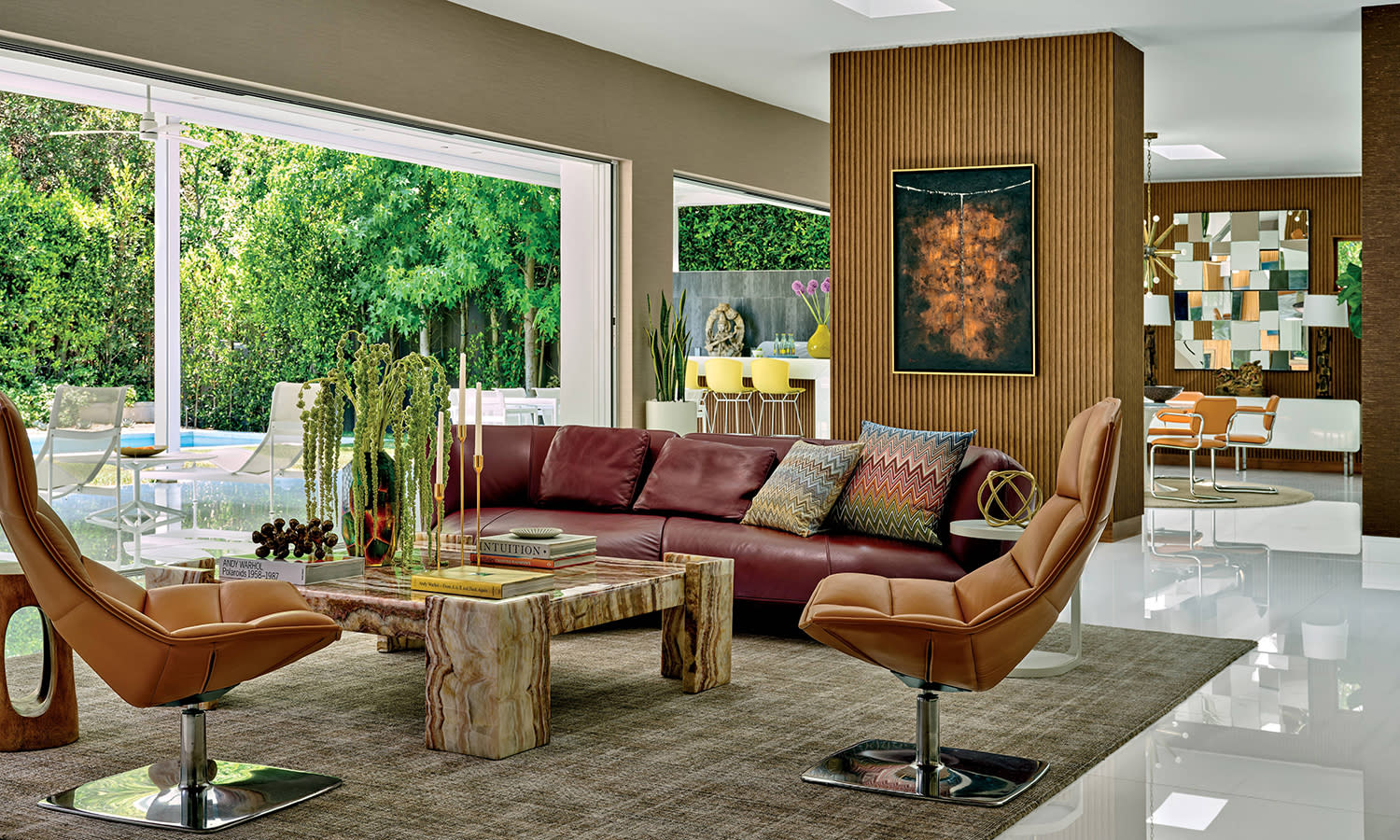
A leather Patricia Urquiola for Cassina sofa joins Jehs+Laub for Knoll lounge chairs in the living area, atop a Ben Soleimani rug. The marble coffee table is from HD Buttercup. The Phillip Jeffries wallcovering, beige with a metallic sheen, adds extra dimension.
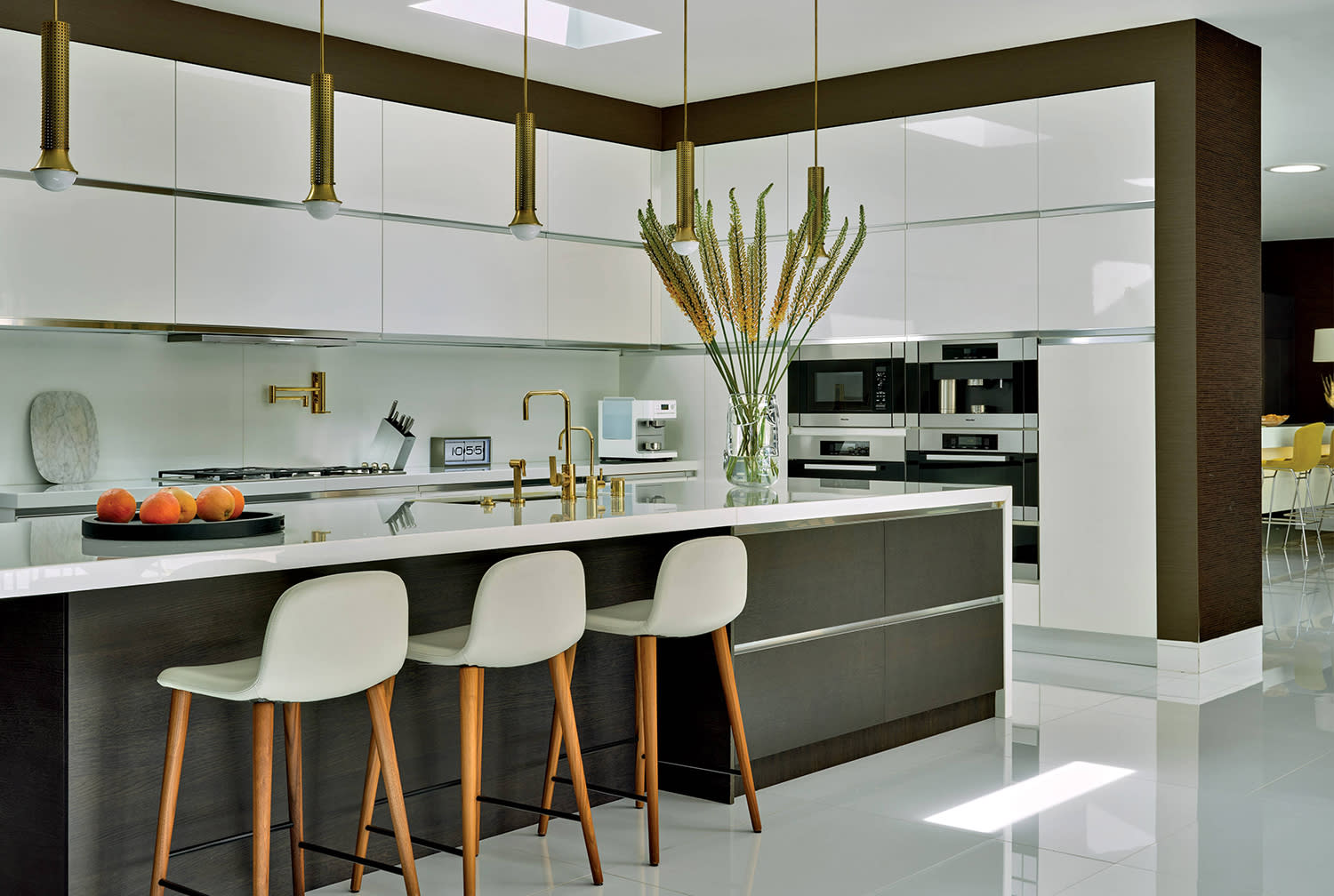
Kelly Wearstler for Visual Comfort & Co. pendants illuminate the kitchen, where the designer and homeowner opted to retain the existing cabinetry and counters. The stools are Design Within Reach, and the fixtures are Watermark, through Renaissance Design Studio.
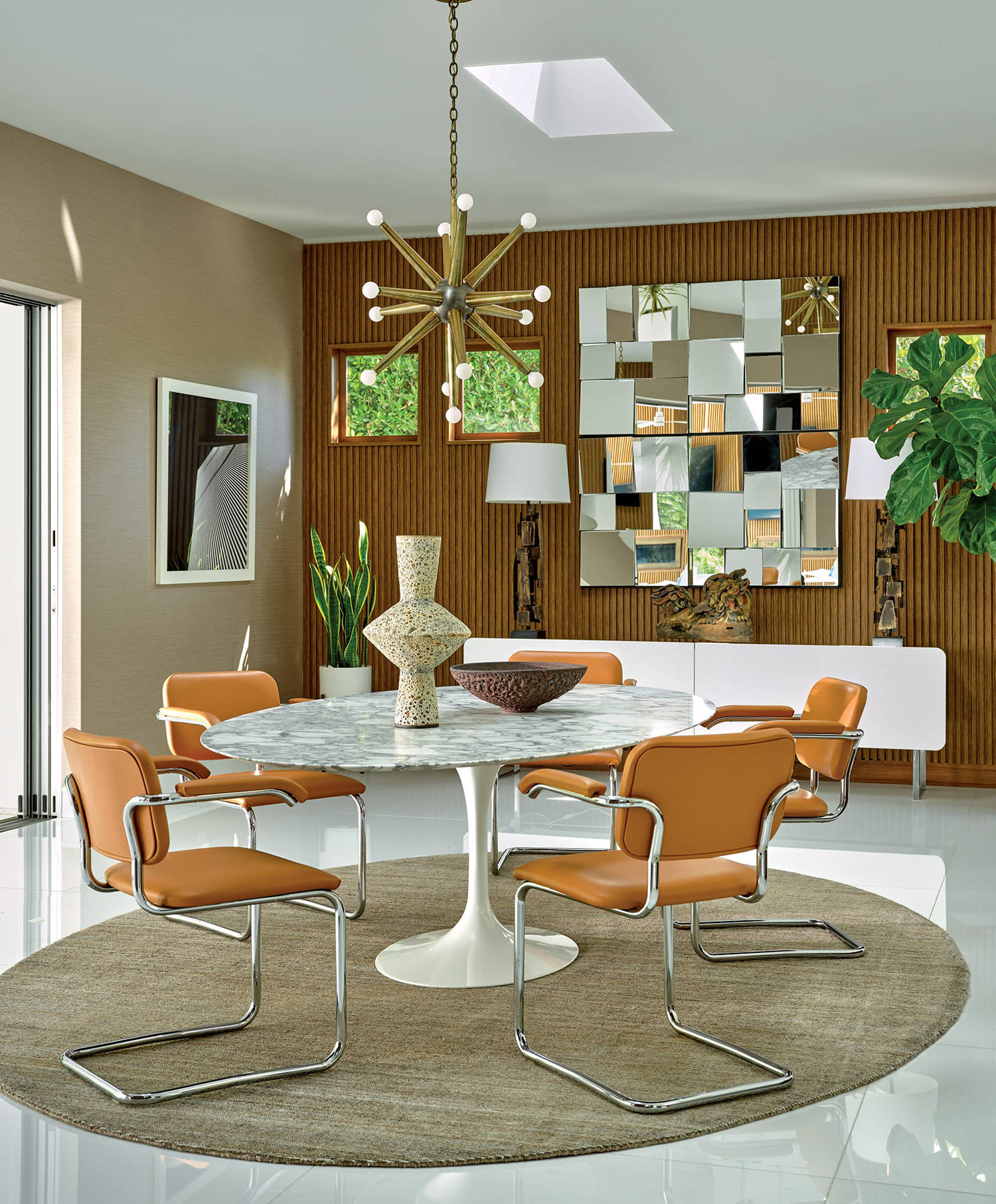
1970s Slopes mirrors by Neal Small reflect the dining area, where Cesca chairs ring an Eero Saarinen table on a Ben Soleimani rug. The pendant and lamps are from Downtown, and the credenza is from Twentieth. The framed photo is by Charlie Bidwell.
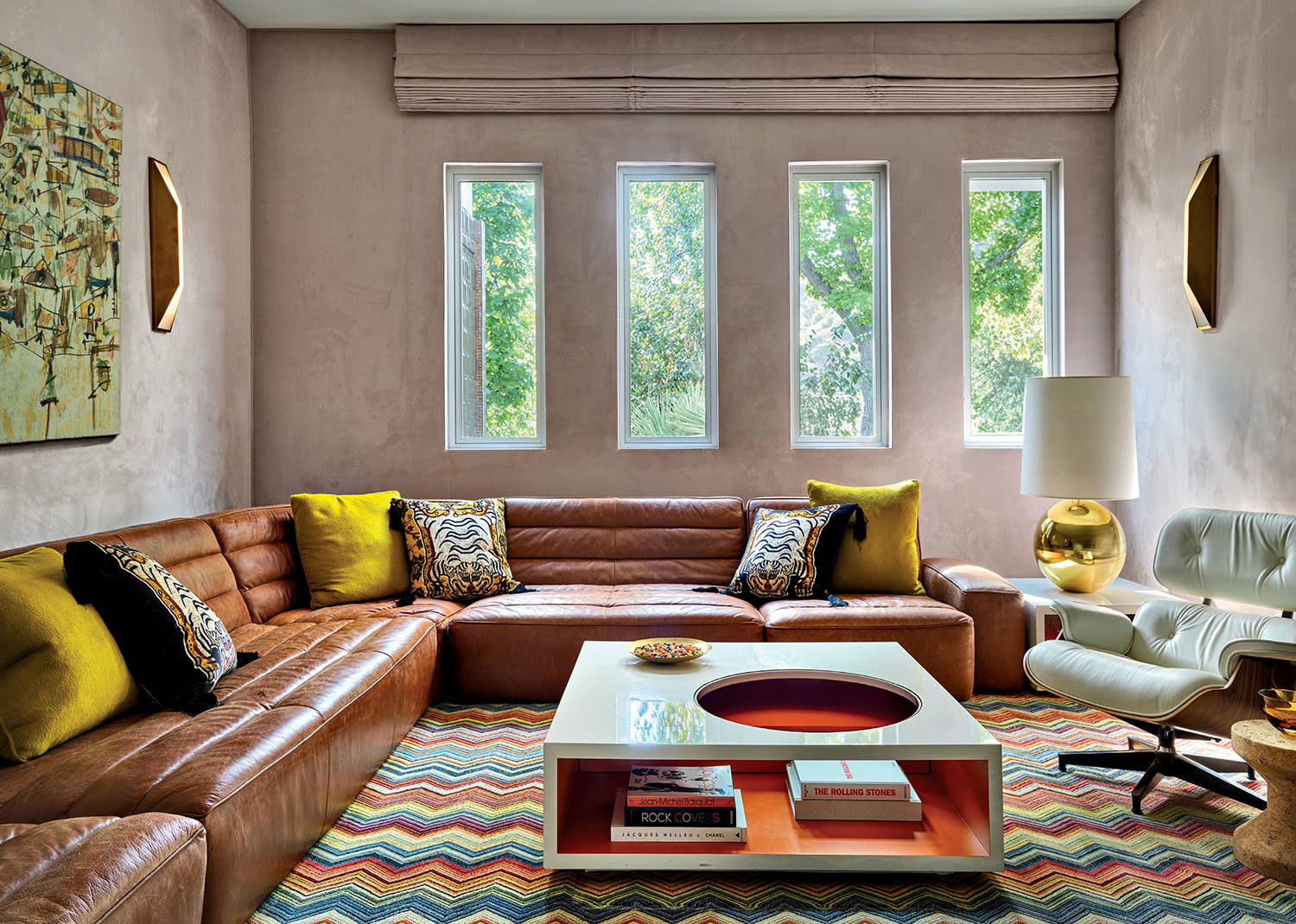
Suede walls backdrop the media room, where a Timothy Oulton sectional and a coffee table from Twentieth gather on a Kane Carpet floor covering. The lamp is from Christopher Anthony Ltd.; the sconces are Visual Comfort & Co. Artwork is by Virgilio Santaella Rivas.
Like the creation of any great album, getting there took effort and editing. Wendy, eager to avoid the dust and disruption of construction, asked Pappas—her friend of more than two decades and the designer of one of her previous homes—to work within the existing bones and layout of the 1961-built house, which had been renovated in 2017. When Pappas first glimpsed it, “It felt like an airline terminal,” he recalls of the expanses of shiny white floor tile (which were retained) paired with primarily white walls (which were not). But the fact that it was such a blank slate ultimately appealed to them both. “Because everything is built on top of all that white porcelain tile, I knew it could hold a lot of color and still feel light,” remarks the homeowner. She leaned into surface treatments everywhere, shares Pappas, who delighted in his client’s collaborative spirit. “She’d say, ‘Why don’t we wallpaper this? Let’s go, let’s do more,’ ” he says, declaring, “Paint refreshes; wallpaper transforms. Wallcoverings became the heartbeat of this home.”
In addition to introducing the distinctive wallcoverings, which fill most of the formerly plain-Jane walls, early in the design process Pappas brought over a vintage brass Brutalist-style table lamp (one of several eventually worked into the decor). It sparked what he calls an unspoken agreement between himself and Wendy about the importance of layering in visual movement and warmth. Now, a variety of lamps, chandeliers, sconces and pendants replace what the designer jokes was originally “an unrestrained use of recesssed lighting.” Large rugs break up the uniform floors, and Pappas accented the great room with walnut slats. They line the back wall of the dining area, wrap a divider wall between the living and dining spaces, and even peek from below an outdoor serving counter. “The slatted walls provide an architectural grounding that really drives the home’s midcentury look,” the designer comments.
Pappas also played to the home’s midcentury origins by using iconic pieces like Eero Saarinen’s 1957 pedestal table in the dining room, the primary bedroom’s curved Lady armchairs—symbolic of 1950s Italian design—and a vintage boomerang-shaped desk in the office. A hexagon-patterned wallcovering in the entry off the garage also boldly references the era, as does the dining room’s Sputnik-ish chandelier. Other key furnishings nod to modern styles and the Bauhaus movement, like the classic cantilever dining chairs and the geometric living area lounge chairs, which feel at home within the dwelling’s clean-lined architecture. Outside, the sustainably focused landscaping, put in place by Sean McGowan of Modern Floristry, has what Pappas describes as “a sculptural, sun-drenched vibe” that amplifies the interior atmosphere. “Think Palm Springs chic with a midcentury backbone and a ’70s wink,” he says of the overall look.
Indeed, the fun factor of blending all these influences and design eras was drawing in elements from one of history’s most free-spirited times: the 1970s. Earthy, retro-y hues of mustard, brown, terra cotta and even bright orange are peppered throughout the house (with Pappas cherry-picking the better hues and aspects of the decade; this isn’t Austin Powers’ shagalicious pad). The media room is the space perhaps most indicative of the period’s flair, with its mauve suede walls, slouchy leather sofa and lacquered coffee table, all atop a rug of rainbow chevrons, a pattern emblematic of 1970s fashion. That’s where Wendy gravitates. “I’m a product of the ’70s, and there’s a grooviness here,” she muses. “All the colors pop. It’s a really happy house.” And that’s a compliment that can only be described as, well, music to a designer’s ears.
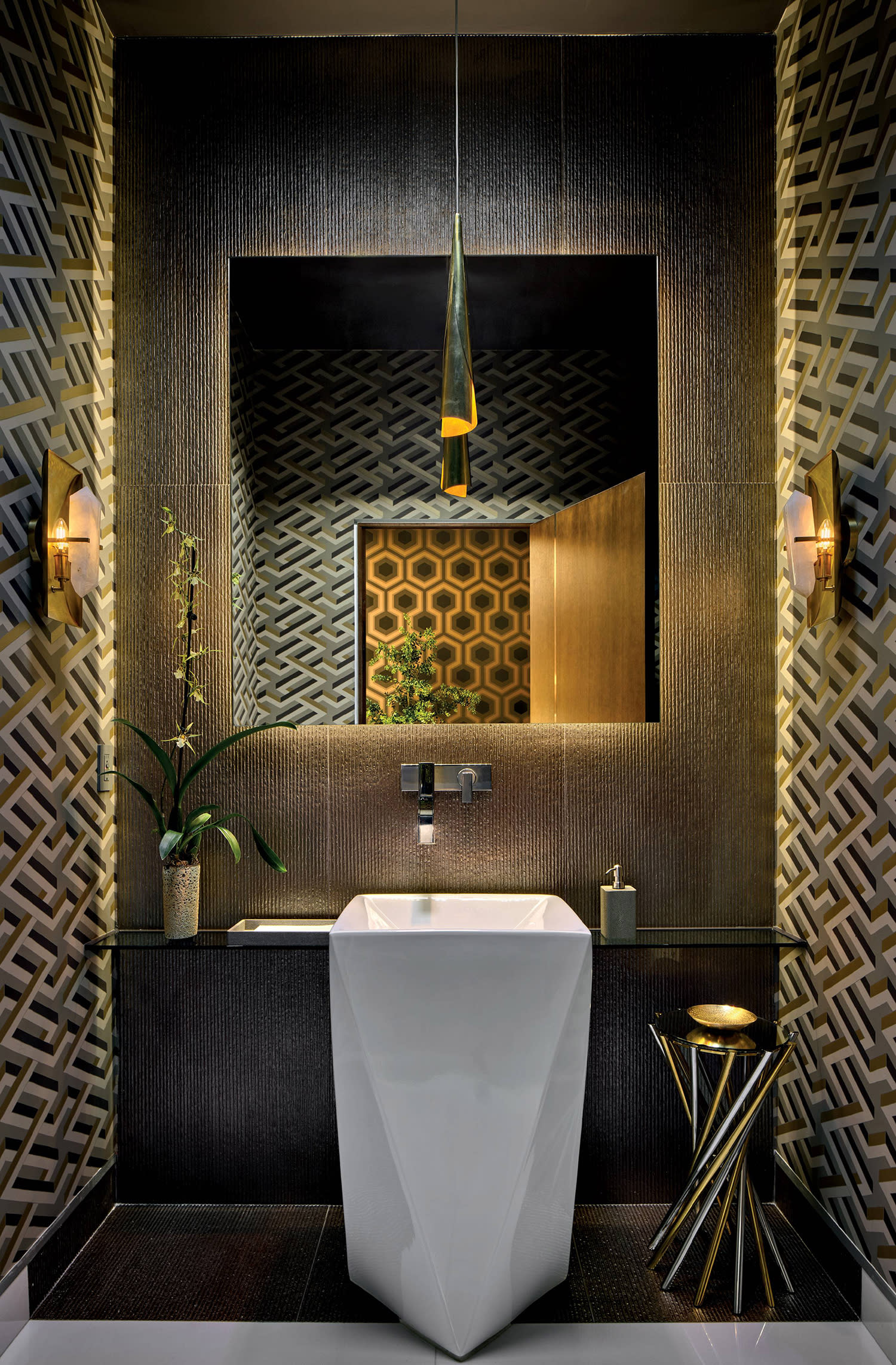
Two geometric Cole & Son wallcoverings appear to overlap when the powder bathroom door opens. The accent table is Jonathan Adler, and the pendant and sconces are Kelly Wearstler for Visual Comfort & Co.
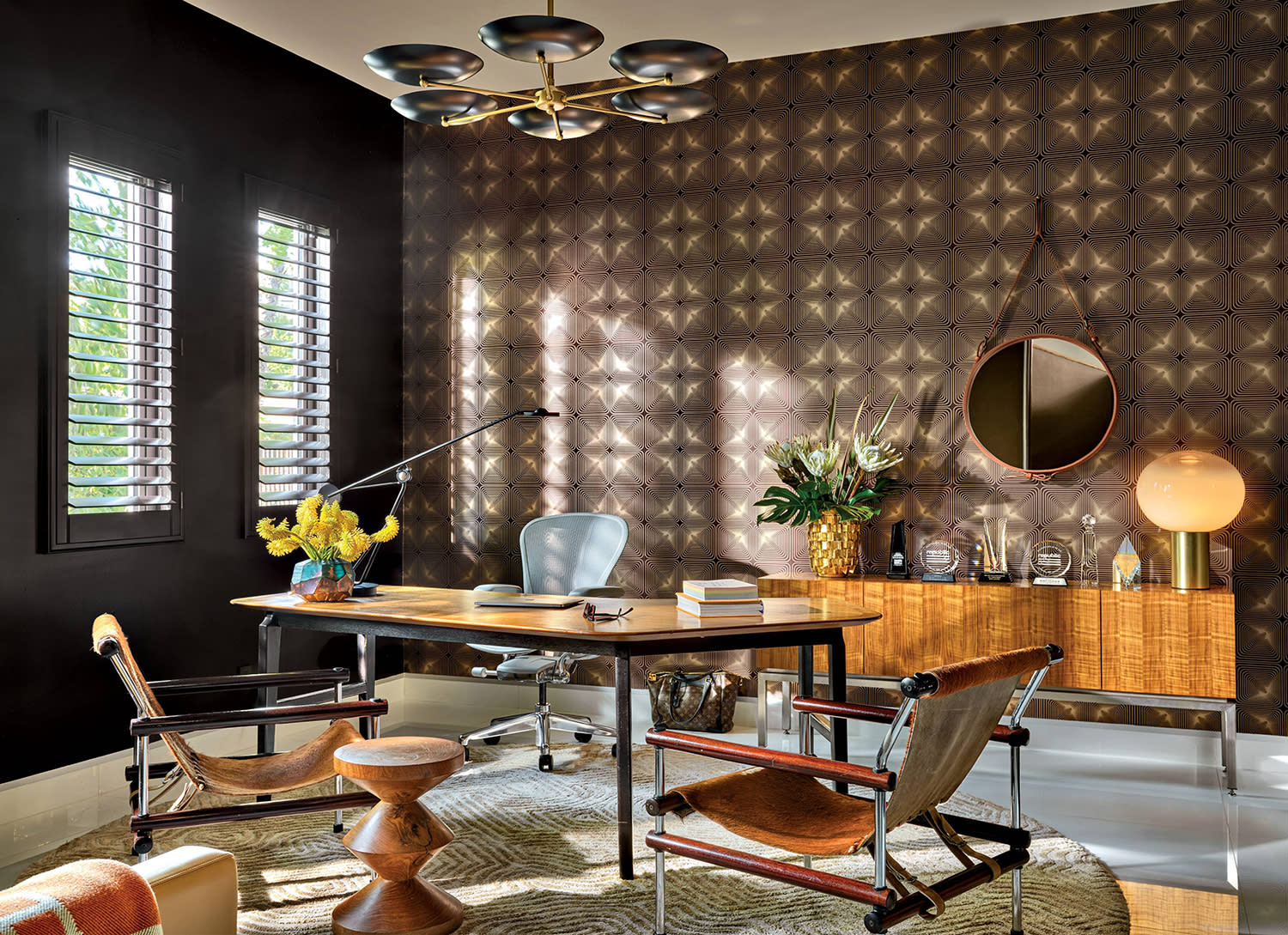
The office’s midcentury boomerang desk is from Chairish, the Scandinavian 1970s armchairs are via Lawson-Fenning, the table lamp is Artemide, and the chandelier is Mitchell Gold+Bob Williams. A Flavor Paper wallcovering highlights the space.
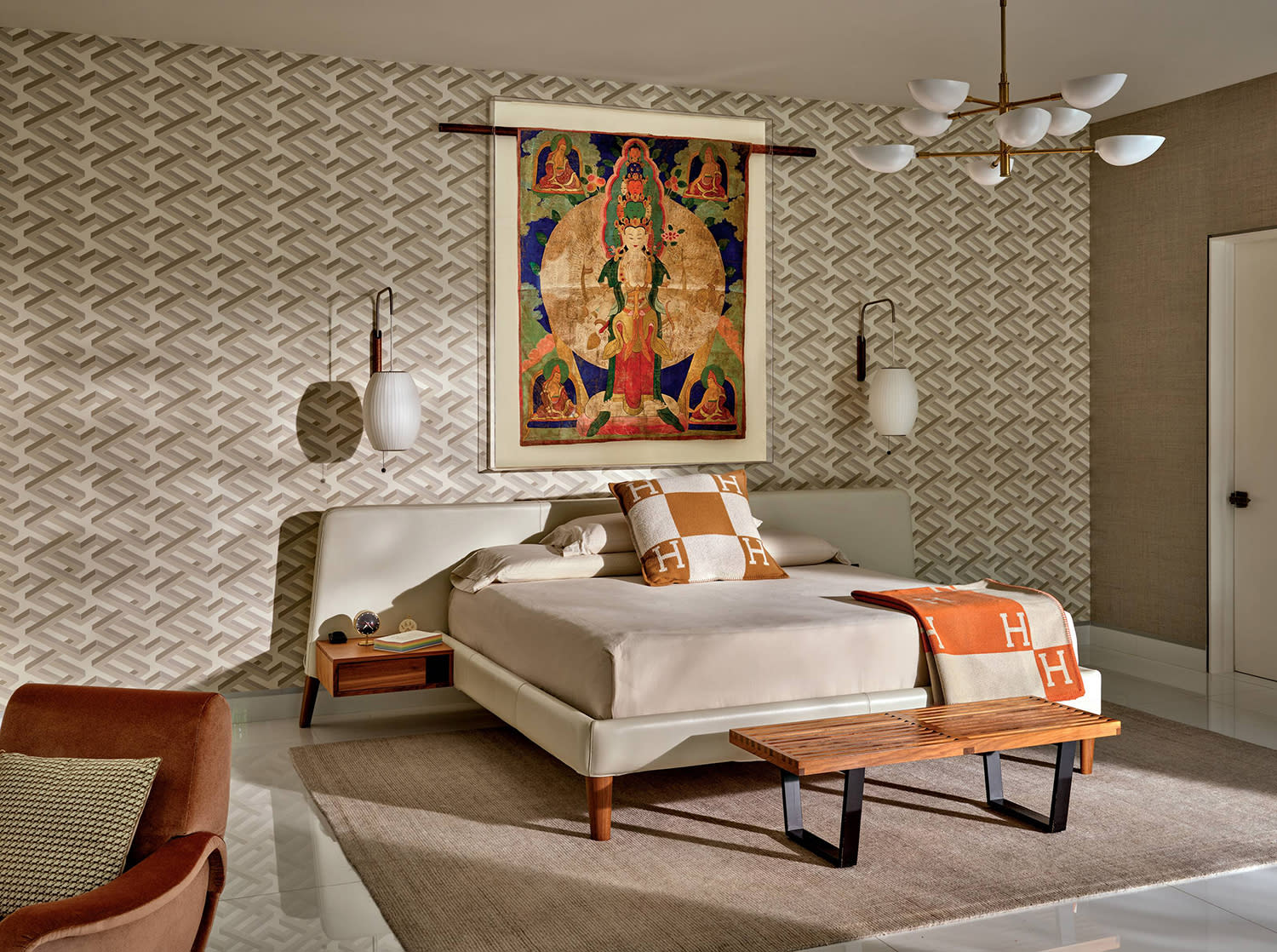
Designer Stephen Pappas drew together a bed, bench and pendants from Design Within Reach in the owner’s suite. A Tibetan thangka painting overlooks the bed. Overhead is a Visual Comfort & Co. chandelier, while a Ben Soleimani rug softens tile flooring.

Cheerful zigzags on a Missoni mat from Farfetch enliven the primary bath. The pouf is Bohinc Studio via 1stdibs, and the Indonesian totems are antiques sourced through Accessory Preview Inc. The brass pendant is from Lamps Plus.
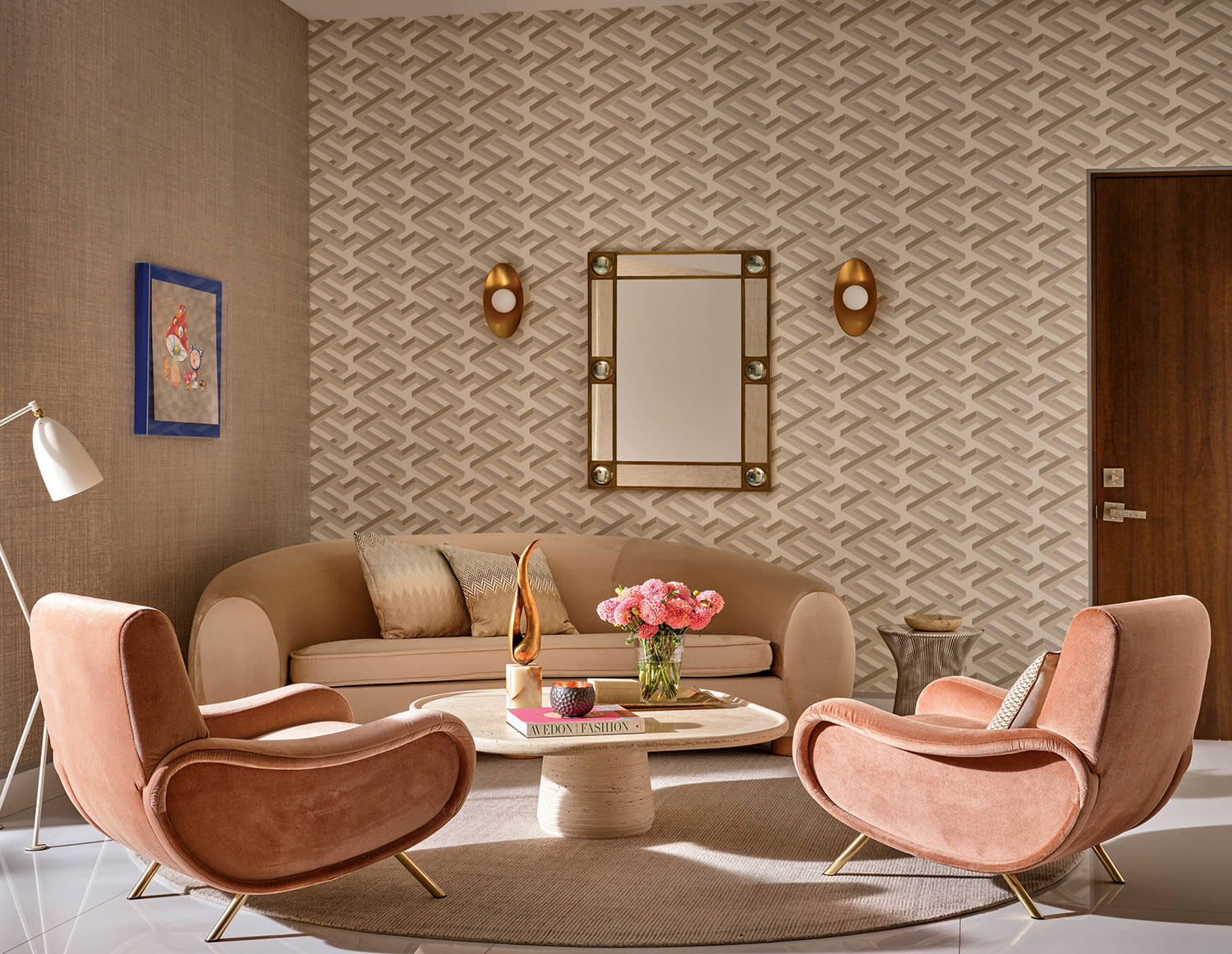
Marco Zanuso Lady armchairs join an Eternity Modern sofa, Rouse Home coffee table and Ben Soleimani rug in the primary bedroom’s seating area. The mirror is Arteriors with a Cole & Son wallcovering behind it. A Takashi Murakami artwork hangs against a Phillip Jeffries grasscloth.

Cole & Son wallpaper stuns in one of the home’s entries. The poufs are Fendi, and the pendant is from 1stdibs. A Design Within Reach mirror reflects an unsigned painting, and the sculpture is from Thomas Lavin.