Brent Kendle was in a pickle. The architect had potential clients from Wisconsin who hoped to build a getaway for themselves and extended family in Paradise Valley—but if and only if their friend who owned the 1-acre plot they wanted to buy would approve of a design that could preserve the views he cherished from his own adjacent property. Winning the commission meant first winning over the neighbor. “We surveyed everything that we could to figure out exactly where the views were,” Kendle recalls.
The geode-like building that emerged, built by general contractor Greg Hunt, feels as if it rose naturally from the earth, or perhaps from Kendle’s subconscious. “I learned a long time ago that the more I overthink things, the harder they become,” the architect says. “Sometimes you have to let your intuition be the guide.” The site’s constraints shaped everything, including a façade that hides the bustling street behind the house. “It needed to have this kind of protective shell,” he explains. “The home is like a blinder, blocking out the things we don’t want to see and focusing on the things we do.”
While Kendle initially considered copper for the exterior, supply chain realities pushed him toward an attainable look-alike alternative: Kynar, a “metallic coating that should last a hundred years,” the architect says. To offset all that sheen and the minimalist walls of glass, he used custom-milled vertical-grain hemlock in protected areas of the ceiling. “It warms up the space a lot,” Kendle says. “We love modern architecture, but we don’t want it to be cold; we want it to feel cozy.”
Home Details
Architecture:
Brent Kendle and Cathleen Kebert-Carboni, Kendle Design Collaborative
Interior Design:
Michael Marlowe and Karen Rapp, Wiseman & Gale Interiors
Home Builder:
Greg Hunt, GM Hunt Builders
Landscape Architecture:
Michele Shelor, Colwell Shelor Landscape Architecture
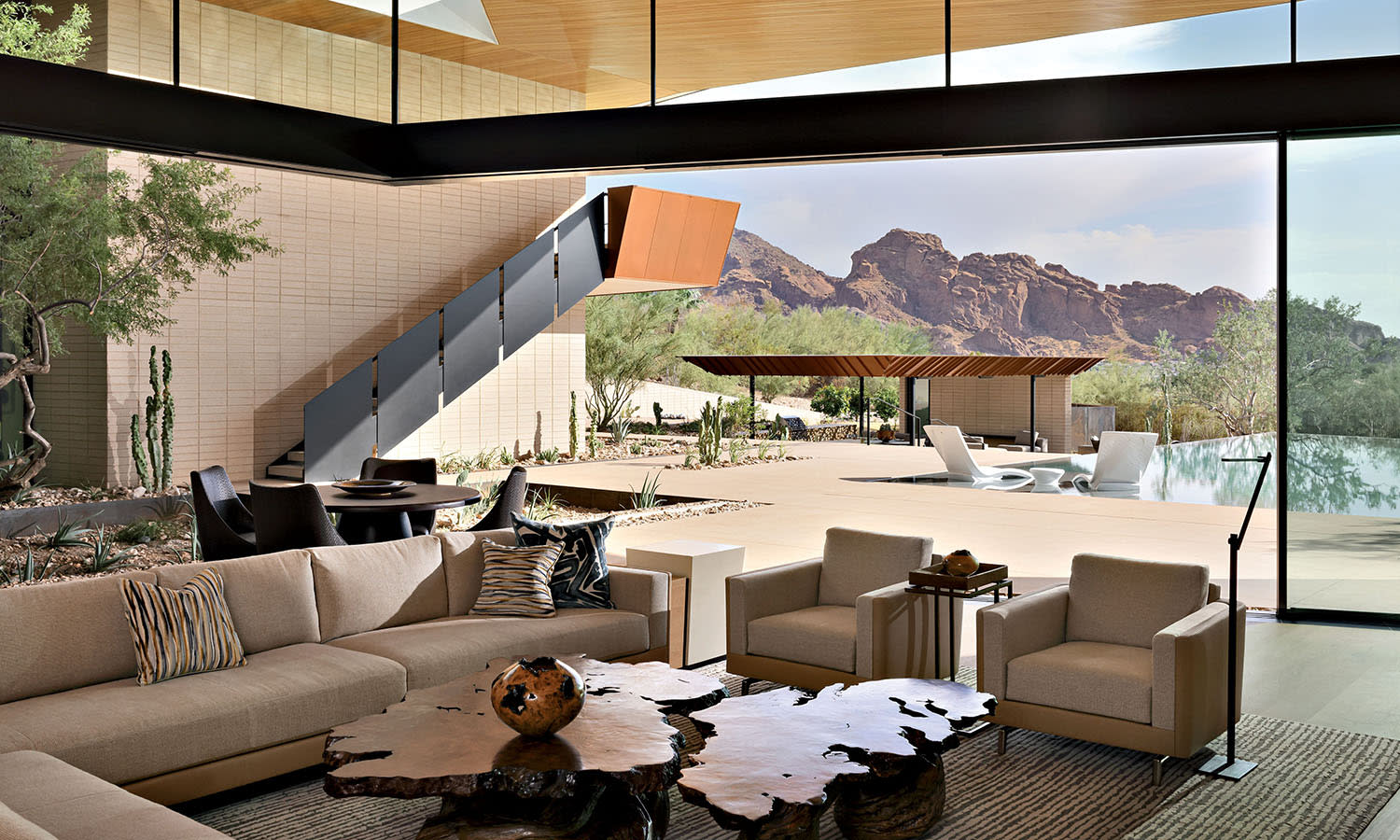
In the soaring living area, a sectional and chairs, both by Holly Hunt from John Brooks, embrace cypress Buffalo Collection coffee tables atop a rug from David E. Adler Fine Rugs. Designed by Kendle Design Collaborative, the stair rail in the background is made of plate steel.
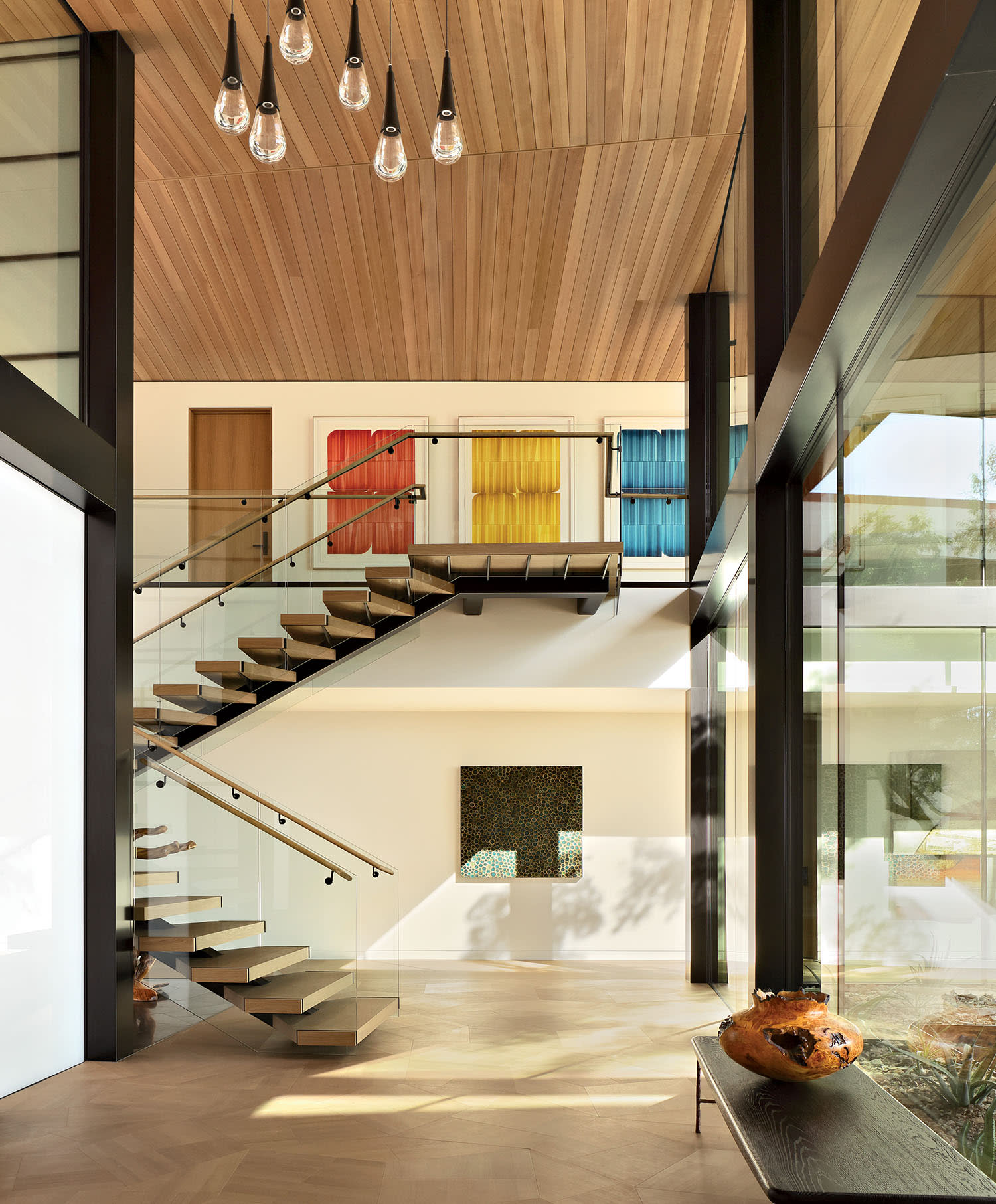
Inspired by raindrops, the entry’s Hammerton Studio chandelier from CAI Designs illuminates a custom bench by Allaire. A piece by Mayme Kranz from Lisa Sette Gallery hangs on the lower wall; the trio of works above are by designer Michael Marlowe.
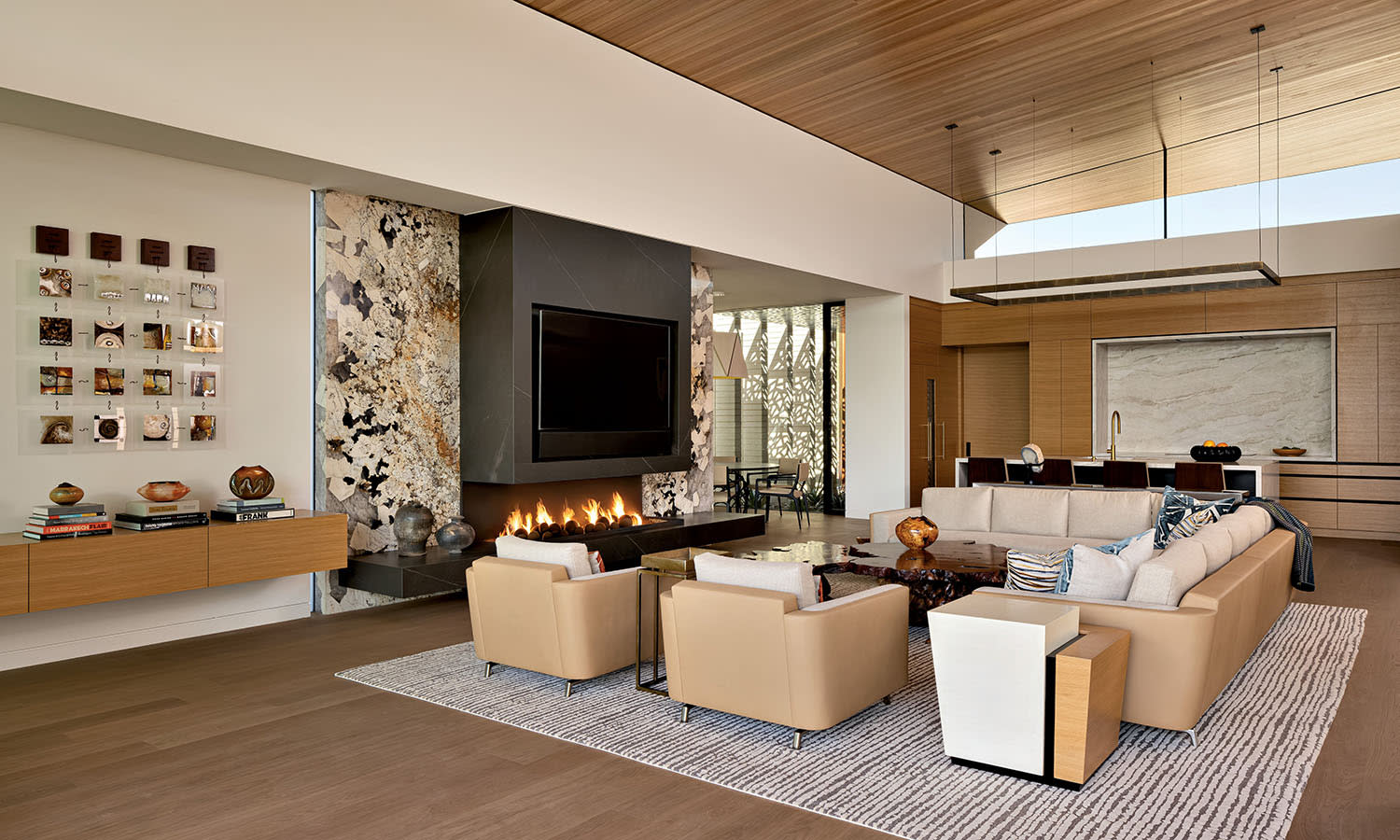
Highly detailed Patagonia quartzite backing a Neolith fireplace, both from The Stone Collection, brings the desert’s earthiness into the great room. Clerestory windows by Fleetwood Windows & Doors allow daylight to flow unfettered.
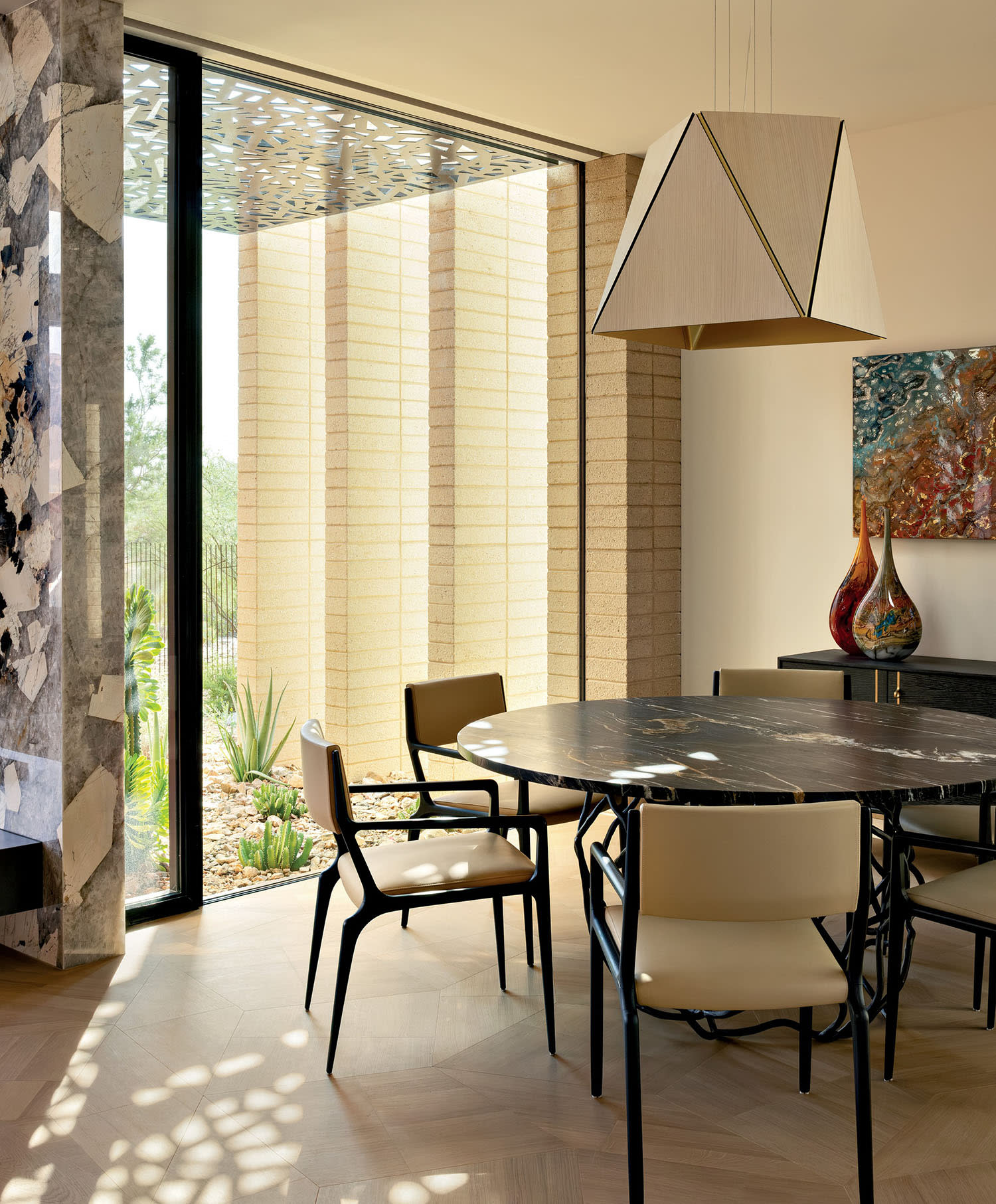
Fabricated by Old World Granite Co. with stone from The Stone Collection, the dining tabletop rests on an Allan Knight base and is circled by Holly Hunt chairs purchased at John Brooks. The Cerno pendant is made of whitewashed oak veneer.
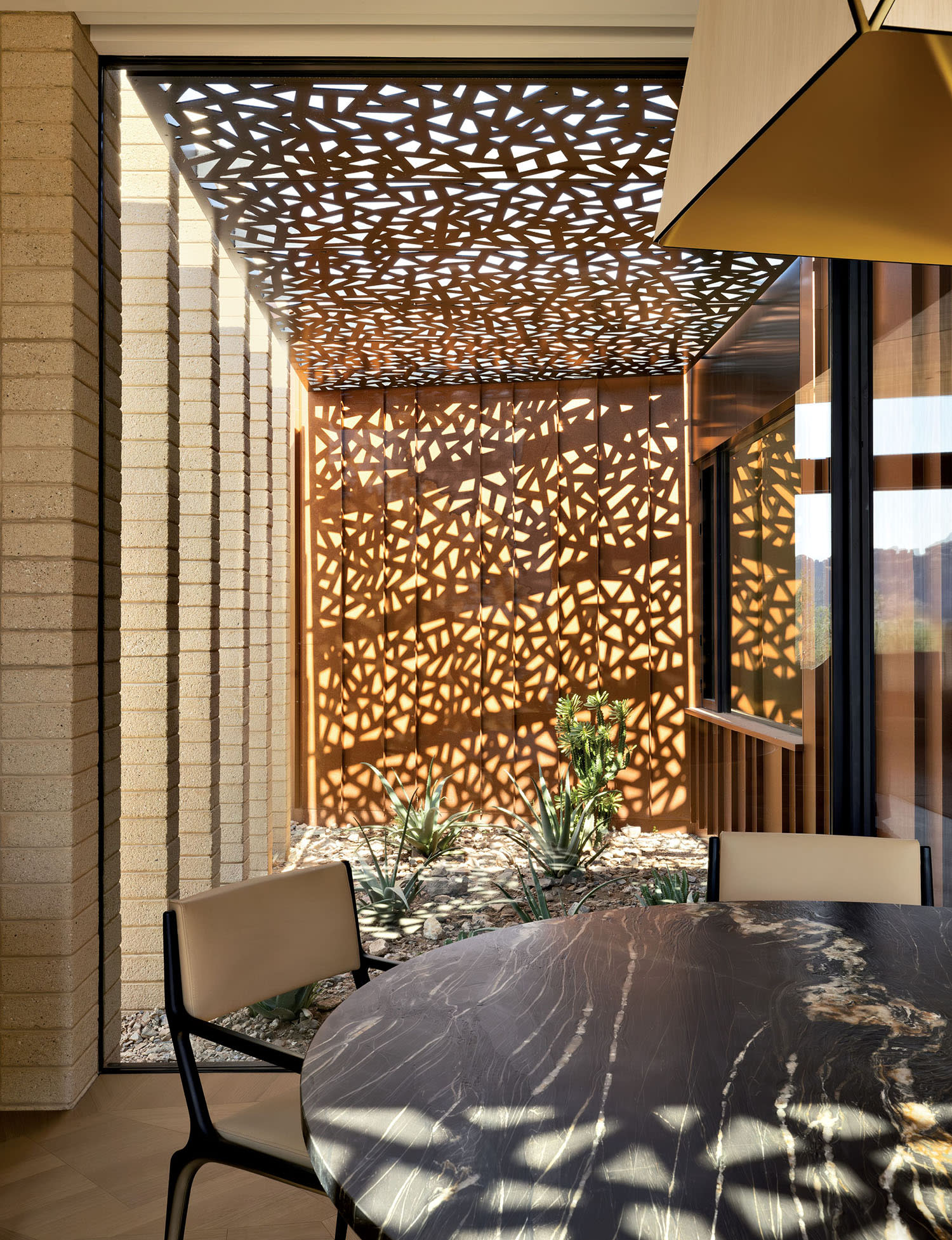
Kendle Design Collaborative created the custom aluminum exterior screen seen from the dining area. The Listone Giordano wood flooring is from The Bazaar.
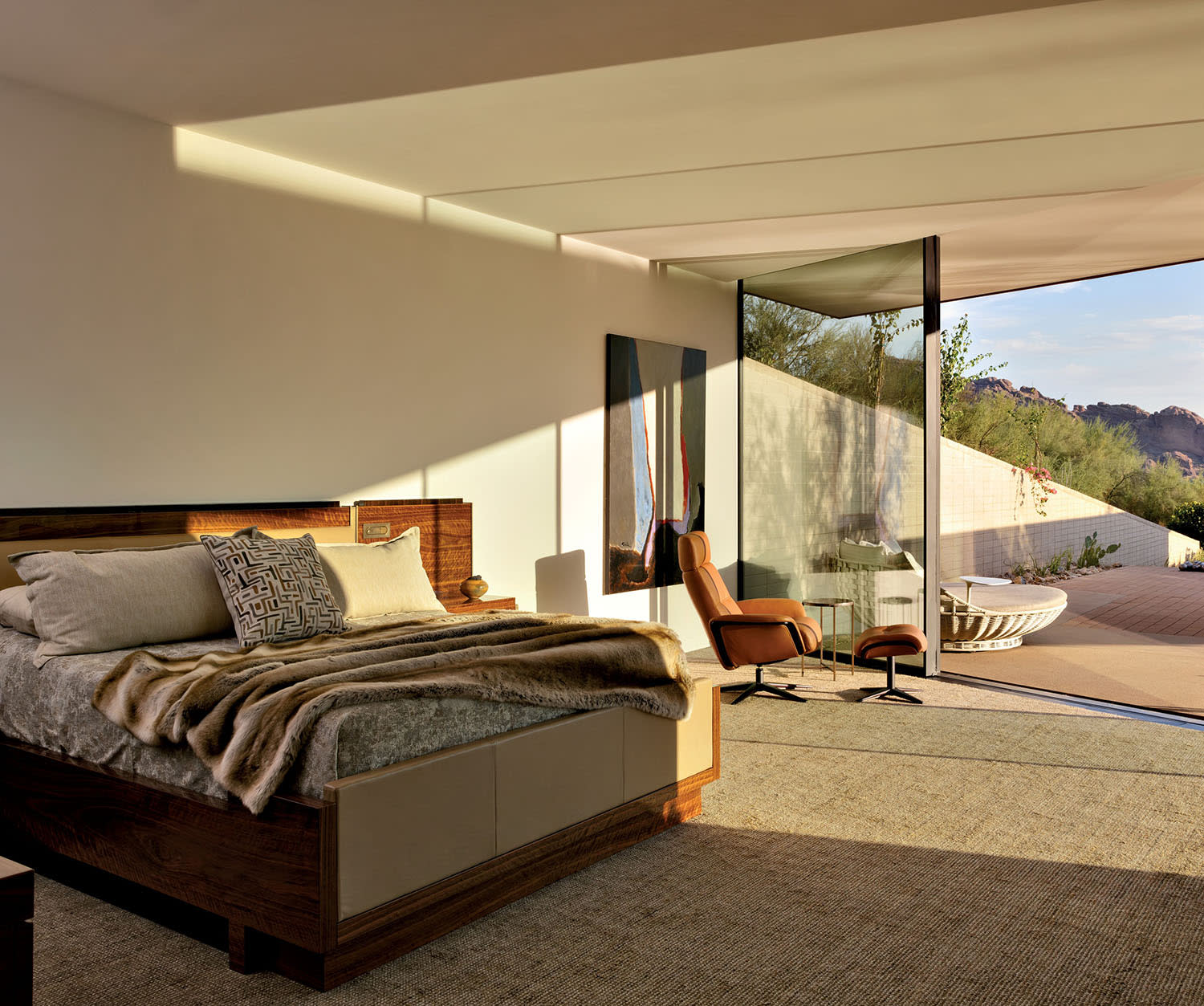
A custom bed crafted by Allaire and a swivel chair from Arizona Leather Interiors foster a serene atmosphere in the primary bedroom. The Bill Tull artwork is from Wiseman & Gale Interiors, and the wool rug is by Cavan.
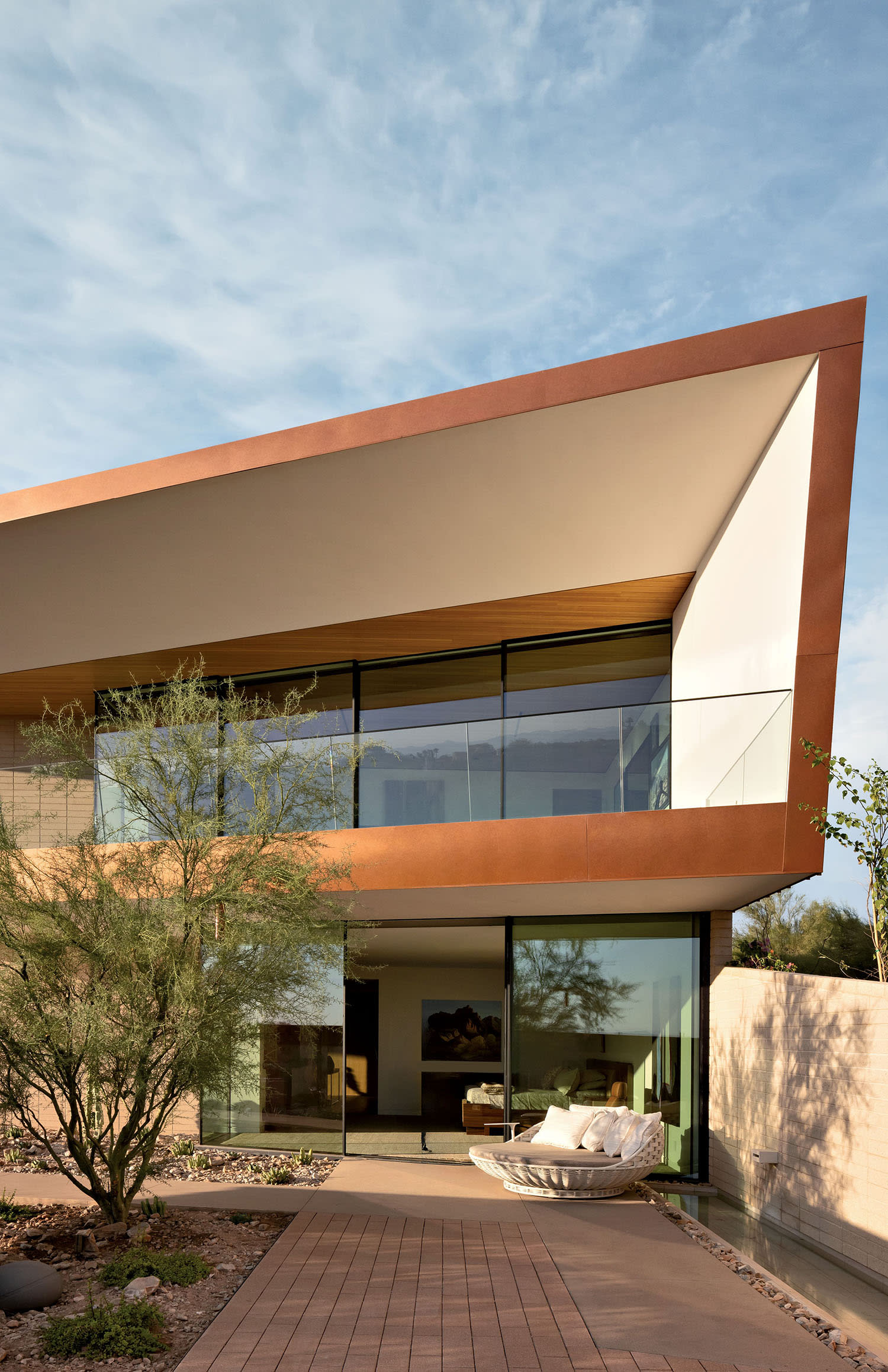
The primary bedroom opens directly onto the pool deck. There, native riprap rock from the site fills the garden beds.
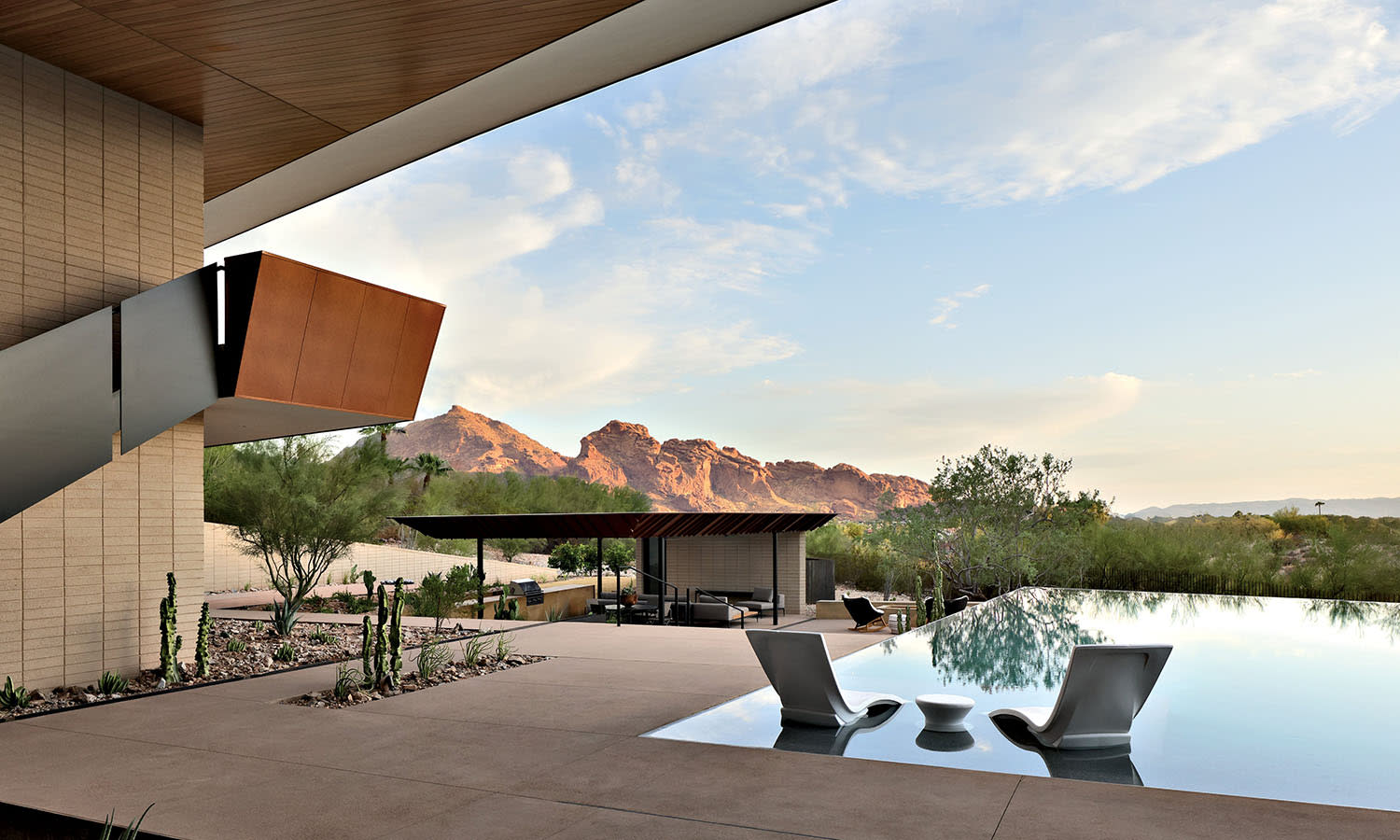
Camelback Mountain stands in the distance; the home’s rust tones echo the landmark’s granite and sandstone hues. Within the sleek garden beds, the “planting composition features totem pole cactus interplanted with lady slipper,” Shelor says.
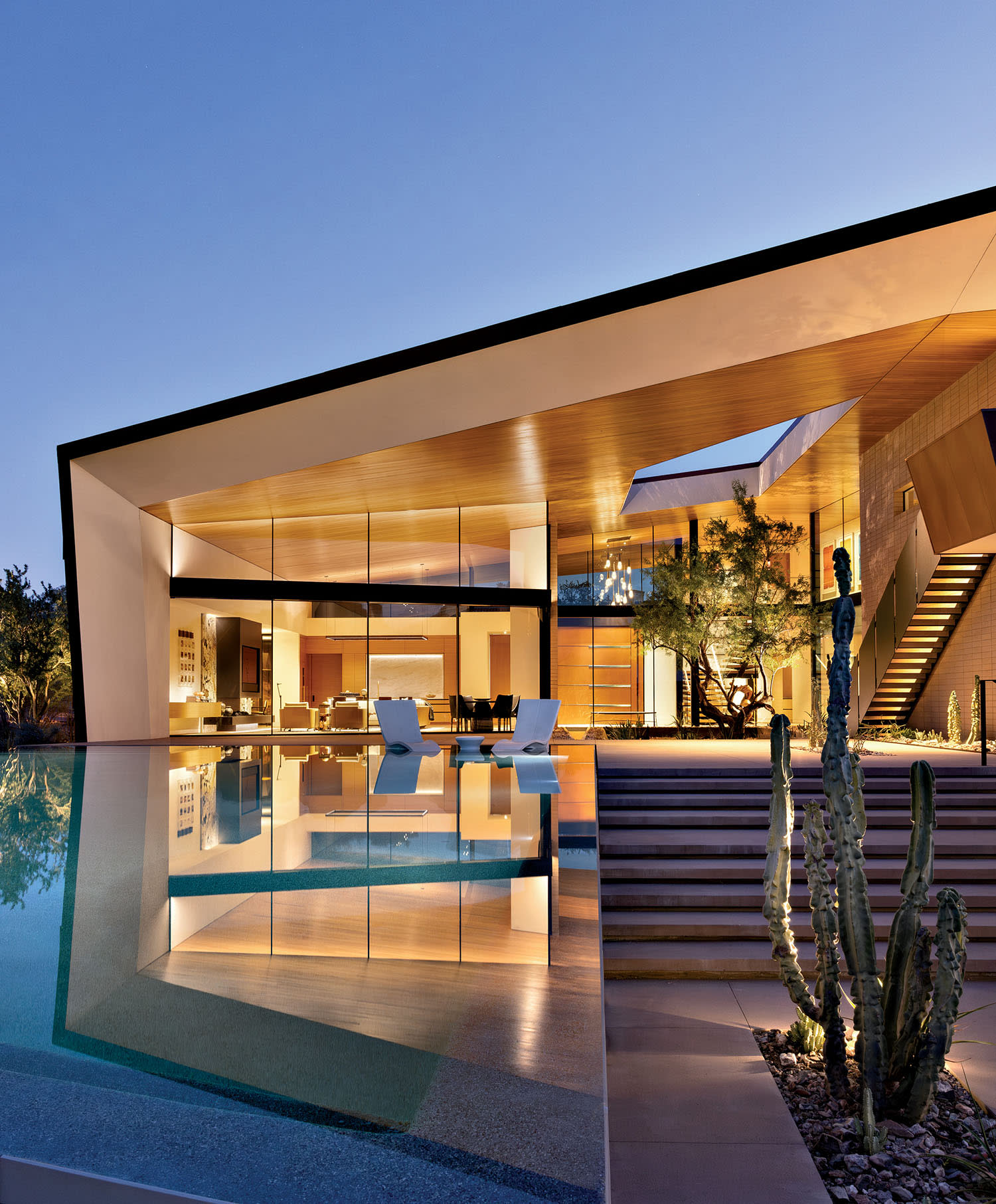
As dusk falls, the dwelling appears to glow from within, almost as if phosphorescent. Warm hemlock ceilings add to the effect.
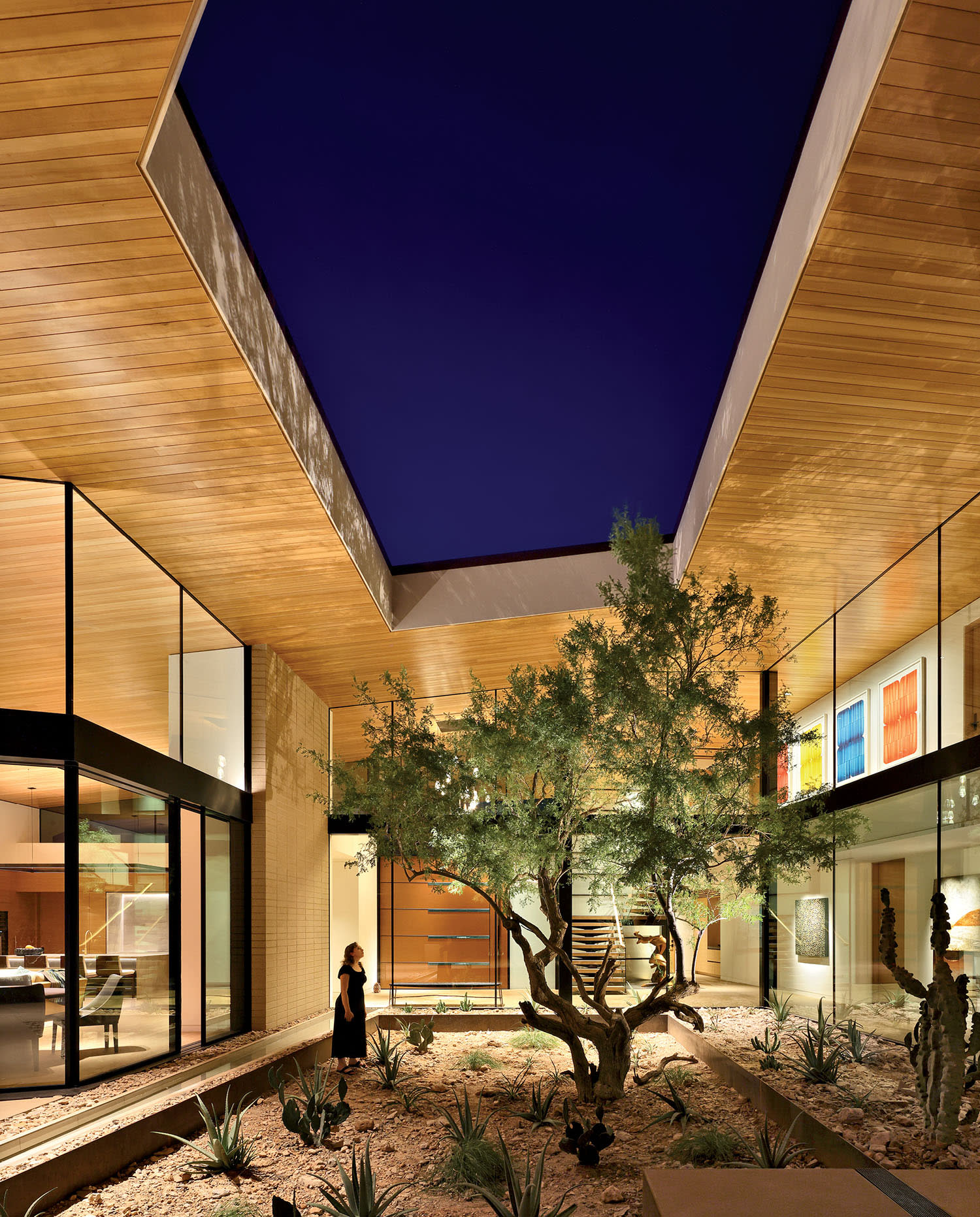
Shelor sourced mature trees for the site through Native Resources International. “The ironwood placed within the sunken garden was chosen for its ability to tolerate partial shade,” she says. “Its ancient, gnarled form lends a sense of permanence and anchors the arrival sequence.”
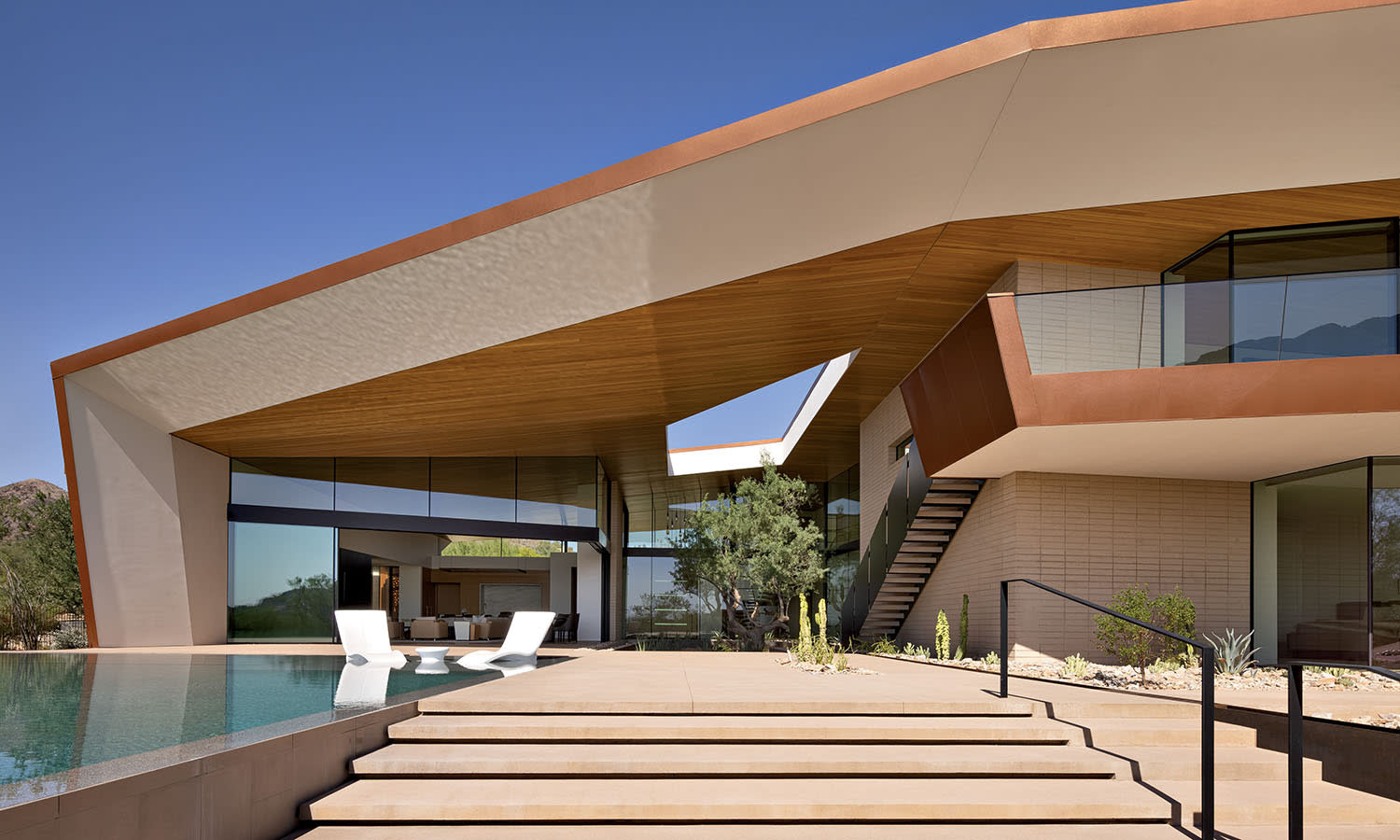
Kynar detailing on this Paradise Valley abode by architect Brent Kendle gives it a geode-like appearance. The dwelling opens wide to the property, designed by landscape architect Michele Shelor.
Interior choices also add to the sense of welcome, with upholstery in soft desert browns and snug, low-slung furniture. “For a contemporary house that has a lot of glass, steel and hard surfaces, the architecture is very inviting, livable and comfortable,” says designer Michael Marlowe, who worked on the project alongside Karen Rapp. That’s partly owed to the team’s ability to pivot. When something didn’t feel right during the furniture installation, they were quick to make a swap. “In the 11th hour we changed out the coffee table in the great room to two very organic cypress tables,” Marlowe recalls. Their original choice was far more streamlined, but “as soon as we started installing, Karen and I both realized we needed something a little bit more organic and dynamic; pieces that reflected the outdoors.”
Adding architectural interest to the grounds by landscape architect Michele Shelor, Kendle designed aluminum screens with abstract laser-cut patterns that protect certain exterior spaces. The screens behave like sculptural veils, producing dappled shadows where used. “The greatest resource we have here is sunshine,” Kendle says, noting that because the light changes throughout the day and year, “it helps animate the home inside and out.”
Light itself becomes architecture in one of the residence’s defining gestures: an angular cutout that illuminates an atrium-like garden centered on a nearly 200-year-old ironwood tree. “It creates this little magic garden in the middle that all the other rooms circulate around,” he says. “It’s kind of like having a little pocket park in your house. And, if you just turn your head to look out to the view, you can see 30 miles across the valley.” The result is a home that feels primal and futuristic at the same time, shaping and reshaping the experience of nature season by season, hour by hour.
A custom bed crafted by Allaire and a swivel chair from Arizona Leather Interiors foster a serene atmosphere in the primary bedroom. The Bill Tull artwork is from Wiseman & Gale Interiors, and the wool rug is by Cavan.