When they found a beautiful Postmodern home in Dallas’ Janmar neighborhood, owners Colbie and Ches Campbell quickly fell in love. The 1980s abode, originally envisioned by renowned late designer Charles Daboub, boasted architectural gems such as a conservatory-style bay window, a curved double-sided fireplace and soaring ceilings. However, it strayed slightly from the clients’ stylistic wheelhouse, having previously lived in and renovated a 1930s Tudor, a 1940s Postwar house and a midcentury ranch. In a moment of serendipity, the wife came across an image of a Postmodern living room by interior designer Jen Talbot, whom she had followed on social media for years. Talbot’s elevated approach struck a chord with the Campbells.
“Postmodern architecture felt unfamiliar to us,” Colbie admits, “but as children of the ’80s, it also ignited a sense of nostalgia for ‘home’ even though it looked nothing like the houses of our childhoods.” Leveraging that sentimentality and the late-20th-century style of the residence, Talbot leaned into organic shapes and clean lines to create custom appointments. In the kitchen, she swapped a boxy laminate range hood and angular Formica-topped island for alternatives fabricated from natural materials like white oak and quartzite. The adjacent breakfast alcove, defined by its curved-eave solarium window, holds a vintage tessellated terrazzo table base with a top milled from natural ash. Flanking it is an L-shaped banquette, whose slender-bolster back creates a sense of coziness without impeding the light-filled, ethereal quality of the space.
In another ode to the home’s original glass features, the designer conceived a curvilinear banquette to sweep across a wall of windows in the sunny reading nook. Placed beneath an original glass-block clerestory, the rectangular parameters are a departure from the adjacent living room, which abounds in round silhouettes that create a sense of buoyancy. “It’s an expansive space, and we wanted to strike the right balance with the home’s late-modernist roots,” Talbot explains. While she dipped her toe in with a restrained approach—seen in some cleaner modern profiles that offset the abode’s 1980s geometry—she discovered the clients wanted to go bolder, leaning deeper into that Postmodern spirit. “The process became one of trust and true collaboration,” Talbot shares, “resulting in a residence that feels highly curated, personal and deeply memorable.”
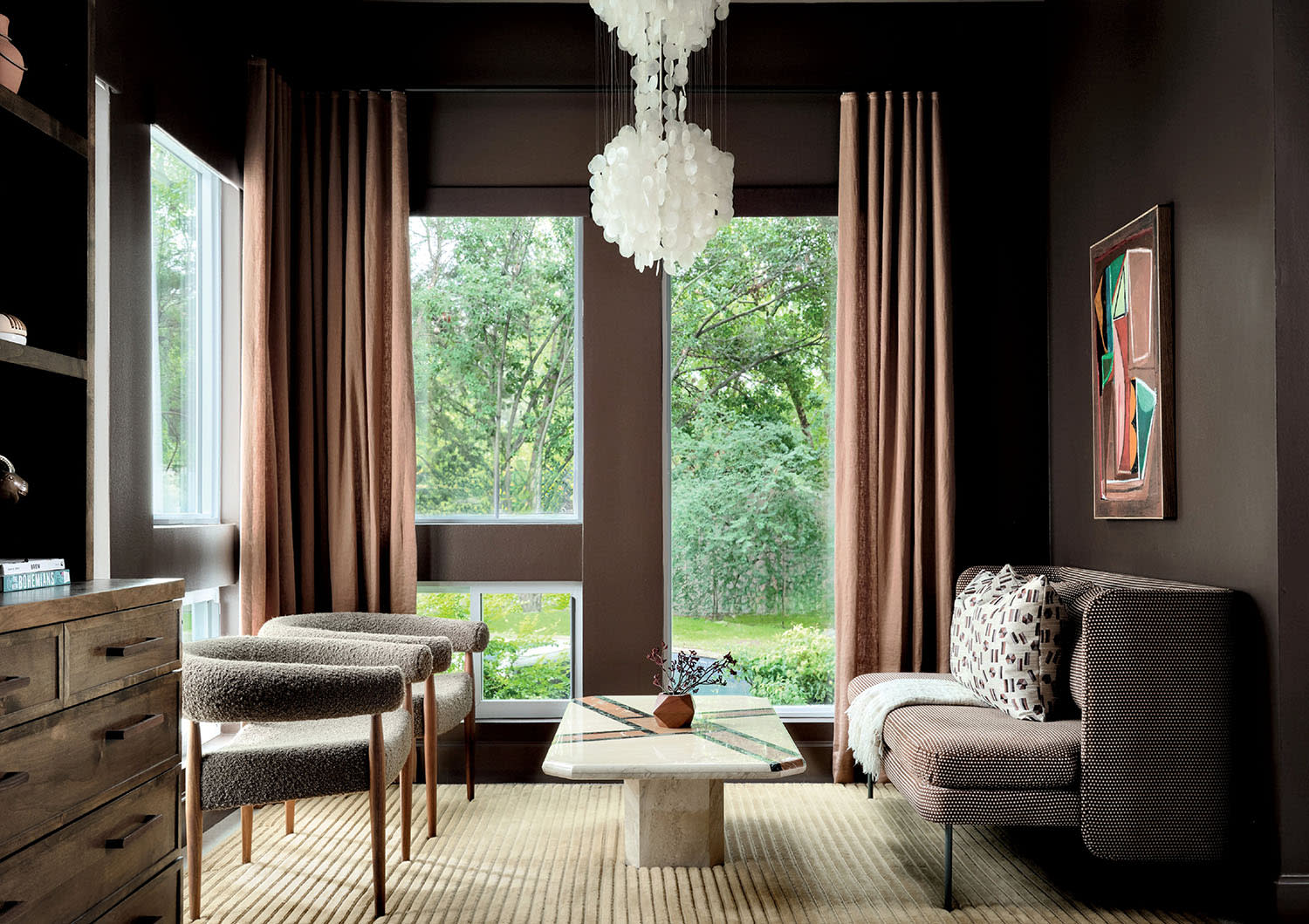
A 1960s mother-of-pearl petal chandelier lends glitz to the primary bedroom’s seating area, further adorned by a Robert Langley painting. The loveseat and chairs were reupholstered in rich Opuzen fabrics.
Further pushing the needle, she relied heavily on custom and vintage selections sourced from dealers across the U.S. and Europe. Iconic 1980s pieces in the dining room—including a bubble dresser designed by Karl Springer and steel accent chair by Swiss architect Mario Botta—serve as functional art that underscore the tension between sculpture and utility. In the living room, Talbot reimagined and reupholstered unique finds, like oversize armchairs with rolled-volume silhouettes and an arched-back sofa. The latter, formerly dressed in a dated pink-and-gray brushstroke motif, was outfitted in a chic and creamy bouclé, while the chairs wear a more subtle woven fabric in soft white. The reserved, neutral palette balances the exaggerated profiles of the furniture and the bold architectural details, imbuing the main living areas with an effortlessly luxurious ambience.
As for the primary bedroom and bathroom, Talbot leaned into the drama and glamour of the era, steeping each in romance with tones of aubergine, mauve, chocolate and crimson. “These rooms are rich, moody and layered with quiet sophistication, evoking the unhurried comfort of a Sunday morning,” she says. Behind the woven checkerboard headboard, she introduced a cinema-worthy signature wall finished in a Belgian wallcovering made from natural cork with a metallic detailing, all illuminated by capsule-shaped sconces from Spain. In the adjacent bathroom, natural stone surfaces mingle with rustic terra cotta and crackled porcelain for a visual feast of color and texture. These spaces highlight the home’s architectural roots while reinventing it for a new century.
“We love that the design is quirky but void of the ’80s kitsch and cliches that came out of our generation,” Colbie reflects. “Jen managed to capture a perspective of the Postmodern vibe that looks new and unique and feels right for our contemporary lifestyle.”
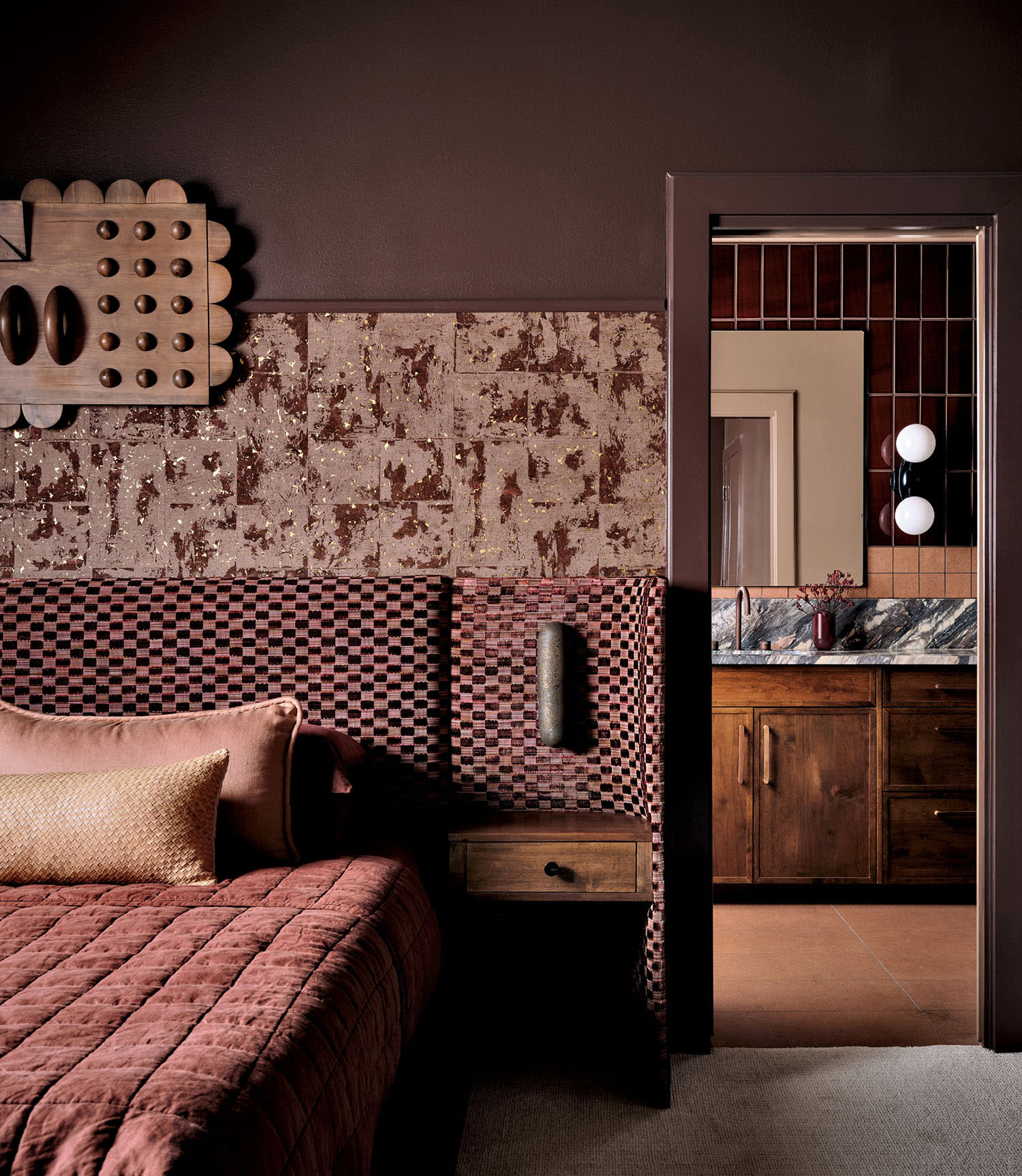
In keeping with the feel of a luxury hotel, the couple’s bed is clad in a Pierre Frey épinglé velvet, backdropped by Arte’s Les Forêts Éclat wallcovering and illuminated by a Lisa Allegra wall lamp. Wood-cut art from Meso Goods adds to the feast of color, pattern and texture.
Tour The Home:
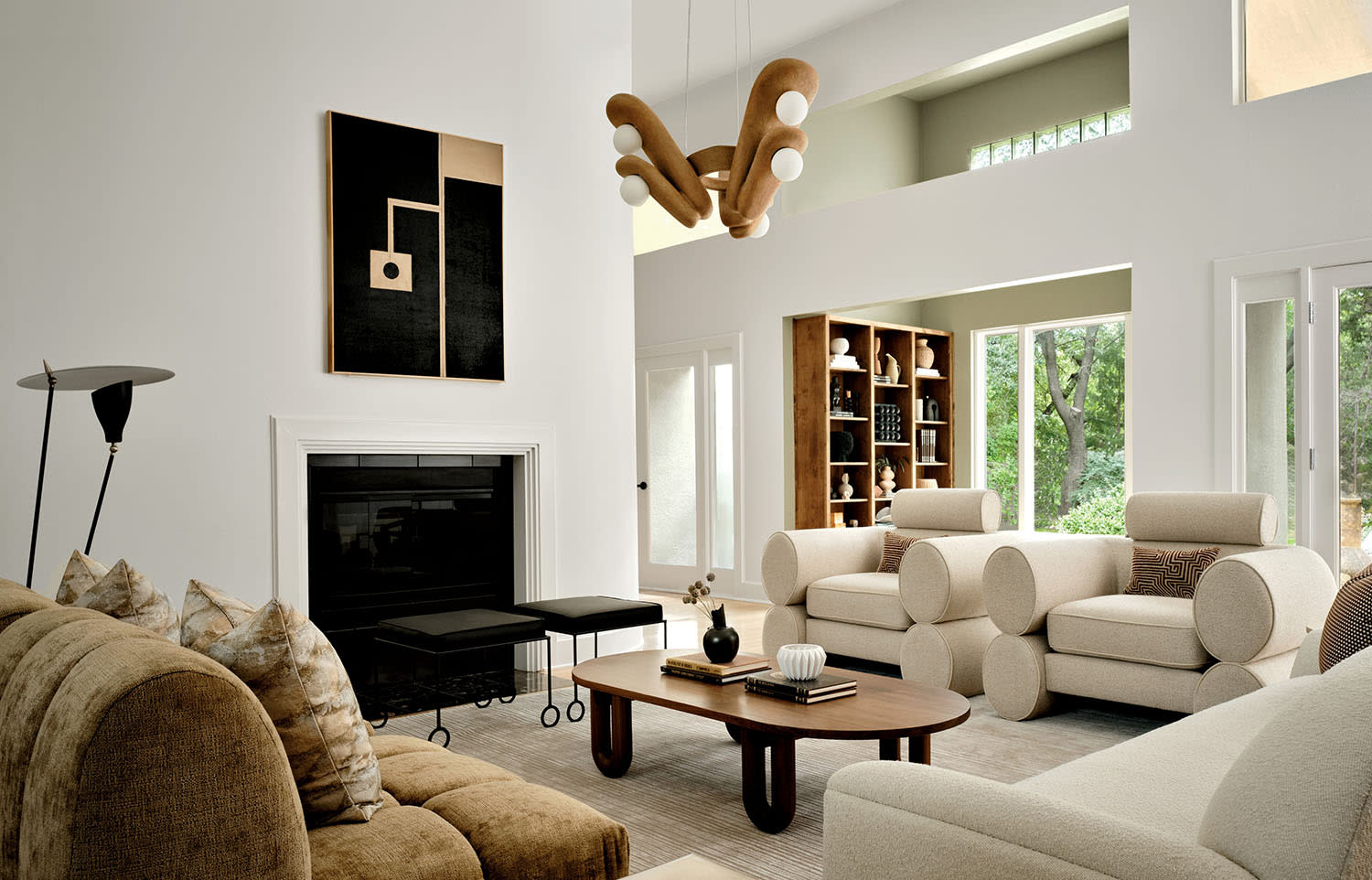
Round Martin Brattrud armchairs face Vintage on Point’s Tetris modular seating and a Warm Nordic floor lamp upon a handwoven rug from Jaipur Living.
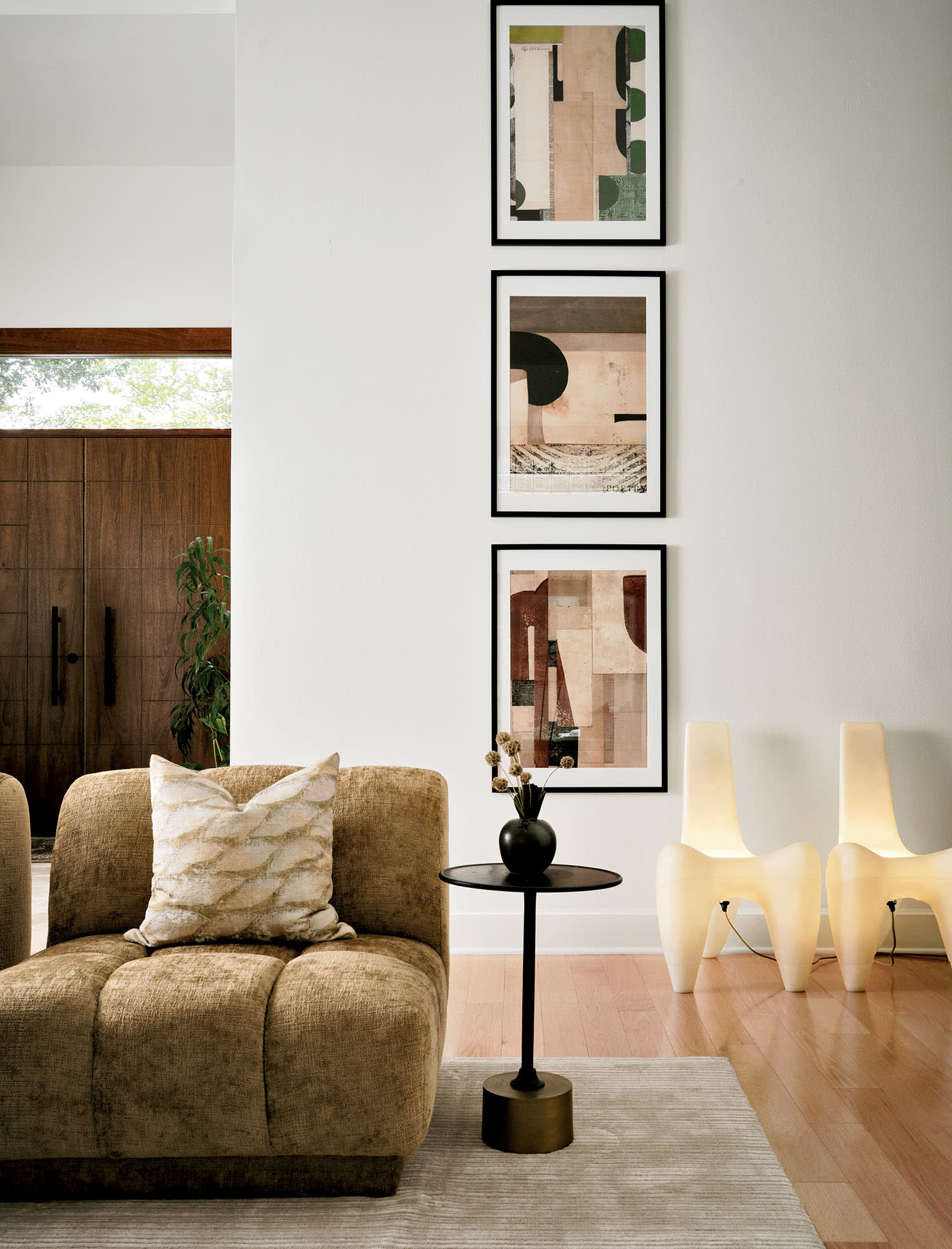
Abstract works by Sarah Z. Short accompany a pair of electrified fiberglass chairs by Douglas Mont in the living room.

Poised atop the dining room’s Jaipur Living rug, vintage seating from Chairish surrounds a custom table with a Lámina Mayor pendant from TRNK overhead. Beyond, 1980s pieces include an armchair by Mario Botta for Alias and a Karl Springer dresser.
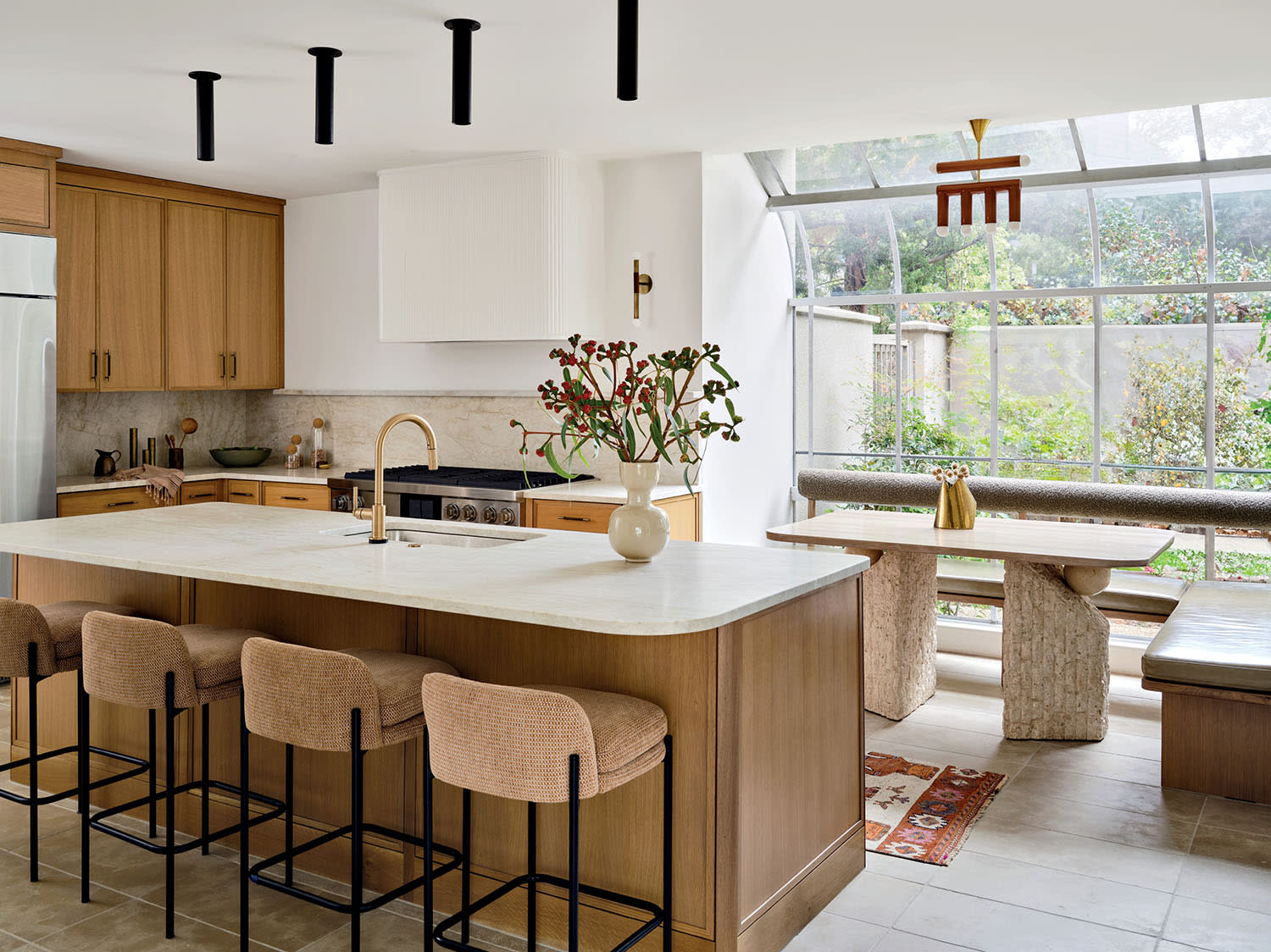
Black canned Lodes lights subtly delineate the kitchen island, which hosts a Brizo faucet and Wovenbyrd stools. At the conservatory-style window, the table’s custom ash top rests on a vintage ’80s base while a Pani Jurek TRN pendant suspends above.
A 1960s mother-of-pearl petal chandelier lends glitz to the primary bedroom’s seating area, further adorned by a Robert Langley painting. The loveseat and chairs were reupholstered in rich Opuzen fabrics.
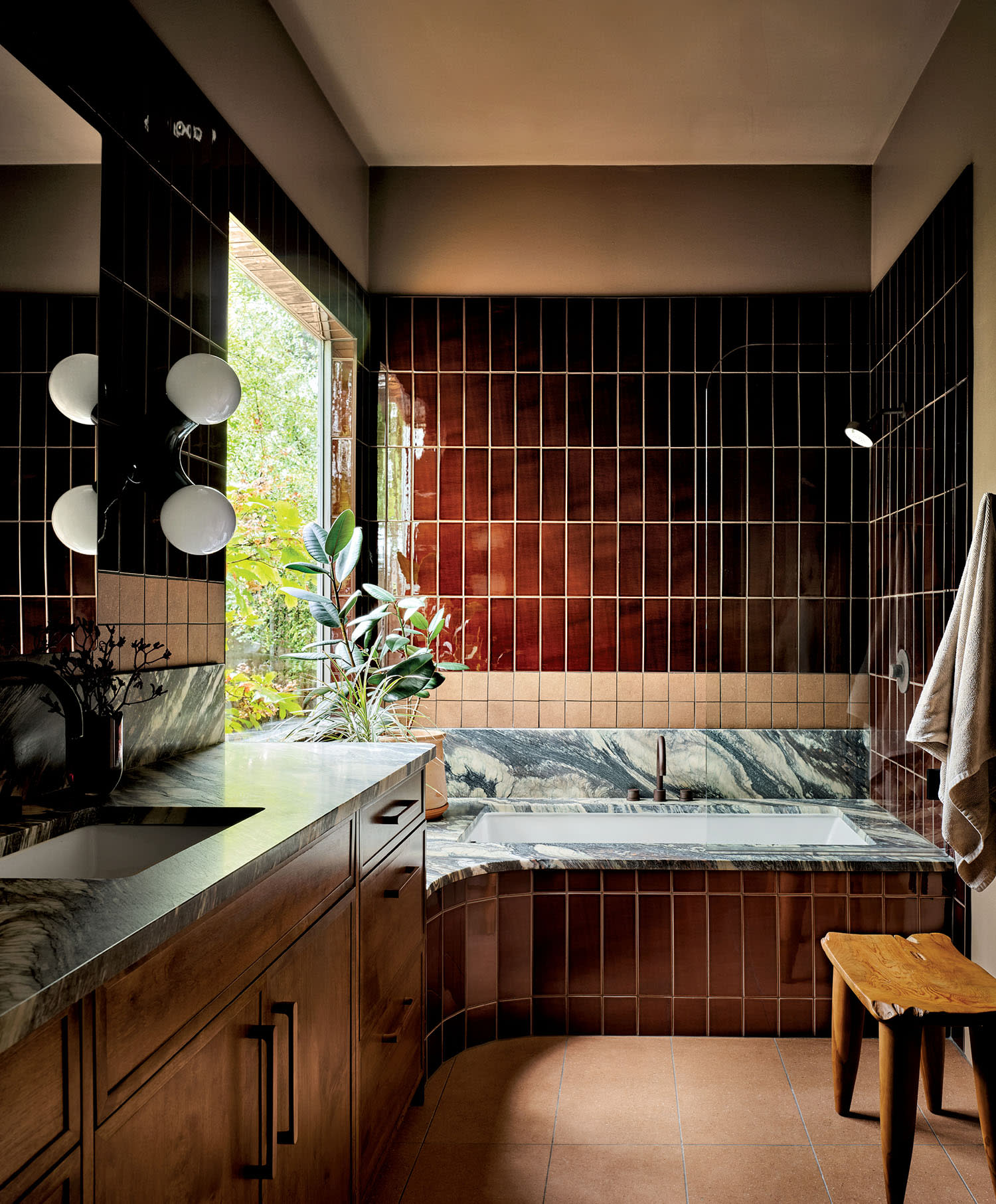
The primary bathroom was updated with garnet-hued Virginia Tile, grained rust-matte porcelain and dramatic stone. The sconce is by A-N-D, and the Phylrich faucets were sourced from Studio41.
In keeping with the feel of a luxury hotel, the couple’s bed is clad in a Pierre Frey épinglé velvet, backdropped by Arte’s Les Forêts Éclat wallcovering and illuminated by a Lisa Allegra wall lamp. Wood-cut art from Meso Goods adds to the feast of color, pattern and texture.