Malibu is considered a celebrity hideout today, associated with a luxurious yet laid-back style of coastal glamour—but this oceanfront community also has a rich history as an artists’ outpost. Such is the backstory of this distinctive dwelling in a remote enclave north of Point Dume. Originally a studio-residence constructed in the 1970s by a father and son who were both artists and amateur builders, it was composed of idiosyncratic sloped and flat-roofed intersecting volumes. The structure’s underlying creativity was evident and some of the right pieces were there, recalls architect Christopher Kempel of his first impression, “but it wasn’t a cohesive, sensible, well-flowing piece of architecture.” However, as his client had purchased the property from the family who’d conceived it and liked its handcrafted origins, it was important to her to work with what was already there. “I also loved the location, which is just spectacular,” she shares, pointing out a quiet lane that leads to the beach, the tree-laden backyard, the Meyer lemon trees planted by the original owners (that she made a point to preserve). “But I wanted something that was me, that had femininity but was also contemporary.”
Home Details
Architecture:
Christopher Kempel, Kempel Architects
Interior Design:
Alana Homesley, Alana Homesley Interior Design
Home Builder:
Joel Fischer, Fischer Construction, Inc.
Landscape Architecture:
Mia Lehrer, Studio-MLA
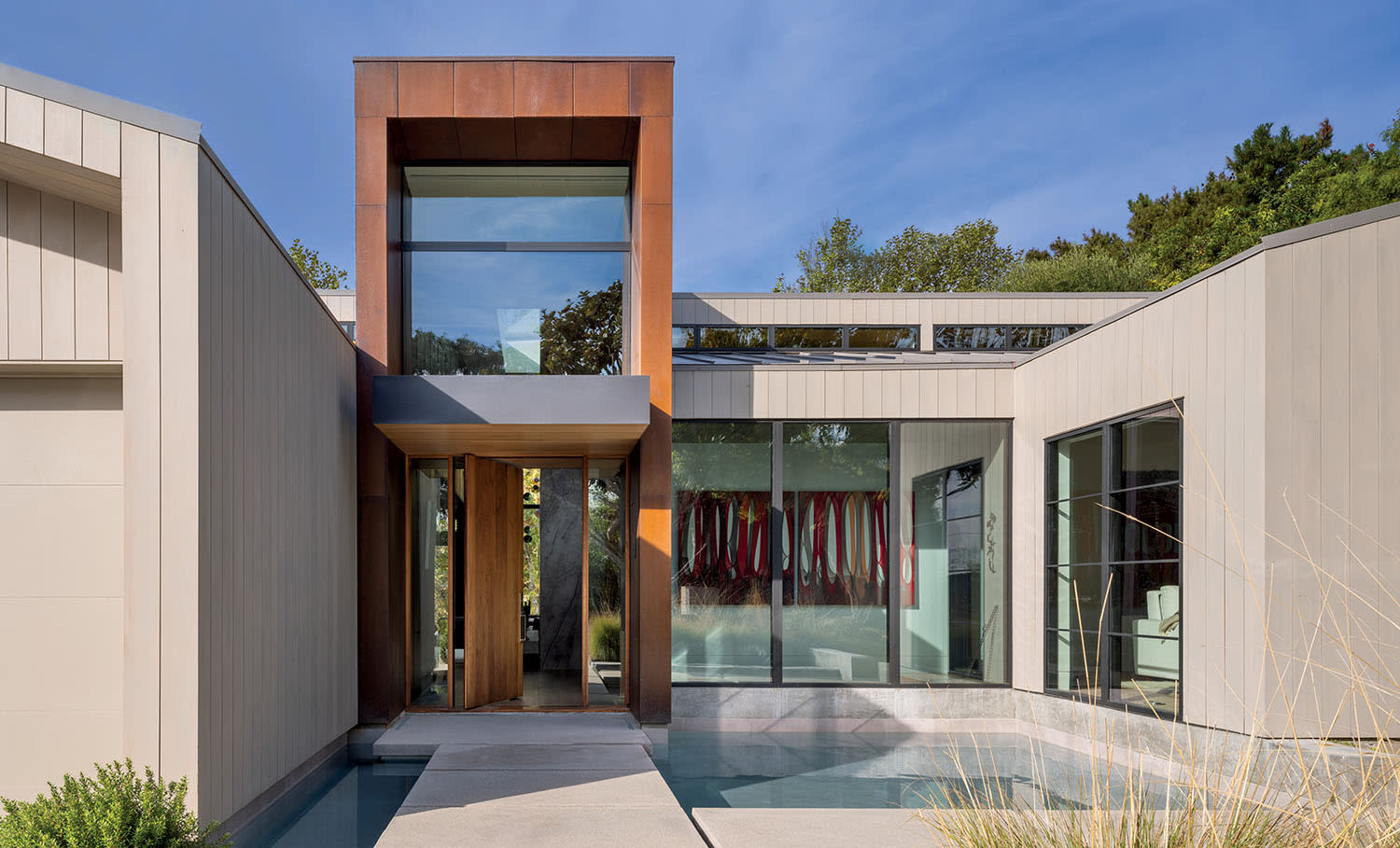
Concrete pads cross a reflecting pond to reach a double-height entry pavilion composed of corten steel paneling and glass by Kolbe Windows & Doors, with a walnut pivot door. Cedar siding in a driftwood-inspired gray references the coastal setting.
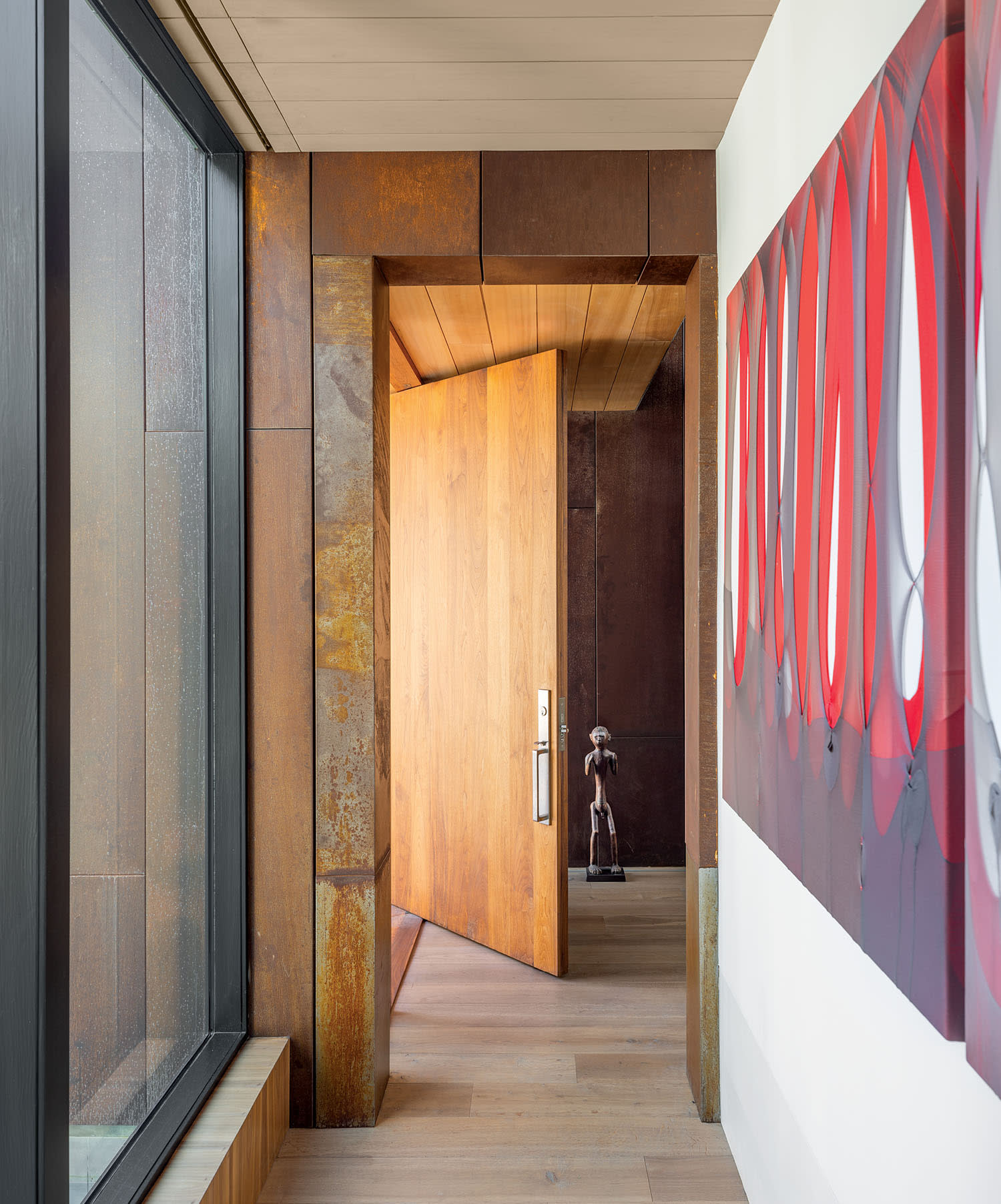
The exterior’s corten steel panels are drawn inside at the entry, meeting a foundation of white oak flooring from Northern Wide Plank and cedar siding on the ceiling. Works by Turiya Magadlela adorn the hall; the sculpture is a maternity figure from Mali.
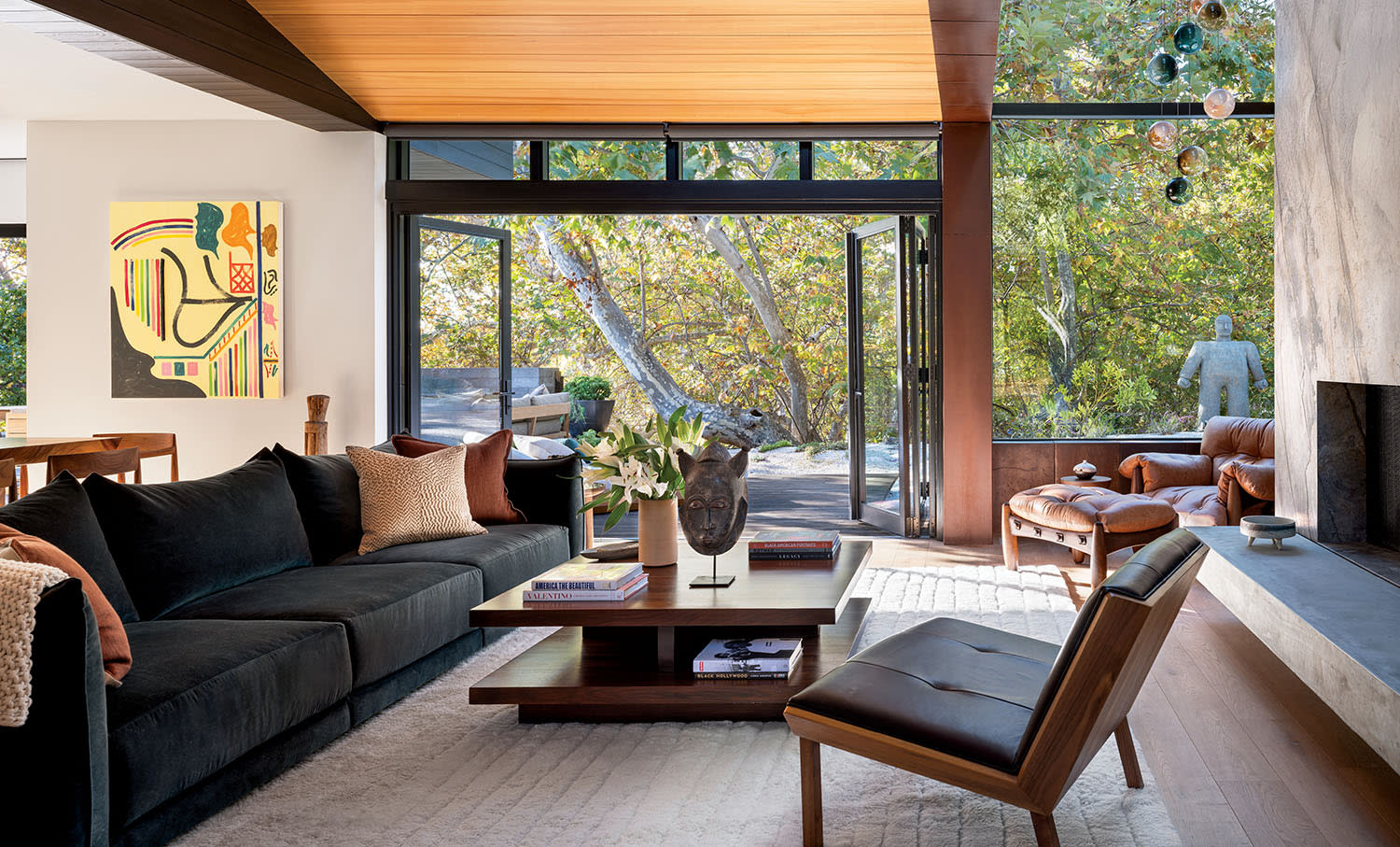
In the living area, a rug by The Rug Company grounds a Maiden Home sectional, a Mr and Mrs White chair, a Sergio Rodrigues armchair and ottoman, and an Aêtava coffee table before a hearth of Jurassic Grey marble. The painting is by Jason Stopa. A Stanley Edmondson sculpture rests outside.
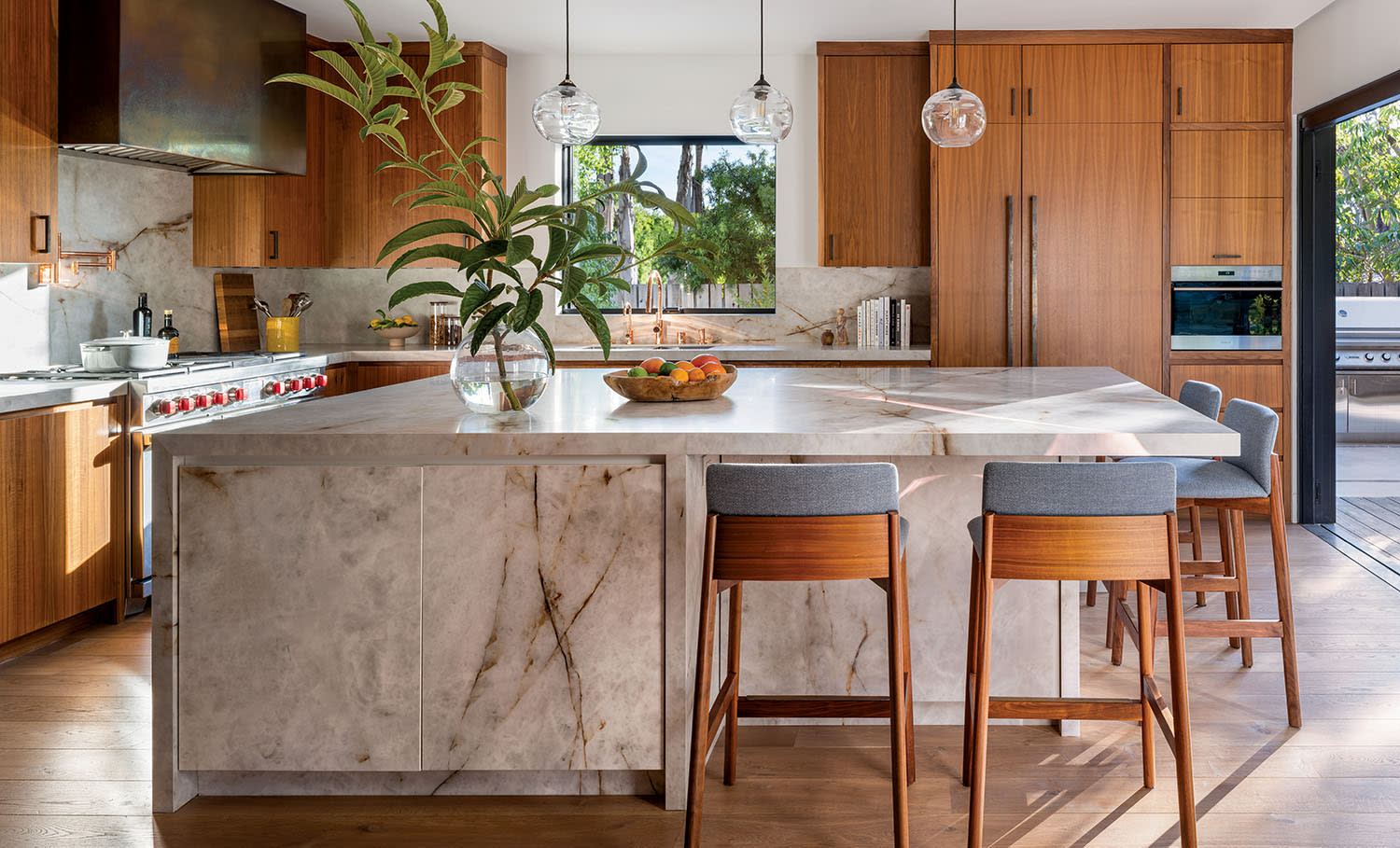
An island clad in Himalaya Crystal from Neolith contrasts with rift-sawn walnut cabinetry and a darkened-brass hood in the kitchen. The counter stools are by Design Within Reach, the pendants are Hennepin Made and the range is Wolf.
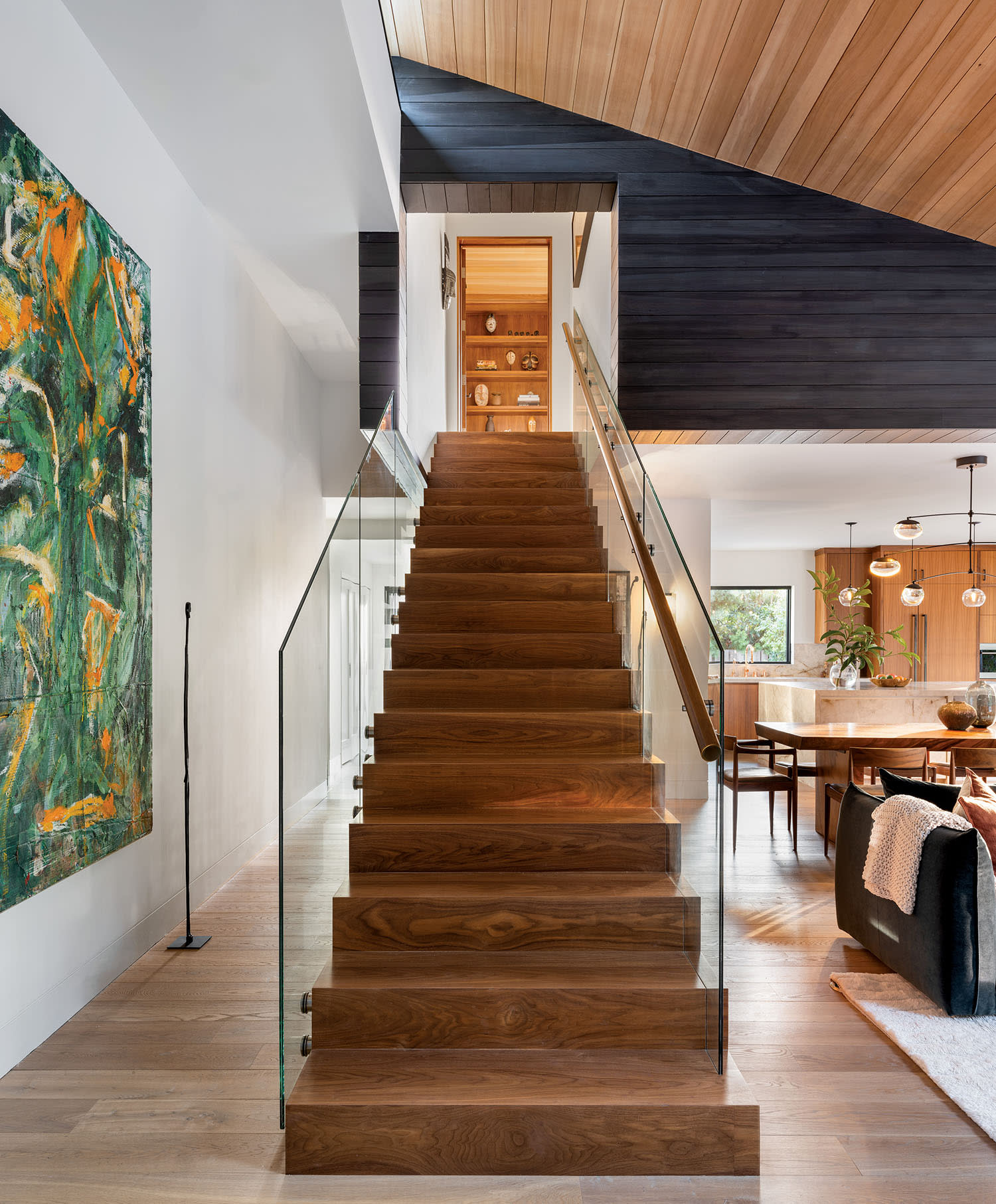
Envisioned as a sculptural feature, a floating staircase of walnut and glass leads to the primary bedroom. Black-stained cedar paneling highlights the architecture. Work by Spencer Russell Lewis and a ceremonial stick wood figure from Tanzania lie at the stairwell base.
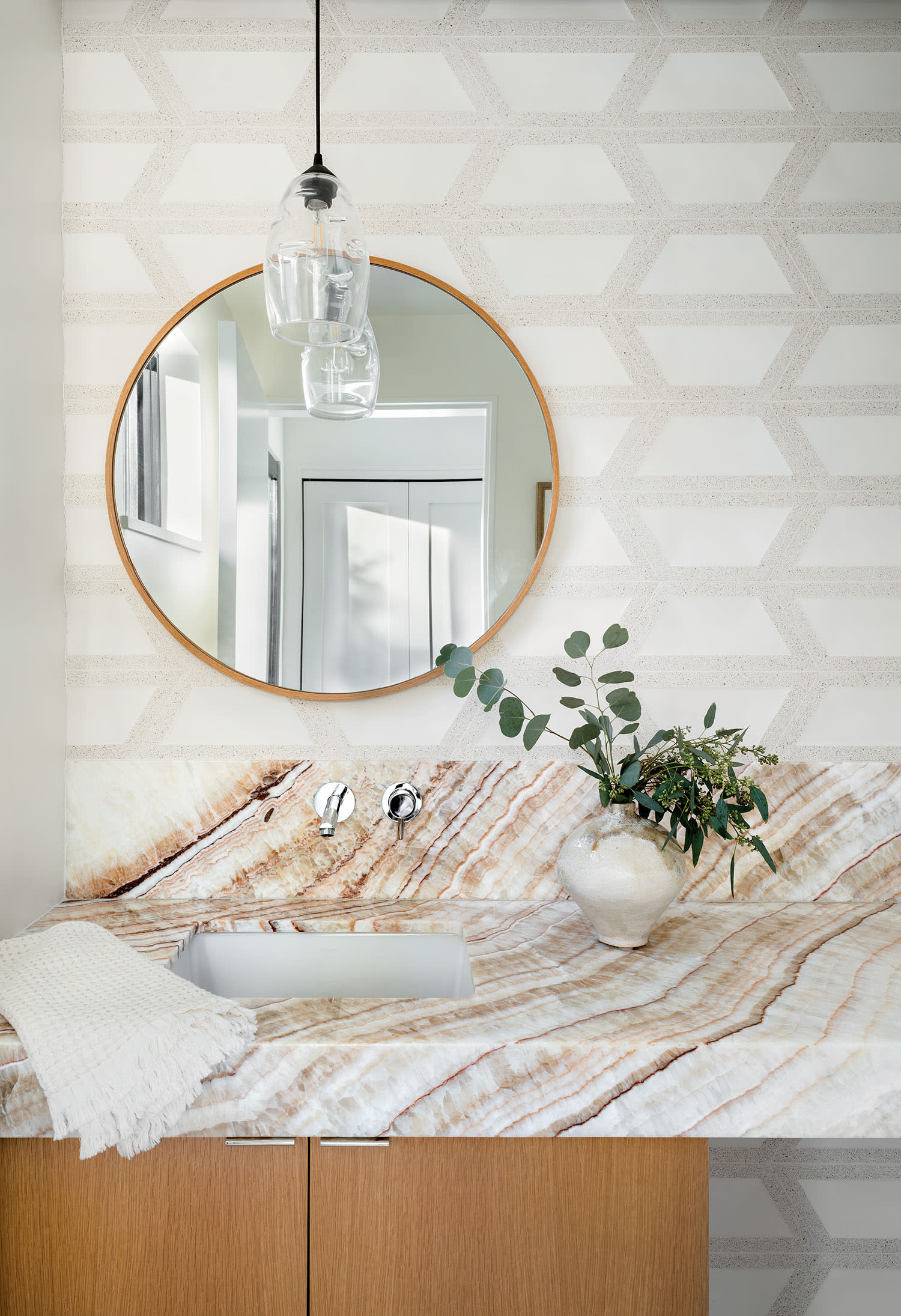
Geometric tile by Andy Fleishman, via Ann Sacks, meets a vanity of Onyx Brioche marble and rift-sawn white oak in the guest bathroom. A Hennepin Made pendant and Crate & Barrel mirror finish the space.
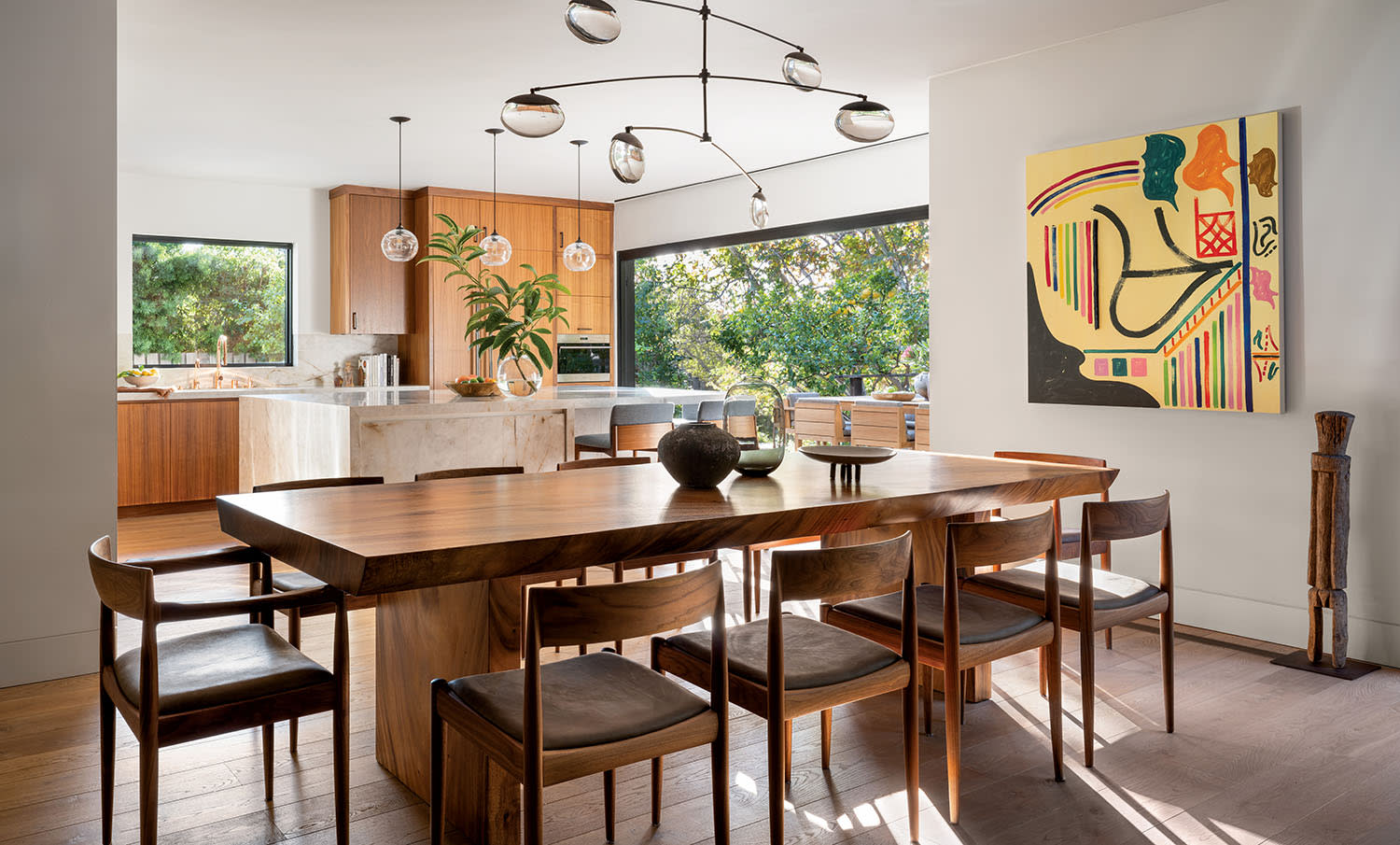
Centrally placed in the open living space, a dining area is defined by an acacia wood table by Flowbkk Inc and Miyazaki Chair Factory chairs, topped by an Ochre chandelier. A wooden sculpture from Cameroon stands at attention nearby.
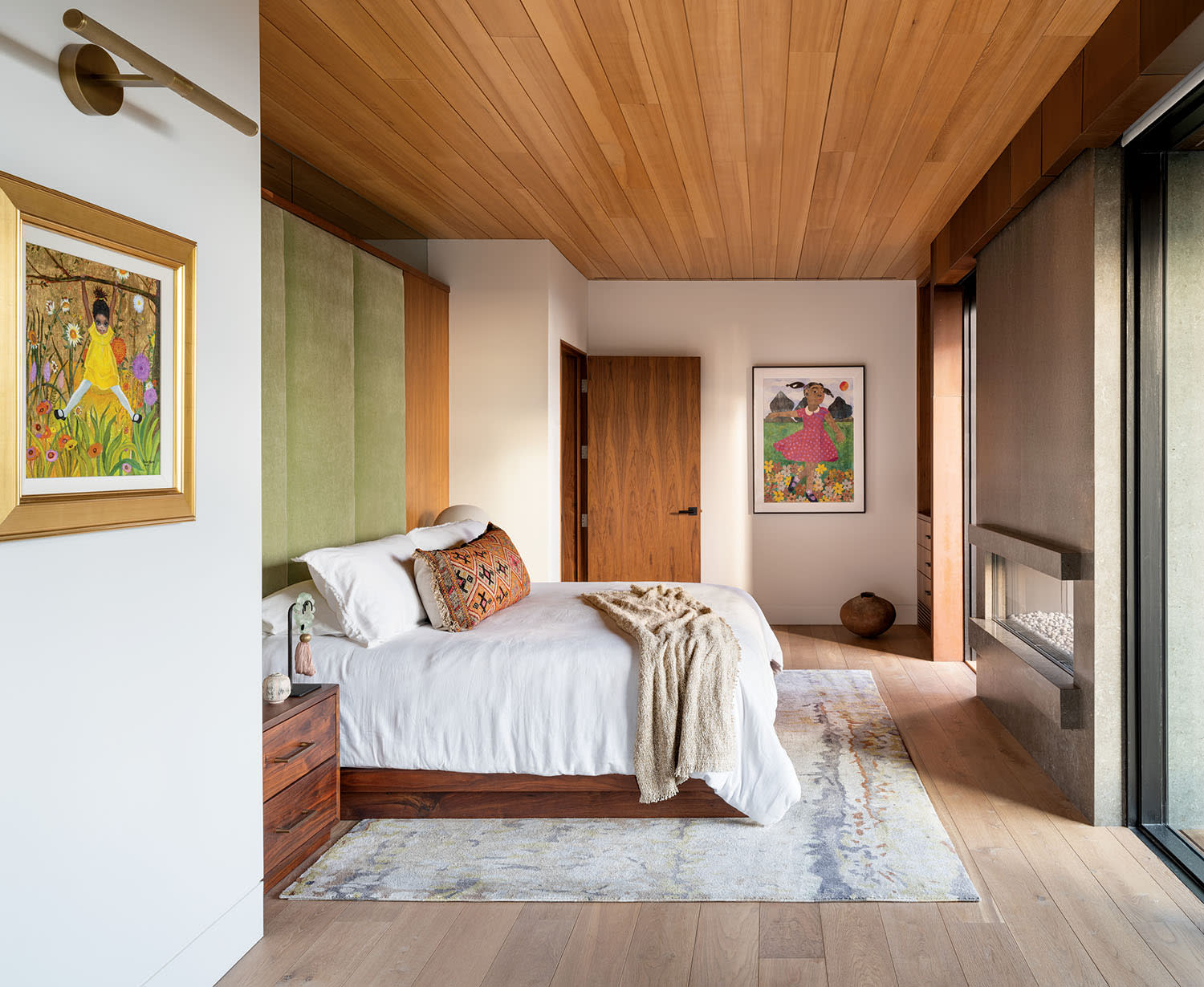
Upholstered panels of a celadon Pindler fabric surround a custom walnut platform bed and nightstands that face a two-sided fireplace of London Blue limestone in the upstairs primary bedroom. Artwork on the far wall is by Evita Tezeno, the other is by Margaret Keane.
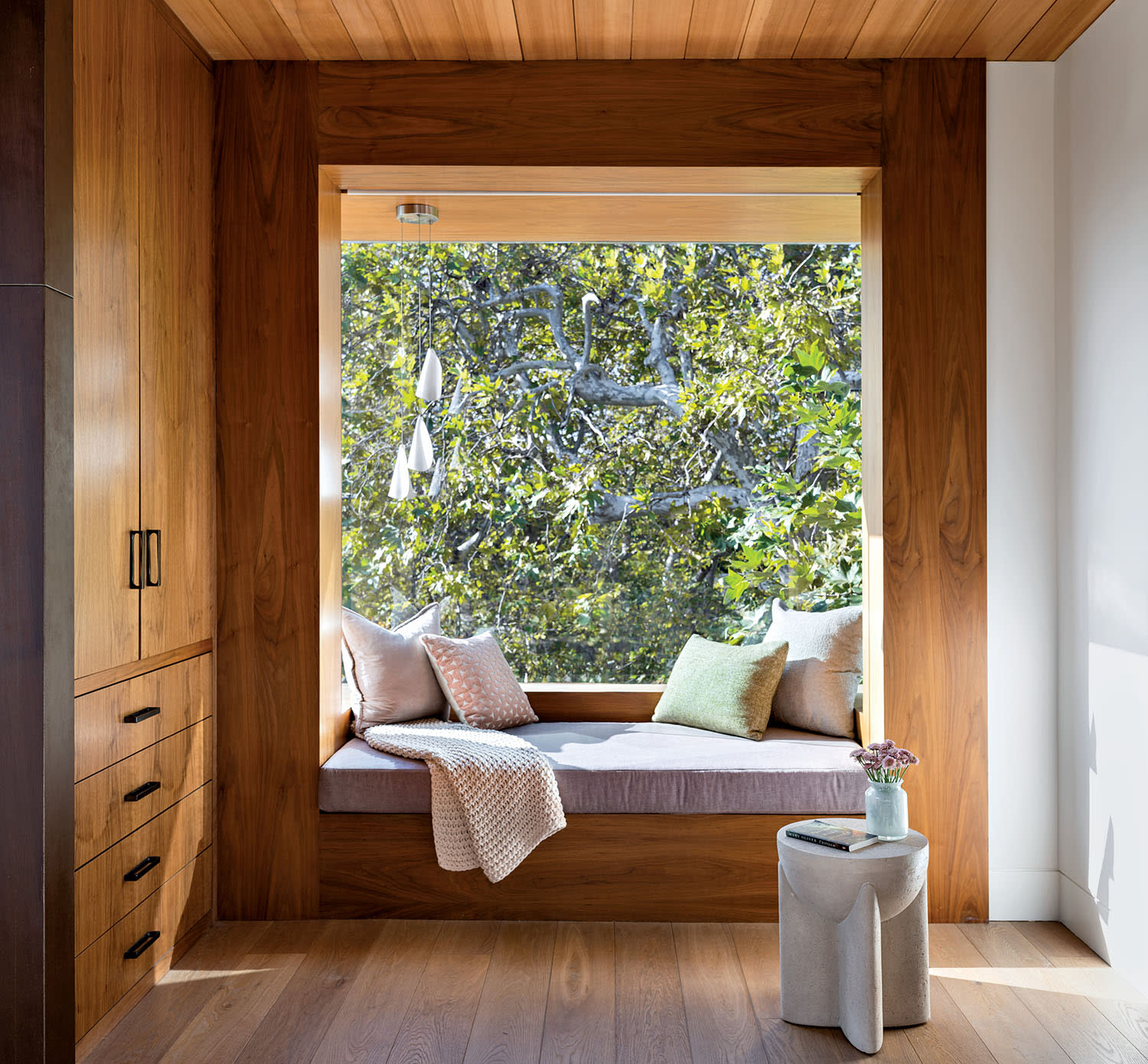
Suspended among the treetops, a walnut-framed reading nook in the owner’s bedroom is a tranquil retreat. The cushion is upholstered in a Castel textile and a Bocci pendant adds lighting.
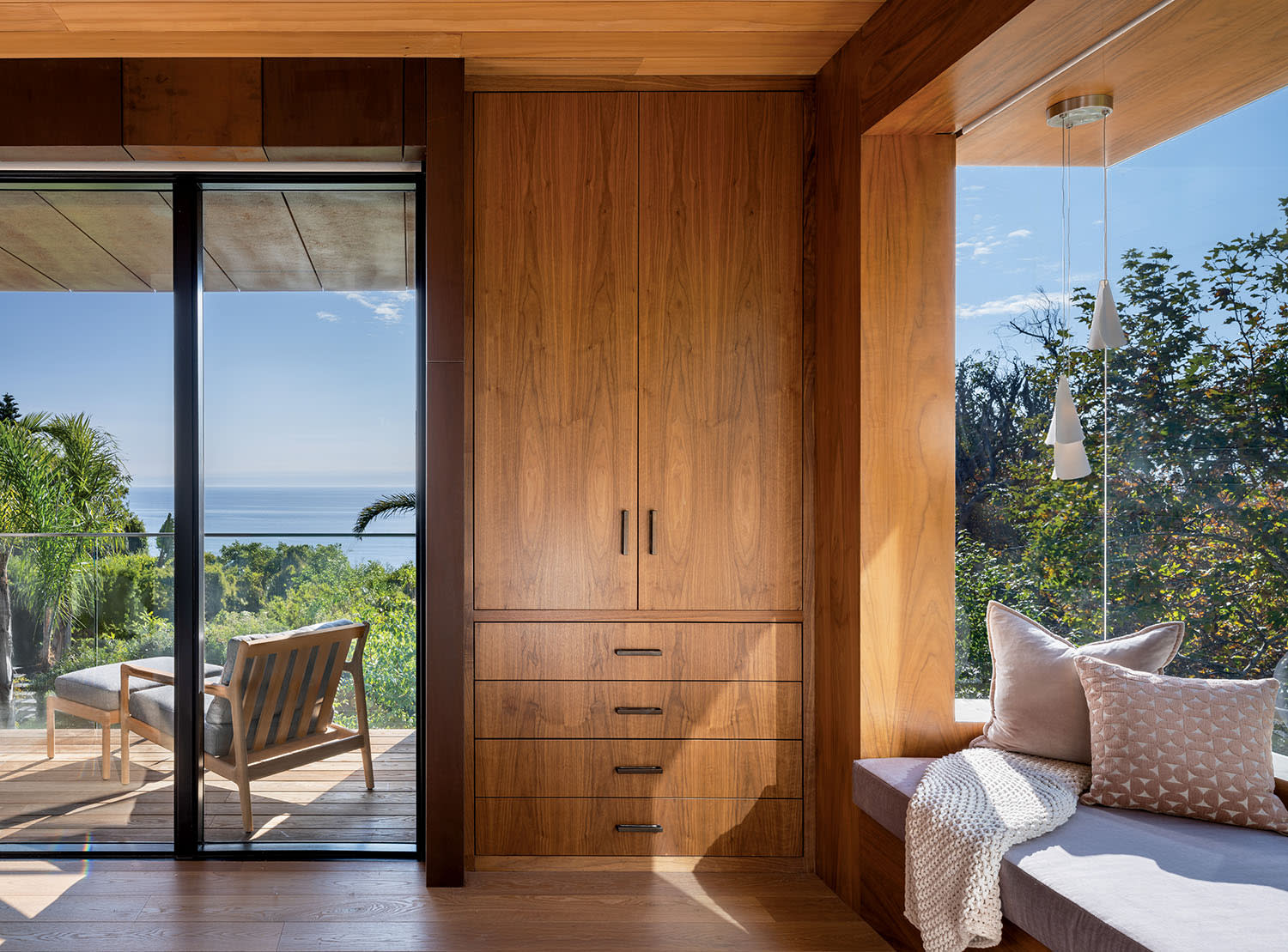
A private deck, with an Ethnicraft lounge chair and ottoman, looks out to the Pacific.
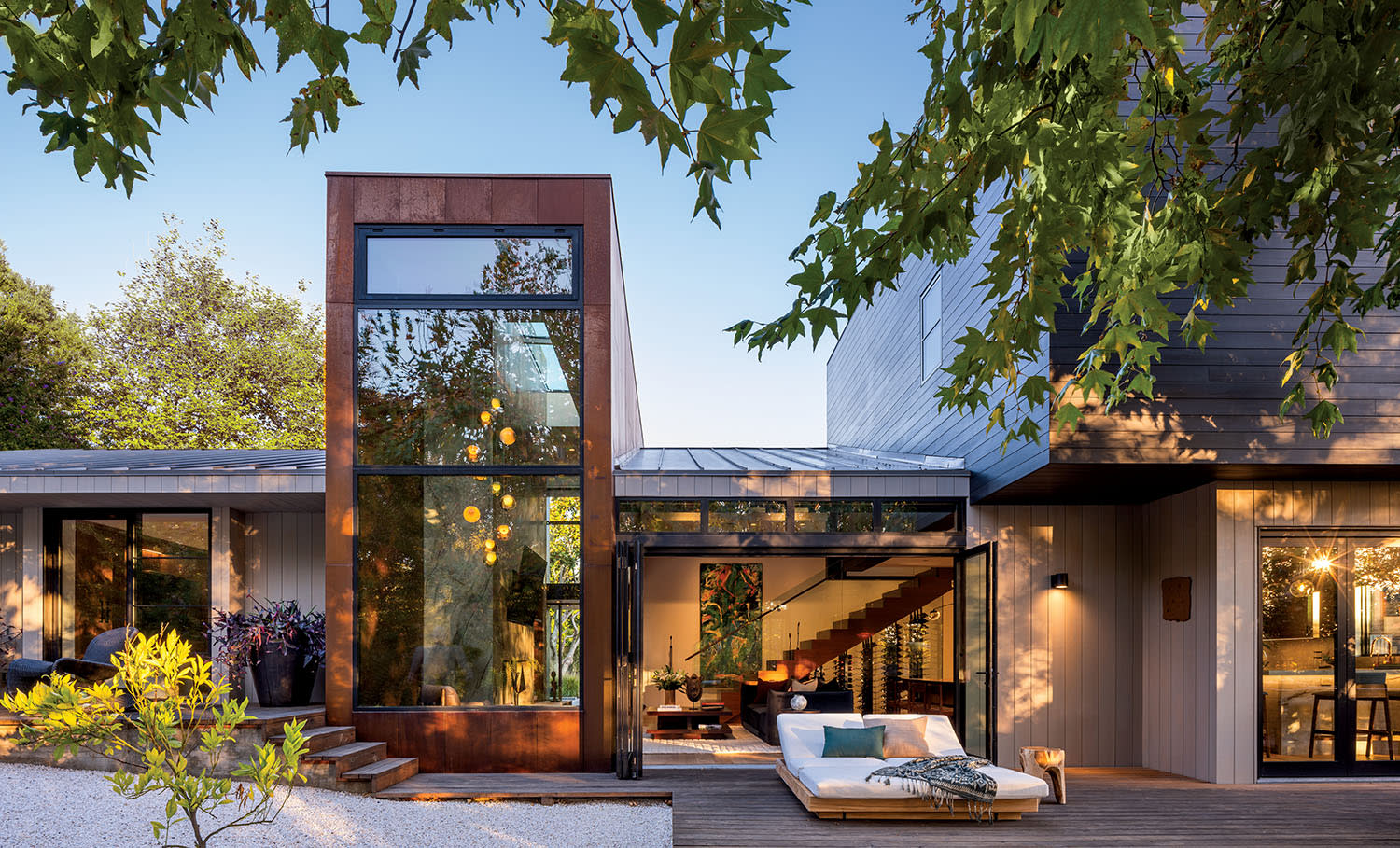
Viewed from the backyard, the home’s corten steel-wrapped “spine” is visible and frames a Bocci chandelier. A renovated deck of existing and reclaimed redwood extends the living area. The outdoor double chaise is RH, with a Four Hands side table.
The homeowner, who has a background in real estate development, understood the complexities of transforming and tailoring the dwelling to her own needs. And Kempel, joined by interior designer Alana Homesley, general contractor Joel Fischer and landscape architect Mia Lehrer, was up for the challenge. “Our big assignment was to take what we had, reorganize it, give it a quiet sensibility and represent it in a way that felt as if we had intended it from the beginning,” the architect says. “The intention was to make it feel like a brand-new build and not like we forced a new hat onto an old head.”
Connecting the single-story house to views of the nearby ocean was an immediate opportunity Kempel saw, resulting in a new upper-level primary suite that looks out over the Pacific and “felt like it naturally wanted to be there,” he notes. The home also begged for a grander entry (two large garage doors formerly overwhelmed the front façade). Now, guests step across concrete pads set into a serene reflecting pool—elements imagined in tandem with Lehrer—to access the home via a dramatic “entry spine.” The addition of this architectural feature, a voluminous double-height central hall wrapped in corten steel that extends across the residence, draws in light through a central skylight and windows at either end. It creates a visual connection from the front door all the way to the backyard and is a key part of how the architect softened the existing rooflines and reshaped the house without drastically changing its footprint. “The colliding volumes are geometric and sculptural now,” Kempel explains.
In turn, the use of corten steel as a grounding element across the interiors informed Homesley’s material palette, which features walnut millwork, two-toned cedar paneling and matte oak floors as a foil. A longtime collaborator of Kempel’s, the designer selected natural elements to enrich and balance the use of metal and strong angles. “We needed warmth and a way to soften these spaces,” she says, noting how the homeowner responded to the golden hues of the walnut and how paler stone surfaces brighten the living room fireplace wall and kitchen island.
The living area is further lightened up by a white rug—a color the designer rarely turns to, yet here, it was “a little aha moment,” Homesley shares, “as it brings a plane of relief from the ceiling, where there’s a lot going on architecturally.” Otherwise, jewel tones like the emerald upholstery of the living room sofa are applied sparingly among neutral hues and rich leathers, and the designer leaned into lighting that appears to float atop the furnishings. See for instance the delicate mobile chandelier over the dining table and the colorful glass spheres that dance above the living area’s leather armchair. That chair, an iconic midcentury piece from Brazil, creates a moment “that brings in a bit of ’60s-’70s modernism and adds to this home’s retro feel,” she says.
These choices all allow the art, a collection of works by female, African and African American artists, to sing. Alongside the design team, the homeowner consulted with art adviser Tiffiny Lendrum on placements for pieces inside and out, from painting to sculptures, traditional masks and more. The effect is that the house now feels like an inviting gallery composed of expressive, intriguing and very meaningful objects, concludes Kempel—which, given its artistic origins, is a fitting next chapter.
Envisioned as a sculptural feature, a floating staircase of walnut and glass leads to the primary bedroom. Black-stained cedar paneling highlights the architecture. Work by Spencer Russell Lewis and a ceremonial stick wood figure from Tanzania lie at the stairwell base.