The mighty pairing of brick and mortar carries within it centuries of building tradition. So, it’s perhaps no surprise that when interior designer Randy Heller was brought in to reimagine this circa-1890s dwelling enveloped in exposed Chicago-style brick, she and residential designer Jenna Edelmayer were determined to honor its history and make the most of its beautiful bones.
Popularized after the Great Chicago Fire, Chicago Common bricks are known for their weathered surface and irregularities, as well as their color—ranging from salmon to ruddy buff. The clients, a young family of four, loved the brick in its natural, native state, so with the help of general contractor David Freeley, Edelmayer maintained, sealed and insulated it. Given the force of the brick’s visual presence, Heller coordinated a color palette to recede alongside the masonry. She began by “analyzing its many undertones, then explored various wood tones for the floors to see how those options changed throughout the day.” Then, she adds, “We selected coordinating wood stains and finishes that would complement the brick and the French white oak we’d chosen for the floors.” The palette she ultimately devised mixes cool and warm shades in organic hues (such as blacks, tobaccos and browns) and family-friendly yet sophisticated natural fabrics like wool and linen.
Home Details
Architecture:
Jenna Edelmayer and Michael Abraham, Michael Abraham Architecture
Interior Design:
Randy Heller, Randy Heller Interiors - Pure & Simple Design
Home Builder:
David Freeley, Ferndale Construction
Styling:
Sami Wiley
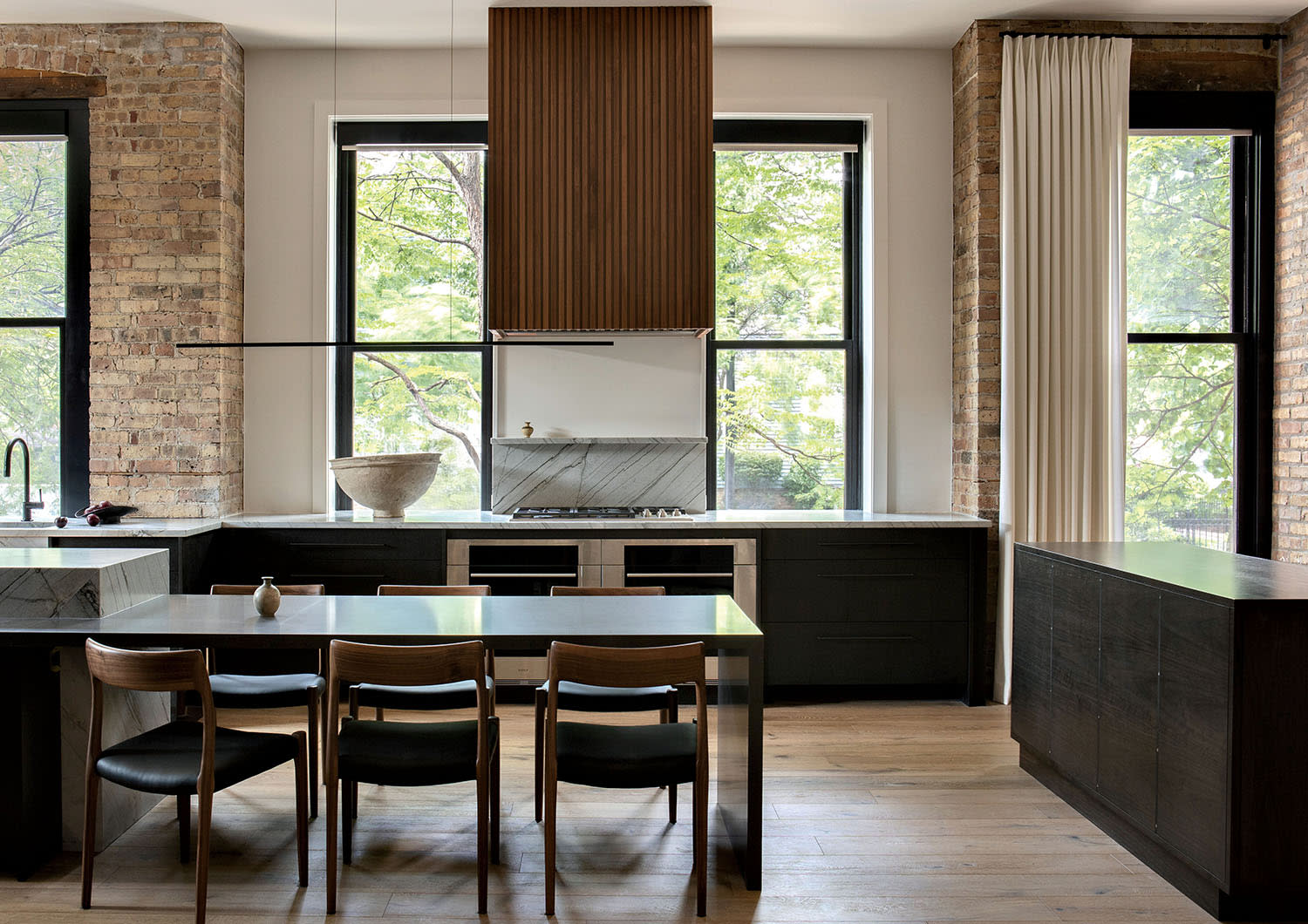
Designer Randy Heller devised a combined island-dining table for the kitchen. Above the walnut-framed, leather-seated J.L. Møllers Møbelfabrick chairs from Design Within Reach is a linear Kuzco Lighting pendant from Lightology.
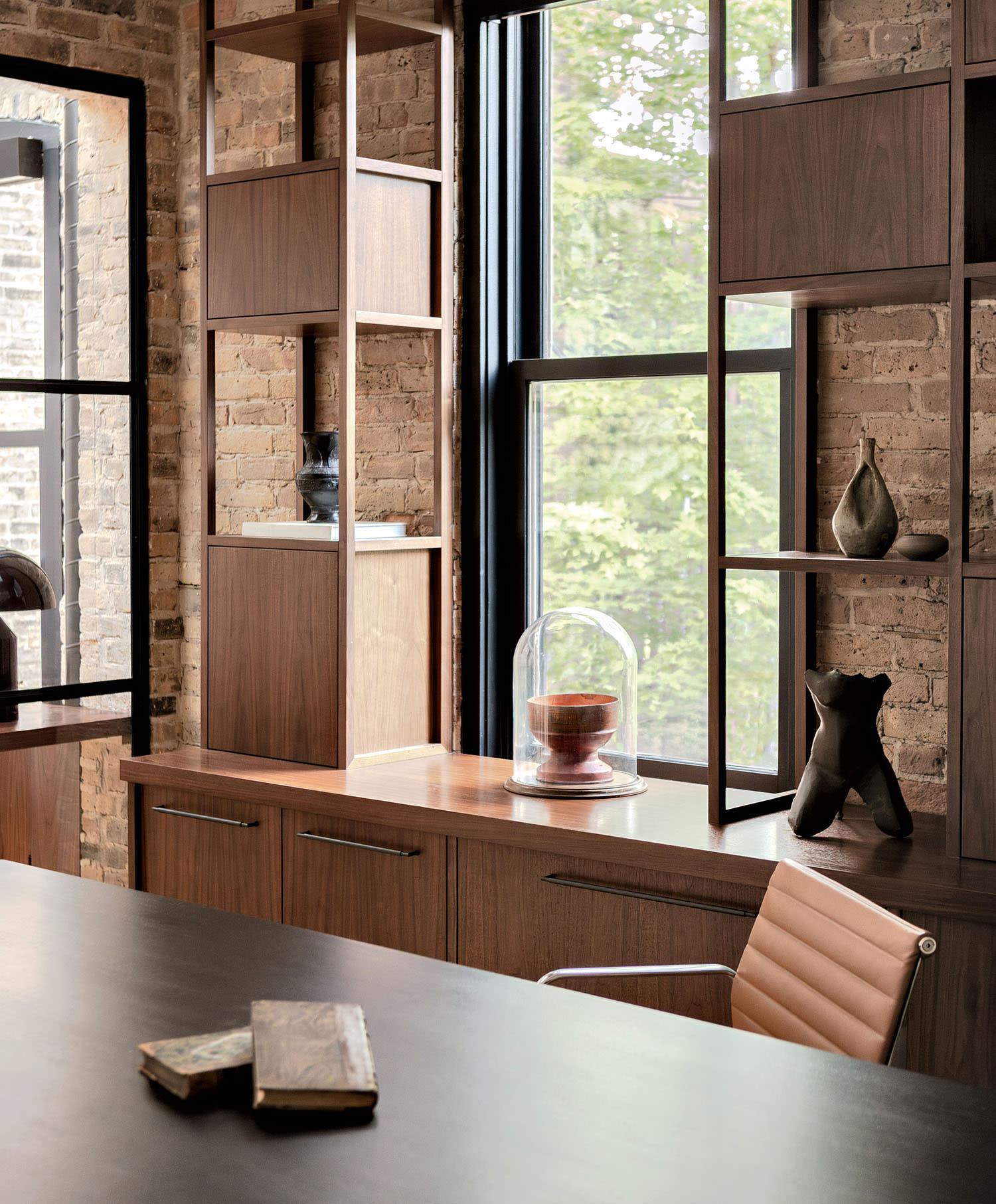
The husband’s office features custom built-in wall storage with accessories from Randy Heller Interiors and À La Carte Studios.
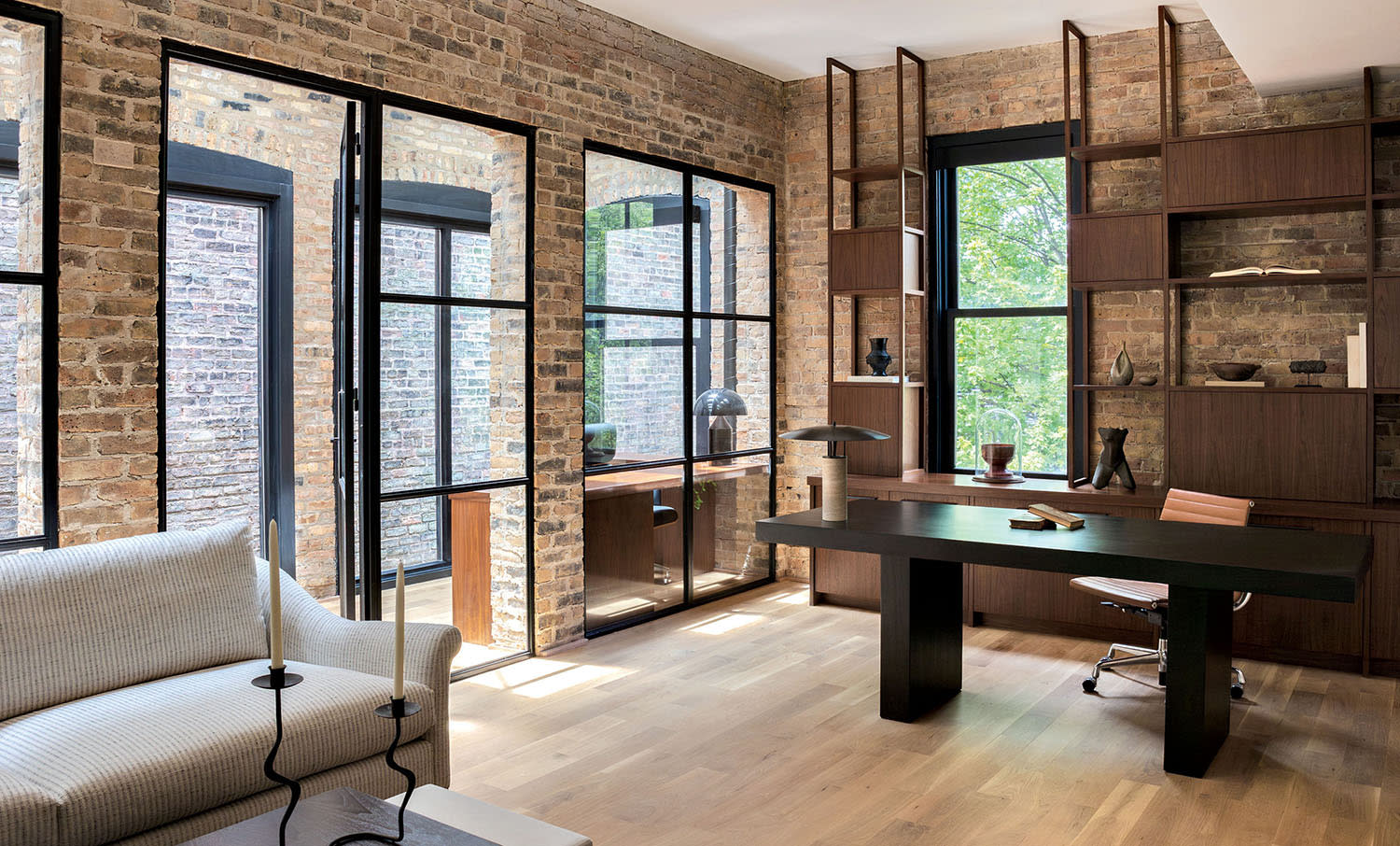
New steel-and-glass dividing panels and doors ensure the his-and-her offices have acoustical privacy while sharing an open view. An Eames chair pulls up to his custom desk, lit by a travertine lamp from Vakkerlight.
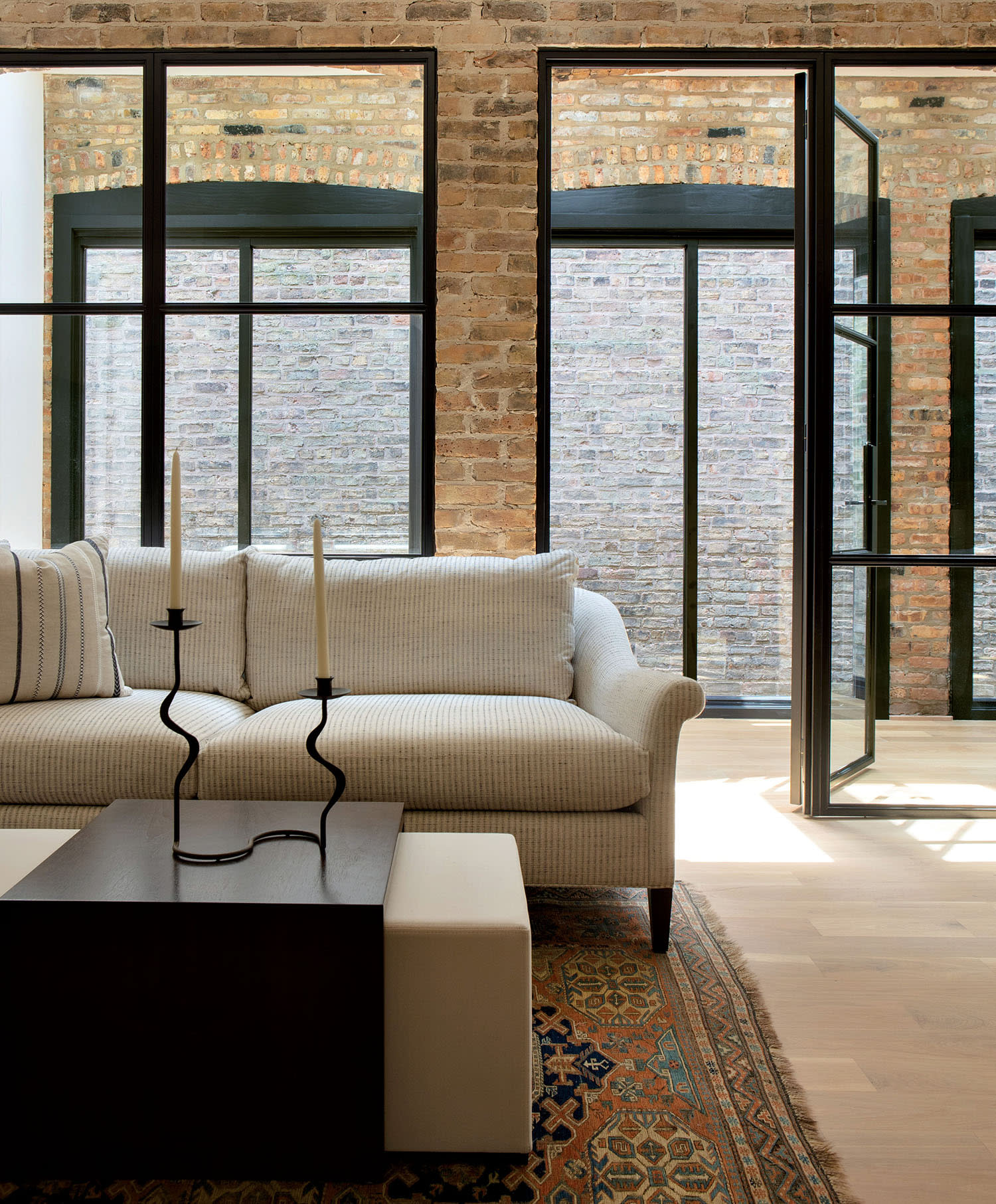
The offices share a seating area anchored by a sofa from CAI Designs dressed in a Fabricut textile and a custom ottoman. An antique rug from Oscar Isberian Rugs provides an underlayer of traditional color and pattern, while candlesticks from À La Carte Studios bring a note of whimsy.
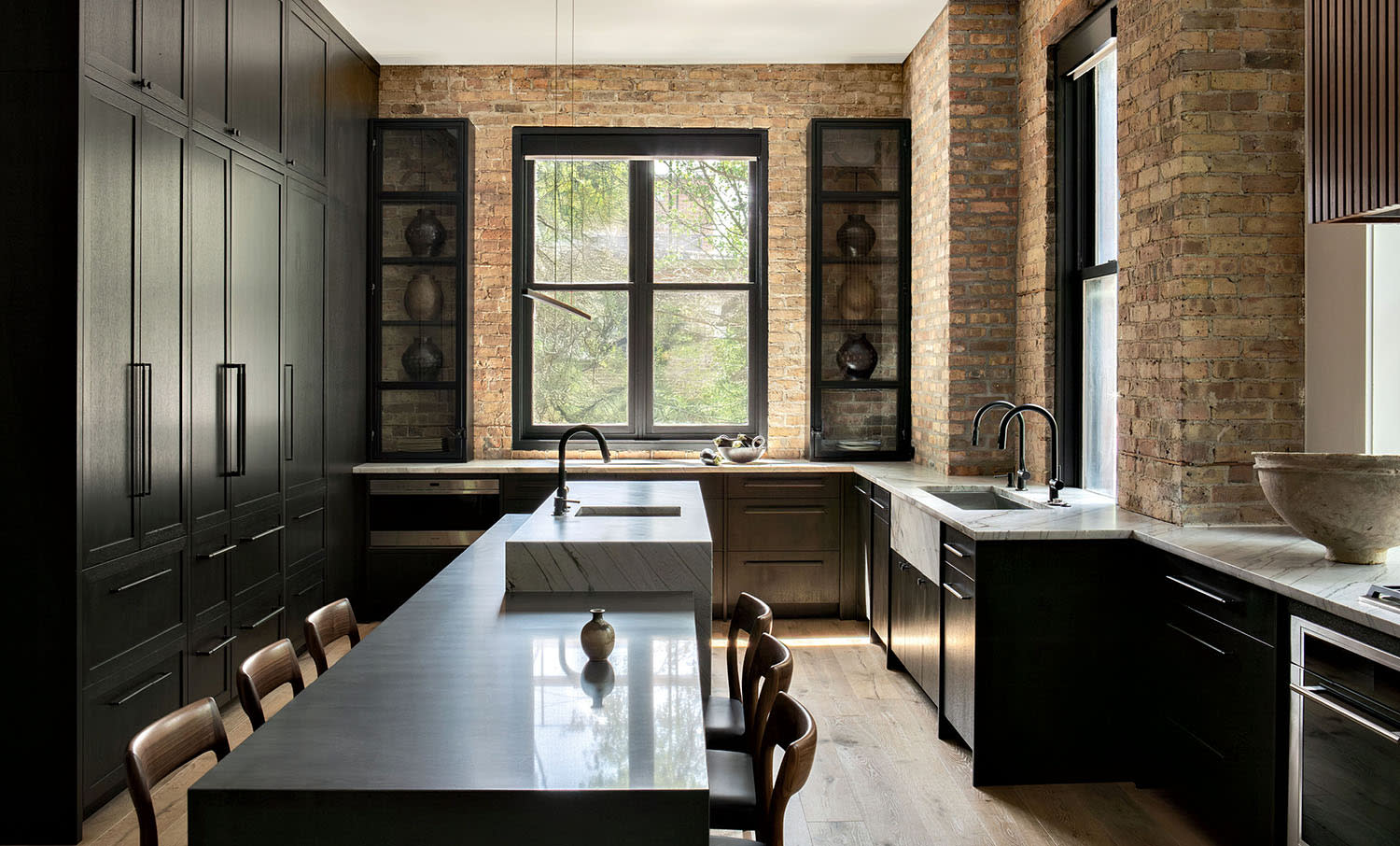
Waterstone oil-rubbed bronze-finished faucets and soap dispensers from Studio41 infuse a subtle patina into the kitchen’s material mix of stone and wood. Paneled appliances with concealed hinges disappear into the custom cabinetry.
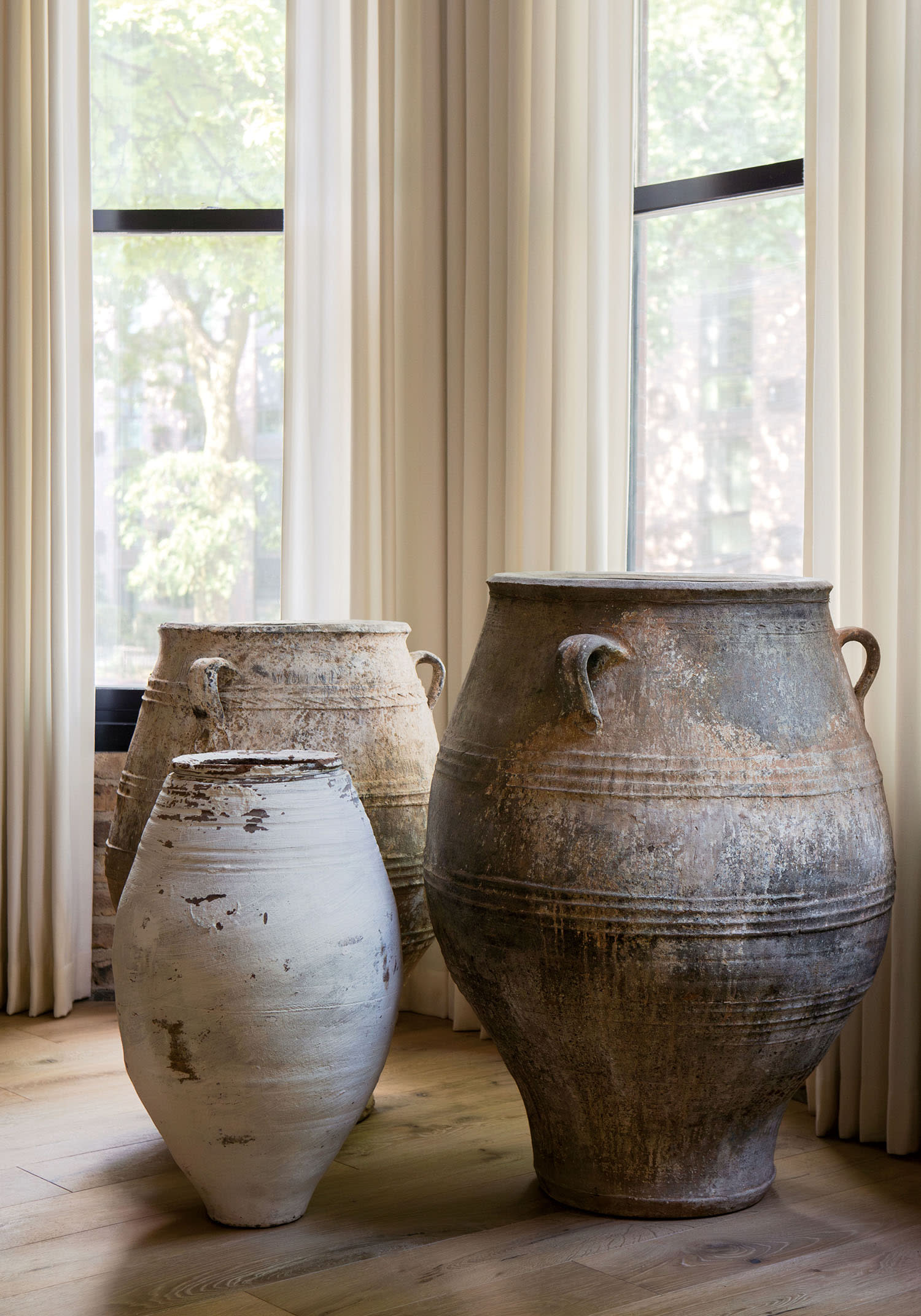
Antique Turkish vessels from South Loop Loft add to the living room’s mix of textures, eras and elements. The drapery panels are made from a Hubbard Design Group textile.
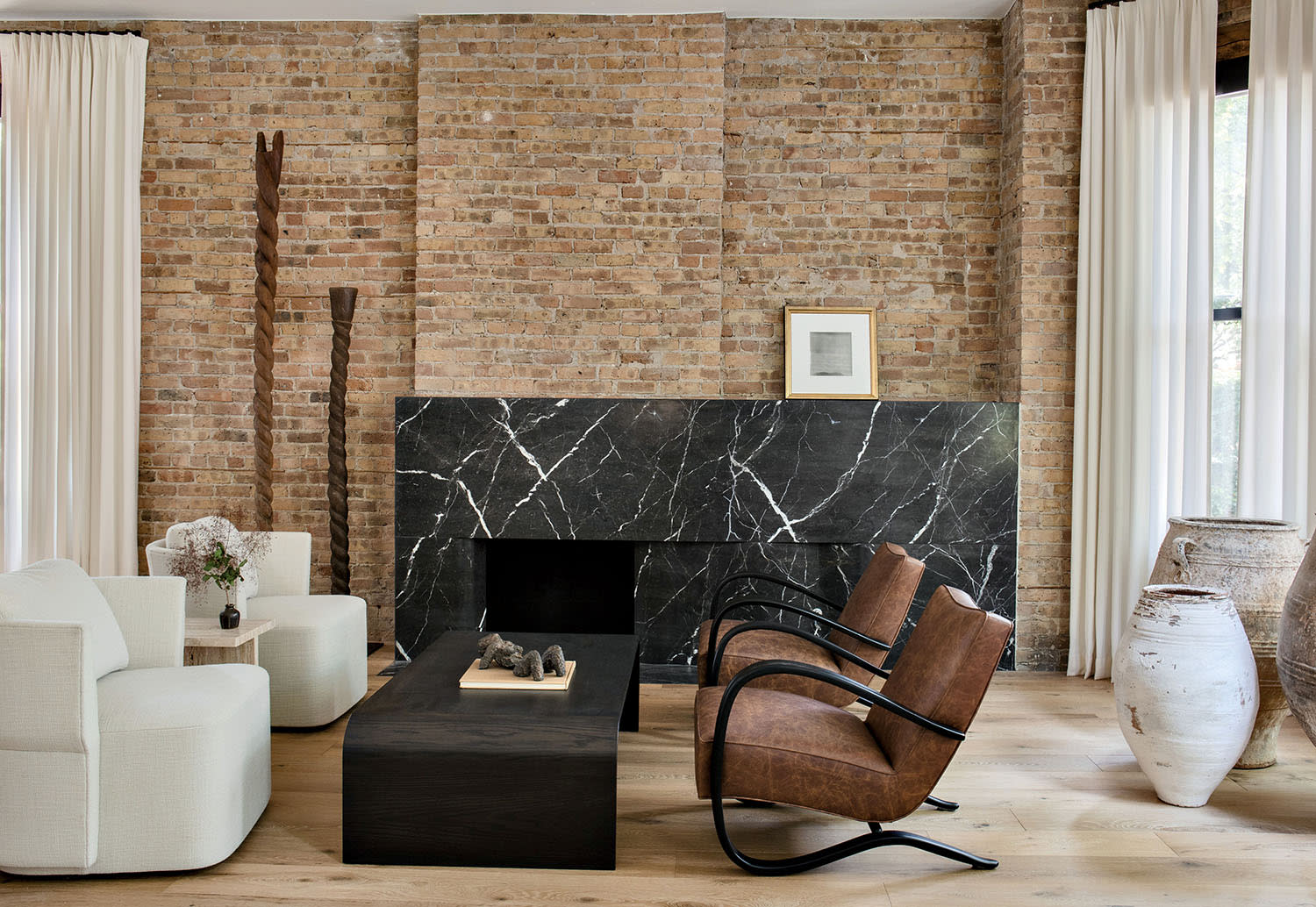
A curved, asymmetrical fireplace fabricated by Atelier Jouvence is the centerpiece of the living room. Holly Hunt-covered Caste swivel chairs face a pair of 1930s vintage armchairs in Crest Leather upholstery.
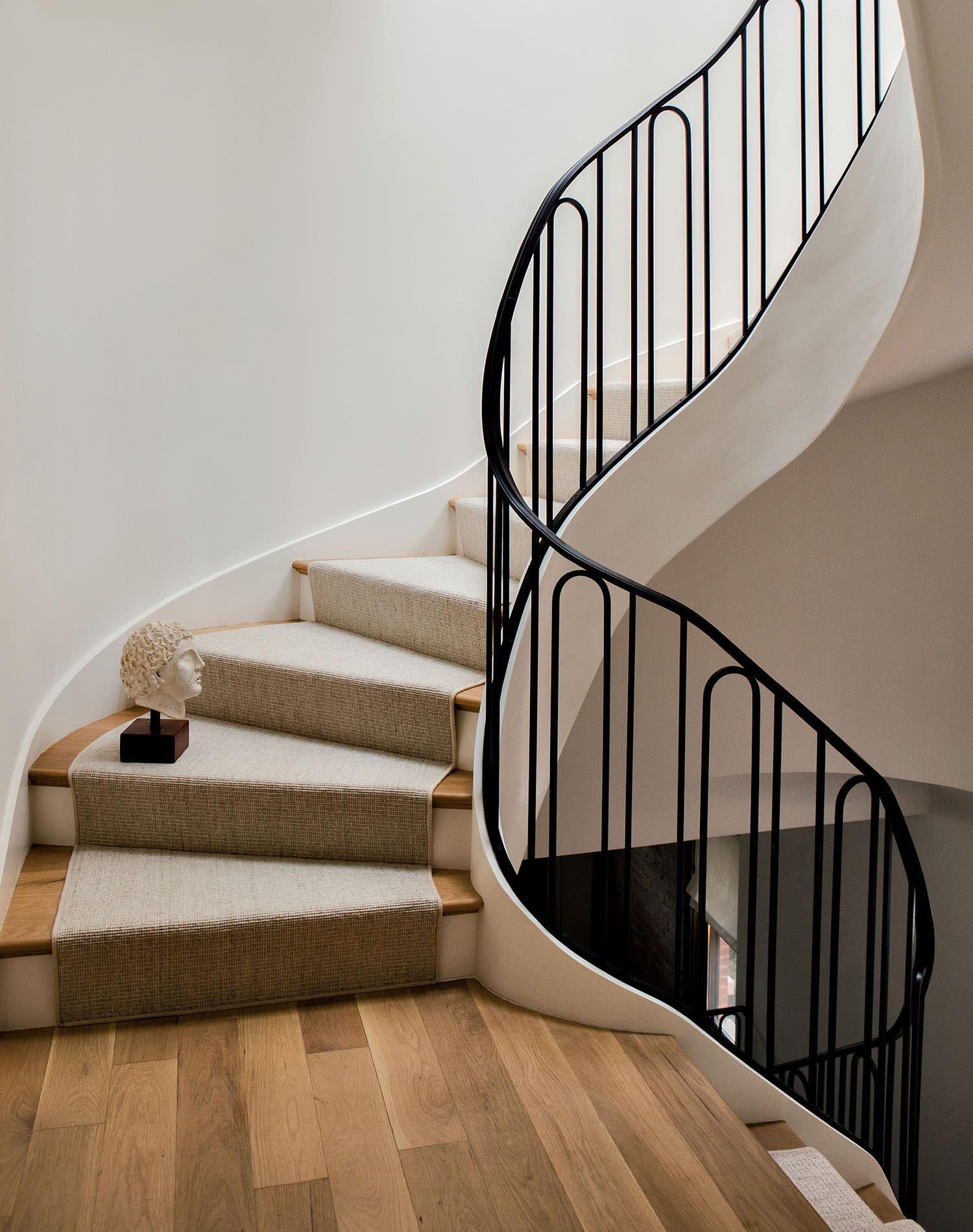
A new curved stair connects the second and third floors.
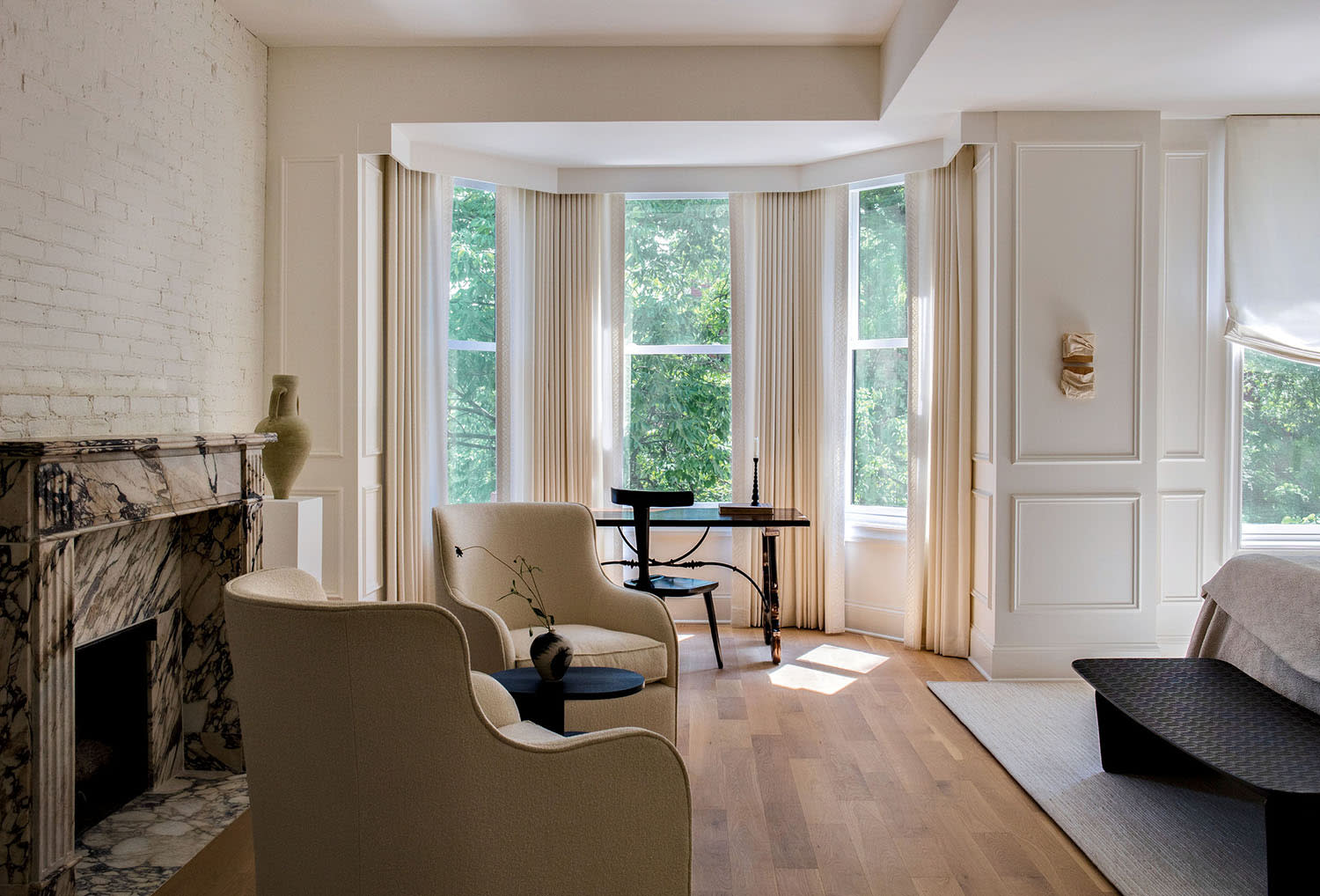
In the serene primary bedroom, Gregorius Pineo lounge chairs in Joseph Noble bouclé flank a Ferm Living side table before the Calacatta Violetta fireplace carved by Atelier Jouvence. A Paul Ferrante table and Codri Furniture chair occupy the window bay.
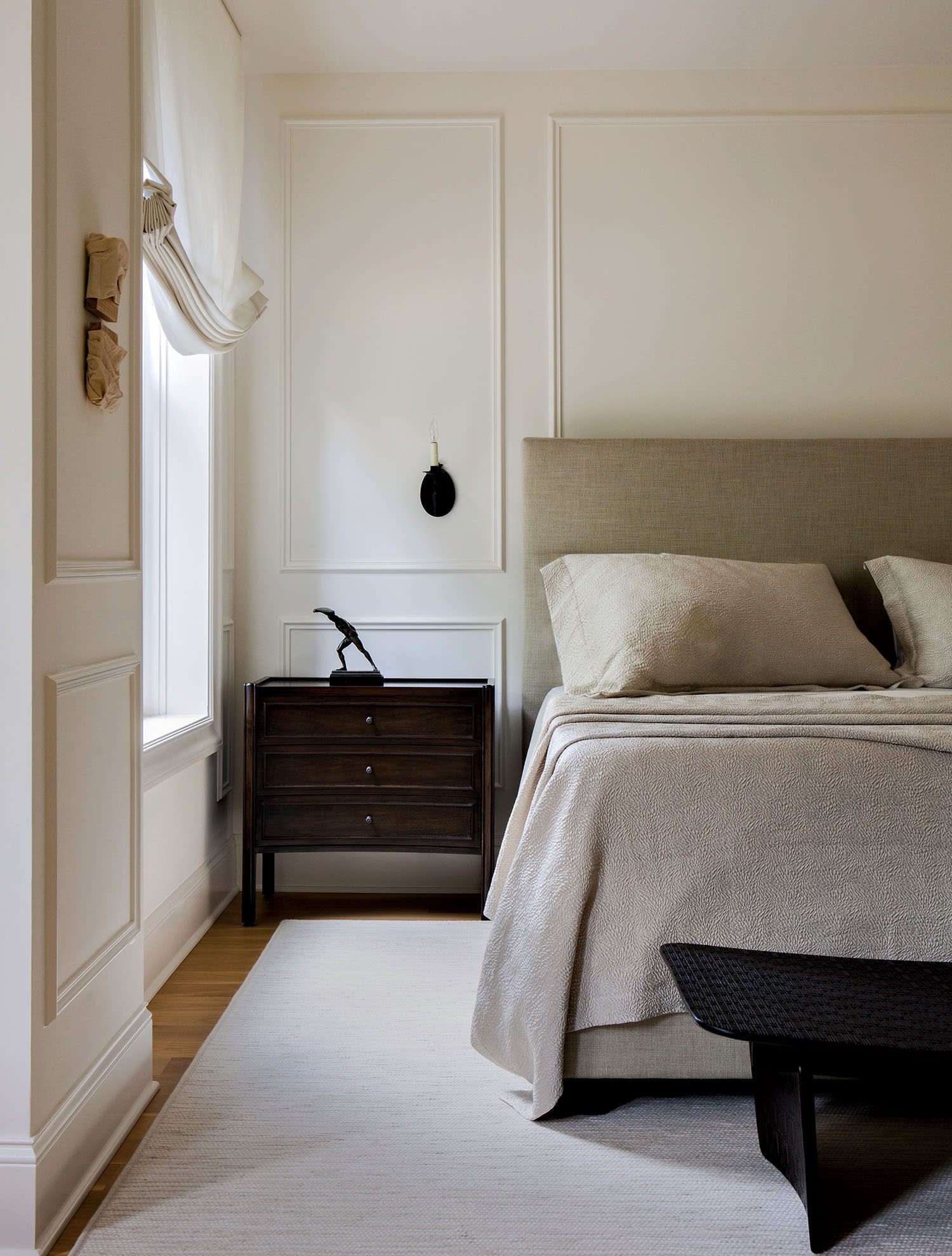
A nightstand by Flores Inc. with Edgar Berebi bronze knobs abuts the Brothers Furniture-crafted bed in Rose Tarlow Melrose House fabric. At the foot of the bed, an Alfonso Marina bench rests on a Cavan Carpets floor covering from Oscar Isberian Rugs.
A previous renovation had imbued the home with a loft-like feel, but the owners desired a few changes to make it more livable. “The circulation was the largest architectural challenge,” recalls Edelmayer, who worked alongside architect Michael Abraham. Their solution? A gut renovation that added an elevator, new curved stair and repositioned the existing staircases.
With the open kitchen seamlessly connected to the dining, family and living rooms, Heller envisioned a cooking space that wouldn’t look like one. This family hub is “more like a room with hidden cabinets than a ‘cook’s’ kitchen with stainless steel appliances,” she describes. “By paneling the appliances and using concealed hinges, they disappear into the custom cabinetry.” The space’s adjacency to the dining room and the family’s desire for a kitchen table for everyday meals presented the designer with a kind of Doublemint challenge: two of everything furnishings-wise in essentially one space. To keep things visually interesting, Heller dreamed up a combined island-table with two surface heights that blend the dual functions into one composition and lit it from above with a simple, linear fixture. In the dining room proper, a classic trestle table and midcentury-inspired chairs live beneath a more dramatic cluster of pendants.
Heller built the living room’s unadorned fireplace into a focal point with an asymmetrical, curvilinear cream-veined black marble surround. Here, she says, she “kept the furniture purposely very low against this very high ceiling,” and used accessories such as large antique Turkish vessels in various natural patinas and finishes to add nuance and surprise into the narrative.
The second floor’s existing light-drenched office—a colonnaded brick-sheathed volume—captivated all. Though they were loath to close in the expanse, the couple needed dual workspaces with acoustical privacy. Cue custom steel-and-glass doors between the columns, dividing the spaces while leaving them visually connected. The built-in storage features a constructivist composition of open and closed geometries, while a mix of vintage and bespoke pieces—for instance, her 1960s-era desk and his made-to-measure counterpart—offer balance.
In the primary bedroom, an architectural envelope of creamy plaster walls with applied moldings adds an elegance to the white-painted brick behind the fireplace. Heller created an inviting seating area by the hearth and populated the window bay with a handcrafted three-legged chair and Spanish writing desk. “I didn’t want anything to feel too traditional or too modern,” she explains, “so we strategically combined the two.” The results here, as in the rest of the home, bridge centuries: the brick bones intact, but the spirit unmistakably of this moment.
A new curved stair connects the second and third floors.