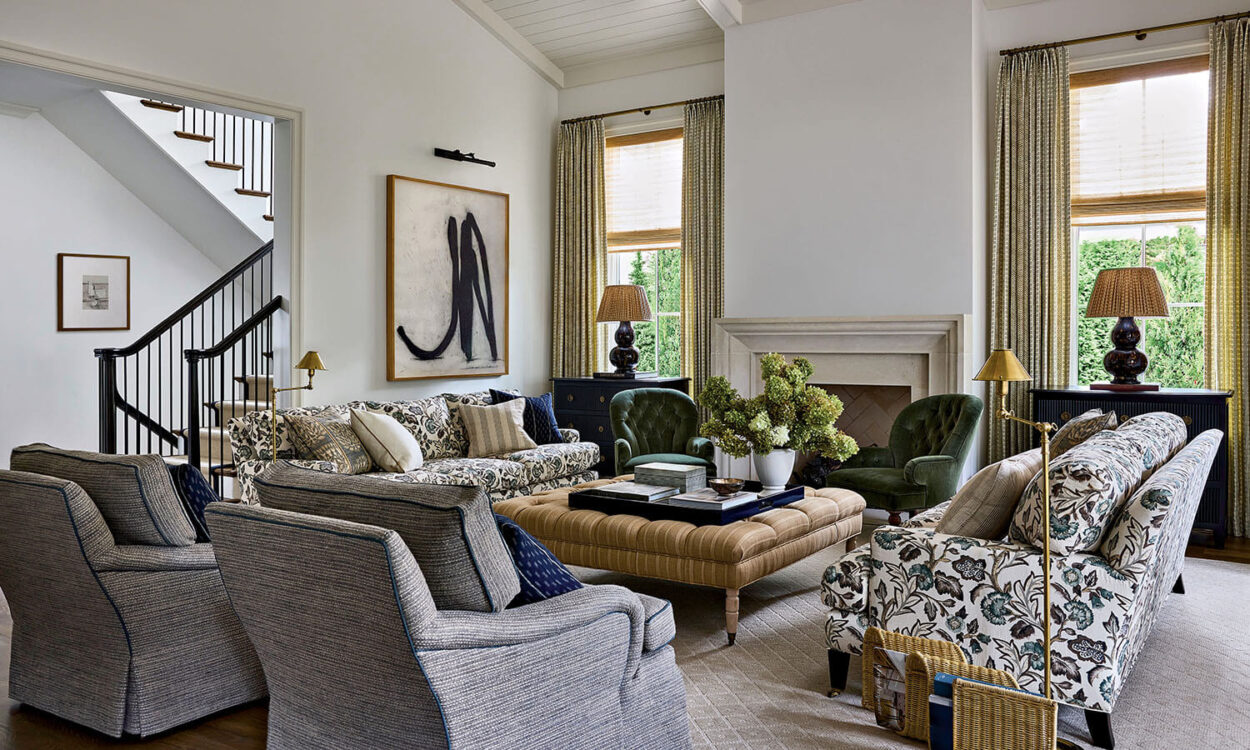
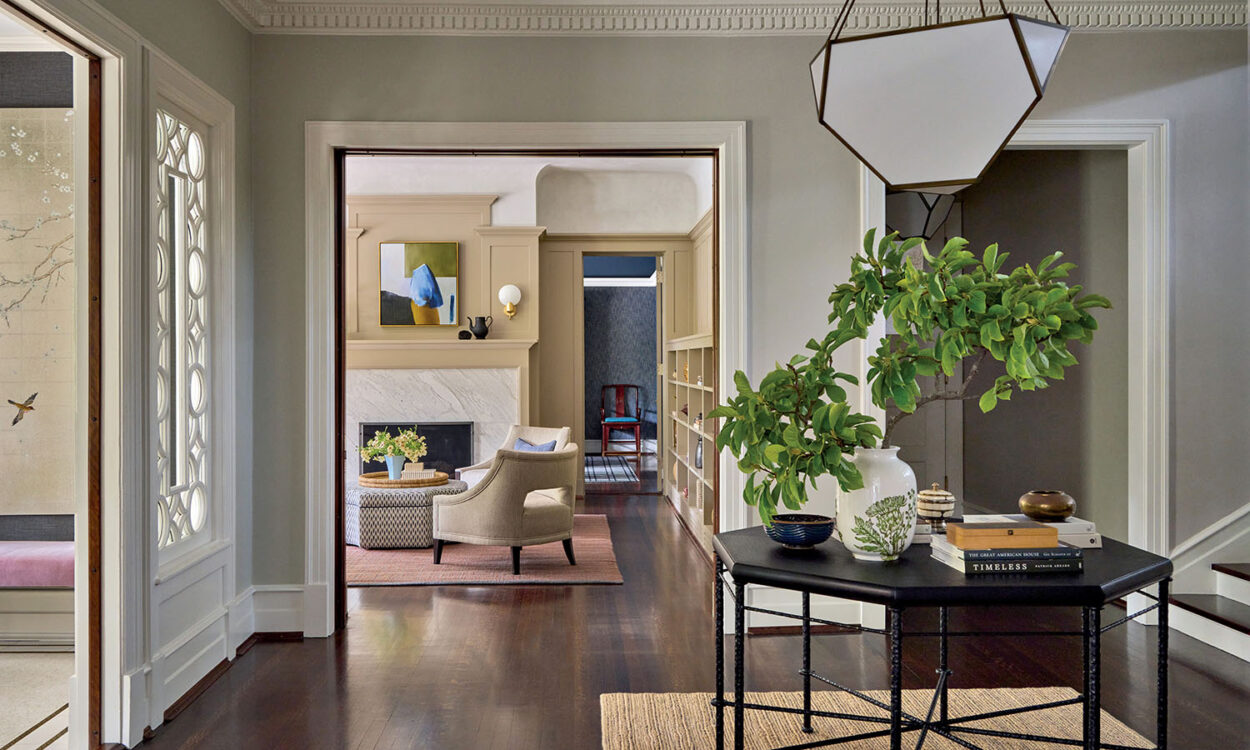
To the uninitiated, designing a house from the ground up can seem as deceptively straightforward as a game of Lincoln Logs: plan, stack, repeat. But the most successful projects leave ample room for evolution, and this family’s new home is proof.
The couple had purchased two neighboring properties in Elmhurst, with plans to demolish the existing houses and merge the lots. Architect John Belcher and contractor Randy Hoekstra already had the floor plans for the new build in hand when designer Diana Wagenbach entered the picture, but the project was still early enough that she could shape the bones of the house in meaningful ways. “We made some really significant edits to the floor plan from the originally proposed drawings to what ended up happening, which was great,” she says.
The resulting home unfolds like a contemporary ranch—albeit a sprawling, highly polished one—with the main living spaces and primary suite on the main level, a basement below and a smaller upstairs zone for children’s bedrooms and bathrooms. It creates a “thoughtful flow that supports both everyday routines and moments of gathering,” Wagenbach says.
From the start, the designer’s goal was to strike a balance between the elegance the clients envisioned and everyday practicality. The challenge, she says, was “How are we going to piece this together to make sense of the space so that they have privacy, but also check all the boxes of it being beautiful and having a great entertaining space?”
Home Details
Architecture:
John Belcher, JMB Architects, Ltd.
Interior Design:
Diana Wagenbach, Studio W Interiors
Home Builder:
Randy Hoekstra, Hinsbrook Construction
Styling:
Natalie Marotta
One of her earliest moves was relocating the primary suite to its own wing on the side of the house near the stairs that lead to the children’s rooms, creating a sense of retreat while still maintaining close access to the kids and a connection to the home’s living spaces. Meanwhile, the back portion of the house became a workhorse, containing the mudroom, laundry room and other practical spaces near the garage for functionality.
Those prosaic spaces didn’t lack for personality, though. The laundry, originally drawn as little more than a corridor, was expanded into a proper room. Then Wagenbach added a feature that feels delightfully old-school: a laundry chute from the upstairs kids’ bathroom. “The idea of a laundry chute just feels like something that’s not being used as much anymore,” she says, yet it’s both efficient and charming.
In the kitchen, function and flair intertwine just as neatly. The island became another moment for creative problem-solving. Rather than accept the natural limitations of stone slab sizes, which tend to max out at 140 inches long, Wagenbach introduced a two-material design, pairing the massive stone portion with butcher block to create a larger, more flexible work surface. “It felt like a fun way to bring in another texture to make it feel intentional, versus having these seamed approaches, which is just not my favorite,” Wagenbach says.
Color plays a role as well, though in restrained doses. The island’s ebonized wood anchors a palette otherwise defined by warm neutral paint and fabrics, ivory plaster and pale oak. “The vibe in general was very natural, but warm and welcoming,” Wagenbach says. Architectural details such as the white oak box beams breaking up the soaring ceilings reinforce the calm, textural effect that is different, yet familiar enough to feel homey. The homeowners seem to agree. When they recently took Wagenbach out to dinner to celebrate the finished project, their verdict was simple. “They told me, ‘It’s more than we dreamed of,’” she says. “And that’s why we do it.”