3 Home Furnishings Brand Founders On Creating Designs That Stand The Test Of Time
For the founders of three distinctive home furnishings companies, authenticity and tradition remain central to creating designs that stand the test of time.
PRODUCED BY SARAH SHELTON
Rosemary Hallgarten
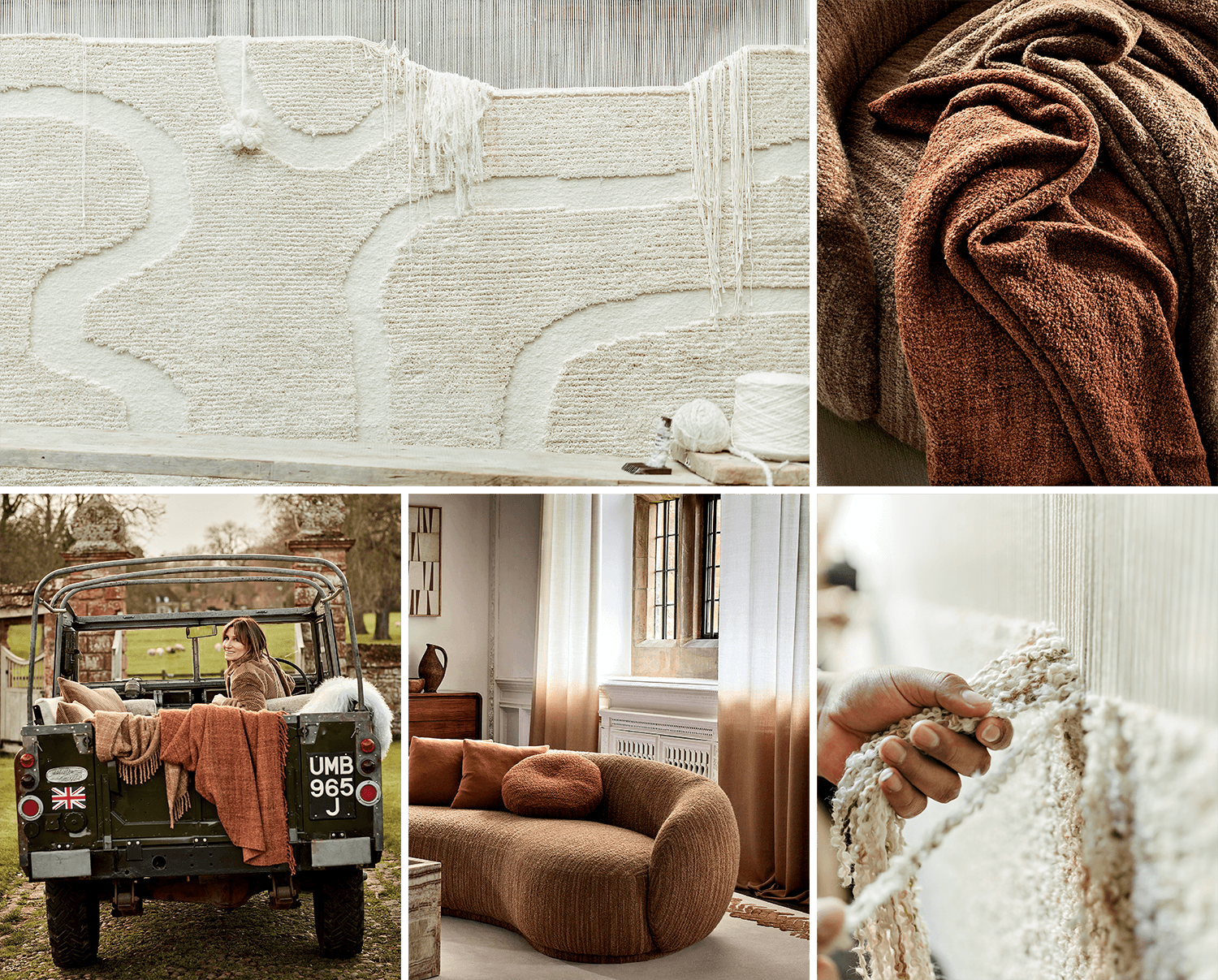
When asked to summarize the ethos of her eponymous company, Rosemary Hallgarten answers with ease: “I want to remain anchored in creating artisan-led, authentic products that have a comfortable elegance.” More than 20 years after launching her luxury rug, textile and soft goods brand, Hallgarten continues to deliver on that promise.
Following successful careers in jewelry design, branding and advertising, Hallgarten’s pivot into floor coverings was kismet, thanks in part to her archaeologist mother’s passion for the medium. As an adult, Hallgarten turned to her mother to learn the art of hand-hooked rugs. “I knew I wanted to do something different when it came to making and producing rugs,” she explains, and soon her brand was born.
After finding intrigue in a sample of Peruvian alpaca, a trip to the country revealed a community of makers, time-tested techniques and remarkable materials that would shape the future of her business. “I fell in love with Peru and alpacas,” Hallgarten reminisces. “I wanted to harness the natural craft of the region while also supporting the artisans, allowing them to preserve their tradition.” Today, the majority of Hallgarten’s rugs are custom-made by hand using locally sourced alpaca fleece in Peru, where her first rug was produced over two decades ago.
Beyond Peru, she discovers premium materials (like Tibetan wool and hemp, Brazilian silk and sisal) and craftspeople from around the world to ensure the highest quality. This fall, the brand continues to expand with wallcoverings. When it comes to inspiration, nothing is off-limits for Hallgarten: “A flash of color, a piece of fashion—it’s about looking around ourselves.”

Jonathan Charles
At the tender age of 12 years old, Jonathan Sowter knew he wanted to be a furniture maker after taking a woodworking class. That rare surety led Sowter to study furniture design and craftsmanship at university, and eventually to Vietnam, where he saw an opportunity to build a furniture company that stood out from the crowded market. The distinction? “We’re making furniture the way it used to be done and should be done, and not cutting corners,” says Sowter, owner and CEO of Jonathan Charles.
Of the many traditional furniture-making practices embraced by Sowter, the art of marquetry has become a calling card for the company, positioned front and center at their High Point, North Carolina, showroom. Dating as far back as the ancient Egyptians and later popularized by the French in the 17th century, marquetry is a decorative application in which thin slices of wood are carefully applied onto a furniture surface and inlaid in a precise way to create a design or pattern. “We are furniture people—we just have a passion for these things,” Sowter explains.
Throughout the brand’s extensive collections, marquetry appears in pieces with wood motifs that feel inherently more traditional, as well as straw—dyed in colorful, bold hues—that embody a more contemporary flair. All of this wouldn’t be possible without an assembled team in place at the company-owned factory in Vietnam, where employees are trained in mastering the art form. The results are certainly impactful: A new generation of artisans has emerged as torchbearers of a beloved craft, making furnishings destined to become family heirlooms.

De La Vega Designs
It’s hard to imagine something as fragile as an eggshell being used in furniture design, but the old-world technique of coquille d’oeuf is alive and well at the literal and figurative hands of Mark de la Vega, founder of De La Vega Designs. “I wanted to find my lane,” he recalls of forming his own design studio after years as an in-house furniture designer. “You can’t be everything to everyone,” de la Vega says. “There are masters out there working with shagreen, parchment and bone. I wanted to specialize in something that wasn’t mainstream.” Realizing that nobody was operating within the eggshell space, he bought a few cartons and got cracking.
An industrial designer by trade, de la Vega is self-taught in coquille d’oeuf, simply learning the process as he went. It begins with patiently peeling boiled eggs and harvesting their delicate shells, then meticulously laying the material in a mosaic-like pattern before it’s lacquered into place. Some 400 years ago, East Asian cultures pioneered this technique when white paint wasn’t available, and today, de la Vega’s team of artists performs this painstaking practice entirely by hand in their Brooklyn studio. Each artisan works on one piece until completion, and the pattern they lay is like a fingerprint—completely unique and impossible to replicate. While the studio also creates beautiful pieces that are not embellished with eggshell, mirror frames, decorative screens, case goods and custom pieces are available in this finish. It’s been an emotional year of rebuilding following a studio fire last fall, but the future looks bright with a wallcovering collaboration, featuring—you guessed it—the humble eggshell.